
What Does The National Emergency Briefing Mean For Social Housing?
25th November 2026
Jenny Danson
Nine of the UK's leading experts have set out the national impact of climate and nature loss across our weather, food, health, security, nature and economy. Their message is that change is arriving faster than the models predicted, and that the UK is not prepared. For those of us responsible for homes, this is not a distant warning. It lands in the buildings we manage and in the lives of the people who live in them.
The same experts are equally clear that the economic case favours acting now. Net zero is estimated to cost about 0.2% of GDP, delay costs more, and the price of renewables has fallen sharply. I have been reflecting on what that combination of urgency and opportunity means for our sector.
What is the National Emergency Briefing?
The National Emergency Briefing (NEB) was held at Central Hall Westminster in November 2025. Around 1,200 people attended, including roughly 85 MPs, about as many peers, journalists, and faith and business leaders. Nine leading UK experts briefed the room.
Its founders set it up because they felt the public is not being told about this emergency in the way we would be told about a pandemic. We have recent, shared experience of what it looks like when government levels with the country about a threat to health, and how quickly behaviour can change when people understand what is at stake.
The briefing has since become a film, shown mainly in person so that discussion can follow. There have been around 6,000 screenings so far, with each one prompting roughly one more. I find that ripple encouraging, because it mirrors how change tends to happen: through conversations in a room between people who then go and act.
What is the NEB asking government to do?
The NEB is asking government to hold a prime-time televised briefing, introduced by the Prime Minister and delivered by independent experts. Around 176 MPs, roughly a quarter of the House of Commons, support the call.
What did the experts say about the weather we are already living with?
Extreme weather events are increasing faster than models predicted. By 2050, one in four properties in England, around 8 million, will be at risk of flooding. UK winter rainfall is up 10% since 1980, and the 2022 heatwave caused around 3,000 excess deaths. Copenhagen's sponge city approach was cited as an example of adaptation that works.
Kevin Anderson set out the underlying science. Atmospheric CO2 stands at 424ppm, up from 280ppm in 1850, and warming is approaching 1.5°C, with a small but real risk of 4°C by 2100. The UK's headline claim is a 50% cut in emissions since 1990, but that figure excludes international aviation, shipping, and the emissions embedded in imports and exports. Once those are counted, the reduction is closer to 20%, or around 0.6% a year.
That gap between the headline and the lived reality felt very familiar. In housing we know the difference between how a home performs on paper and how it performs for the family living in it, and we know that progress measured against the wrong baseline can leave us more comfortable than we should be.
Tim Lenton spoke about tipping points. A collapse of the Atlantic circulation could make the UK far colder and prevent crops from growing. He was also clear that positive tipping points exist, as clean technology keeps getting cheaper.
Why does this matter for the homes we manage?
Reading across the evidence, almost every theme comes back to the home.
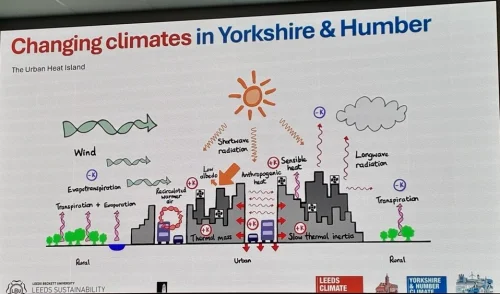
Heat and flooding are the most direct. Thousands of excess deaths in a single heatwave, and one in four English properties at flood risk by 2050, describe the conditions our existing stock will need to withstand. Much of our homes were never designed for the summers or the rainfall now arriving, and the residents most exposed are often those with the fewest options to adapt on their own.
Health runs through everything. Hugh Montgomery explained that climate change harms health directly, and indirectly by undermining economies and food supply. He was equally clear that action brings health and cost benefits, citing a £126 billion annual saving from tackling obesity. I have long argued that a good home is one of the strongest health interventions we have, and this evidence strengthens that case.
Food is closer to housing than it first appears too. Three of the five worst harvests on record have occurred this decade, and about a third of food price inflation in 2023 was linked to extreme weather. Tenants already feel that in their pockets, alongside their energy bills, with too many making that choice already about heating v eating, and that is set to get worse. The experts also noted that a shift to plant rich diets, less waste and more resilient production could free up land the size of Scotland.
Security was described by a former senior Army officer, who called climate a threat multiplier and warned that cascading crises risk ungovernability. He pointed to renewables and a decentralised grid as routes to energy independence. Homes with good fabric, local generation and smarter heating are part of that picture, and social landlords own a significant share of the buildings where it could happen at scale.
Nature is the theme we discuss least as a sector. The UK sits in the bottom 10% of countries for biodiversity intactness, and only 14% of English rivers are in good health. The experts called for nature to be treated as critical infrastructure and for harmful subsidies to end. Landlords manage estates, green spaces and drainage across the country, so we are closer to this question than we sometimes recognise.
Can we afford to act?
This was the part of the briefing I would want boards and finance directors to hear. Tessa Khan and colleagues set out that net zero is estimated at about 0.2% of GDP, and that a faster transition saves an estimated $12 trillion compared with staying on fossil fuels. Inflation would have been markedly lower had we decarbonised earlier. Offshore wind costs are down more than 50%, solar more than 70% and batteries more than 80%.
In our sector the upfront cost of retrofit is real, and I would never pretend otherwise. But the cost of not acting does not disappear. It moves into damp and mould, cold and overheating homes, rent arrears, repairs and pressure on the NHS. The question is less whether we pay and more who pays, and when.
Is the public ready to hear this?
According to the briefing, 83% of people want more climate action, yet MPs substantially underestimate that support. I suspect a similar gap exists between what residents and colleagues are ready to hear and what we assume they are ready to hear. The appetite for a conversation may be greater than we think.
What I am taking from it
The briefing does not ask us to despair. It asks us to stop treating climate and nature as a separate agenda and to recognise them as the conditions in which every other priority will now be delivered. For social housing, that means seeing resilience, health and decarbonisation as one piece of work rather than three competing budget lines.
I am still working through what that means in practice, and I would value hearing from others doing the same. Have you seen the film, or hosted a screening with your board, your team or your residents? What conversation followed? I would love to hear what you took from it.
Image credit: Healthy Homes Hub
Unlock all content
This is the 1 of 3 articles you can access for free. Become a member to unlock unlimited access to our full content library.