
Climate Gathering: Lessons for Social Landlords
23rd November 2026
Helen Greig
300,000 oysters have been reintroduced to the Humber estuary over the last two years, in ‘rapid reefs’. Why? Because oysters filter seawater, which helps improve water clarity and coastal health; and reefs create shelter for fish and other species, whilst buffering wave energy and reducing erosion.
This is just one of the fun facts I got by attending the Yorkshire and Humber Climate Commissions fourth gathering, on 17th November 2026 at Wakefield Trinity’s stadium. I’ll readily admit it was not high on the list of things one should do with jetlag after only getting back from Canada less than 24hours previously. However, I not only managed to stay fully awake for the whole day (despite a couple of yawns that were nothing to do with the content), it energised me in a way I was not expecting.
Whilst it was not an event directly focusing on housing or health, as ever it would be impossible to separate those topics out from the changing climate and its impact. Overheating, flood resilience and trust were key topics for the day, all familiar themes for those working in social housing. Below is a quick summary of some of the key points gleaned from the sessions – whilst the event was focussed on Yorkshire and Humber, the learning is applicable far more broadly.
1. Overheating is not just a risk for the South of England
The extreme heat workshop, led by Professor Jim Parker of Leeds Beckett University and Dr Susi Lorenz of the University of Leeds, gave the clearest signal for landlords.
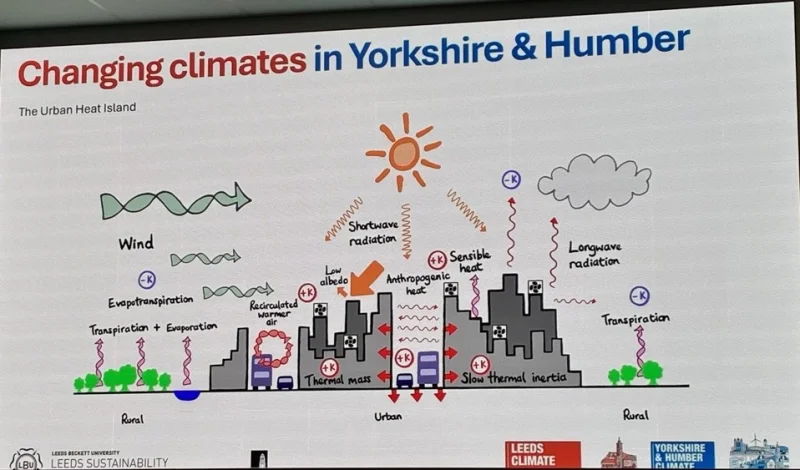
Much of the UK’s housing stock was designed to retain heat in winter, not release it in summer. Leeds temperature data showed a warming trend, with urban areas warmer than nearby rural sites, especially at night. Dense, poorly ventilated and overcrowded homes, including some back-to-back terraces in Harehills, were identified as a particular risk.
The health effects described went beyond discomfort. They included disrupted sleep, poor concentration, dehydration and strain on mental wellbeing. Older people, children, disabled people and those with health conditions were seen as most exposed, alongside renters, who may be unable to fit shutters, awnings or other adaptations themselves.
Several practical points emerged:
External shading was identified as one of the most effective ways to stop solar heat entering a home.
Opening windows helps only when outside air is cooler. Security concerns can rule out ventilation at night, particularly in ground-floor homes.
Reflective film on large glazed areas, used in Sheffield schools, reportedly showed benefits soon after installation.
Trees and shaded green space lowered heat stress in Leeds monitoring. Paving over gardens and laying artificial turf removes that cooling.
Participants also cautioned against short-term fixes that create longer-term problems, and against treating winter warmth and summer cooling as separate programmes.
2. Flood resilience is moving into housing
The water session made clear that flood resilience is no longer only a matter for engineers and upland land managers. Sarah Tyler of Connected by Water outlined South Yorkshire’s draft Integrated Flood and Water Management Plan, which aims to move the region from reactive flood response to proactive water stewardship.
Two elements are directly relevant to providers. The partnership is pursuing pilots of the government’s proposed flood performance certificates, intended to give residents, lenders and insurers a clearer picture of how resilient a property is. It is also working with housing leads and developers on practical briefs to make property-level resilience standard in new builds and retrofits.
The pressure behind this is measurable. Jonathan Moxon of the Aire Resilience Company reported projections of an 8% increase in flows in the upper Aire catchment by 2069, which could test the capacity of Leeds’ engineered defences. The company is funding upstream land management through five-year business contracts, aiming to cut peak flood flows by 5%.
For landlords with stock in flood-prone areas, flood performance certificates could in time affect insurance, lending and stock valuation.
3. Resident trust decides whether projects land
The community energy workshop, drawing on the Sheffield Energy Hub and geothermal proposals by Pickering Town CIC, offered lessons that apply to any retrofit or decarbonisation programme that depends on residents taking part.
Engagement works best as a two-way conversation. In East Durham, a geothermal scheme asked residents open-ended questions before designs were finalised
Local messengers carry more weight. In Pickering, trained volunteer “Geo Champions” were found more approachable than external institutions or commercial firms, a finding that strongly resonates with the learning from the Healthy Homes Hub Asthma-Friendly Homes programme community champions, based on whg’s model in the West Midlands
Physical presence matters. Sheffield’s hub, in council-provided premises, covers retrofit, fuel poverty, insulation and flood preparation in one place. Pickering used a weekly market stall to explain the project to passing residents
Bills are the entry point. Amid cost-of-living pressures, messages about lower household costs proved more effective than environmental goals alone
Digital channels build on existing relationships. Neighbourhood WhatsApp groups worked when introduced by a trusted peer, not as campaigns started from scratch
Commercial branding can erode trust. Participants suggested firm rules against sales pitches at public sessions
The Pickering team also found that addressing a contentious history directly, in their case former gas wells linked to anti-fracking protests, helped bring former opponents into the conversation.
4. Homes are now central to cutting emissions
George Coley of Northern Powergrid noted that electricity generation, the UK’s highest-emitting sector in 1990, is now its lowest. The leading sources of emissions are surface transport, energy use in buildings, and land use and agriculture. Replacing gas boilers was named among the changes needed.
The Commission’s chair reported that clean sources generated about 66% of British electricity in the second quarter of 2026. As the grid decarbonises, the case for electrified heat in homes strengthens.
The geothermal discussion added a practical point on technology choice. Deep geothermal suits continuous heat loads, such as a swimming pool, but high drilling costs are harder to justify for seasonal demand. Participants noted that falling prices for air-source heat pumps, solar panels and batteries make these increasingly competitive. Free early-stage support, including Community Energy Go and Reheat, was described as underused. Public grant processes were reported to take 8 to 9 months from launch to payment.
5. Adaptation needs joined-up planning and a fair share of costs
A recurring theme was that adaptation is fragmented. Flood, drought, urban greening and wildfire planning are often handled by separate teams with separate budgets. Participants rated regional preparedness for extreme heat lower than that of their own organisations.
The Commission’s chair argued that adaptation needs considerably more attention as the world risks exceeding 1.5°C, without reducing efforts to cut emissions. The chair also warned that a transition which shifts costs and risks onto people with fewer resources will struggle to secure lasting support.
The health case for action was illustrated by Bradford’s Clean Air Zone. Figures shared at the event included a 25% drop in respiratory GP visits and £184 million in health and economic benefits over 22 months.
What social landlords need to consider
The gathering pointed to questions social landlords can ask of their own stock and programmes before next summer:
Which homes are most exposed to overheating, and which residents in them are most at risk?
Do retrofit specifications address summer heat as well as winter warmth, including external shading?
How might flood performance certificates affect homes in flood-prone areas?
Are engagement plans built on trusted local voices and visible, two-way contact?
Are adaptation, decarbonisation and greening planned together, or by separate teams?
The social housing sector is uniquely placed within communities to connect people, ambition and evidence, turning it into action that makes homes and communities healthier. Consider the work to join the dots, bring together the thinking and action, and engage in bigger initiatives as a grain of sand. An irritant in the short-term, perhaps, because everyone is busy and it’s hard changing culture and process.
But like those 300,000 oysters now living their best life in the Humber Estuary, it’s that grain of sand that will go on to produce a pearl.
Image credit: Healthy Homes Hub
Unlock all content
This is the 1 of 3 articles you can access for free. Become a member to unlock unlimited access to our full content library.