
Celebrating Two Years of Healthy Homes Hub
14th September 2026
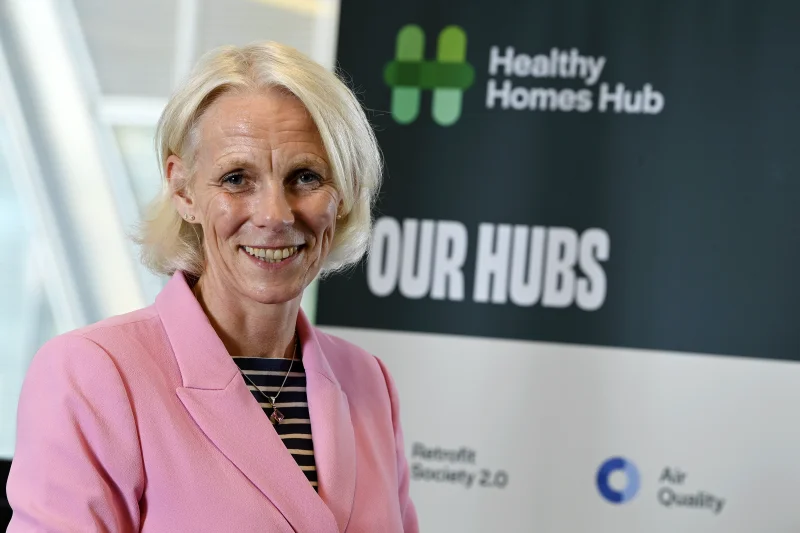
A conversation with Jenny Danson, Chief Executive
Two years ago, Healthy Homes Hub set out with one line as its compass: no home we live in should make us ill. As the Hub marks its second birthday this month, Chief Executive Jenny Danson reflects on what's been built, what's been learned, and where the sector goes from here.
Healthy Homes Hub turns two in September 2026. What does that milestone mean to you?
Honestly, it's not the date on the calendar that means the most to me, it's what's grown up around it. Two and half years ago this was just a couple of us with an idea. Now there's a significant membership organisation behind it: over 1,300 active members on our website, over 5,000 following us on LinkedIn, over 2,600 subscribing to our weekly newsletters. And we've welcomed more than 1,200 housing and supply chain professionals to our events, online and in person.
But I think the number that’s perhaps most important to me is the fact that between them, our members manage over 70% of social housing stock in England. Rather than being a vanity metric, it actually means when we share something about compliance, mould, overheating, data or retrofit finance, we're speaking with the sector, not at it.
What's the biggest misconception people have about Healthy Homes Hub?
That we're primarily an advisory or consultancy service. We're not just that - we're a membership body and collaborative knowledge resource that brings together housing providers, policymakers, contractors, academics and health professionals – a coalition of the willing with a single aim: to put health at the heart of housing.
By connecting these voices and facilitating convening spaces through our Hub, Summer and Winter Ideas Exchanges, Retrofit Society 2.0 meetings and our Making Housing Better podcast, we’re helping to turn challenges into practical solutions and ensure healthier homes aren’t just an aspiration, they become a reality.
Thinking about the work that you’ve delivered over the last two years, what are you most proud of?
It's less a single piece of work than three projects that sit together for me, all of which combine to create a huge research and innovation opportunity for the sector. Our Warm Rents programme is the one I'd start with. The idea is simple: warmth is treated as part of the rent, not something a resident has to find extra money for. We have 10 housing providers covering the cost of keeping homes in the project at a minimum of18°C during occupied hours, with smart meters and sensors flagging when a home's running colder. Residents keep control above the agreed minimum, giving them the flexibility.
What I like about it is the mindset shift. Landlords are already paying for cold homes by way of mould washes, repairs, complaints, damp and disrepair claims. Warm Rents redirects that spend into prevention instead, and the project is being evaluated independently so it can inform policy on how rent and affordability get set in future, not just how this programme runs.
Alongside this, we recently launched our Cooler Homes programme. As a sector, we've spent years focused on cold and fuel poverty while overheating in social housing - made worse in some cases by the very retrofits meant to help not to mention the increasing numbers of heat waves we’re experiencing - has had far less attention. And that’s despite the fact that it's elderly residents, young children and people with existing health conditions who feel it most.
Working with Map Impact, Good Homes Alliance, Loughborough University and Oxford Brookes University, we're giving participating landlords a heat risk score for every home in their portfolio and a plan for what to do about it.
And finally, our Asthma Friendly Homes project which aims to tackle something we know is preventable - children in social housing are disproportionately affected by housing-related respiratory illness, and too often children are rushed in as emergency admissions into hospital, when this should be able to be managed at home.
Four housing associations in Tower Hamlets are working with NHS Barts Trust and North East London Health & Care Partnership to go into the home a family's already living in and deal with the fuel poverty, damp and air quality driving the illness, rather than treating the symptoms and sending the children back to the same conditions.
What comes out of the other side is a governance model for how housing and health teams work together, a training framework for community champions, and a sector-wide adoption blueprint, so the whole sector and the communities they serve can benefit from it.
Energising Assets launched this year too. Why now?
Because retrofit is only as good as the finance standing behind it. After two years of hearing and seeing housing providers work through off-balance sheet structures, and the mismatch between modelled and real-world performance, it was clear they needed an independent bridge, as opposed to another vendor with something to sell.
Energising Assets exists to sit on the housing provider's side of the table: helping them navigate the operating and financing model before they commit, and make sure what's being promised on paper actually stands up once a home is occupied.
It is also great to work with other forward-thinking organisations like Energiesprong UK, Baringa Partners and the Green Finance Institute to rethink a challenge and provide a range of options for housing providers to consider. We learn from our peers, and it helps to define potential solutions to complex systems challenges that housing needs to overcome. Not least how it can pay for the work it needs to do to make the homes, healthy, safe and fit for the future.
What's been the hardest part of the last two years?
Wanting to do too much! There's so much pressure across the sector to deliver change - on damp and mould, retrofit finance, overheating, resident health outcomes - that the instinct is to try to be useful to everyone on everything at once.
We've had to learn to say no to good ideas so the ones we're actually running - for example, Warm Rents, Cooler Homes and Asthma Friendly Homes - get the depth they need rather than spreading ourselves thinly across a dozen half-finished ones.
And that's been harder than it sounds, because every one of those ideas we didn't chase initially was a real problem someone was asking us to help with. That said, they remain in the future roadmap rather than in the discarded pile, so watch this space!
What does success look like for the next two years?
More homes reached, and more members sitting alongside them. Growth in our membership matters because it's how more of the sector gets access to what we've built and the shared knowledge and collaboration that brings, but growth on its own isn't the point. The surplus we can generate, the more this allows us to do – and to keep it free to all social housing providers.
The real measure of our success is whether the preventative work we talk about and facilitate - thermal comfort, air quality, procurement standards - is actually reaching more homes, consistently, not just being discussed by more people. And that's the shift ahead - from proving the approach works to scaling it, with a bigger and stronger membership behind it.
If you had one message for the sector on this birthday, what would it be?
The same one we started with: no home should make the person living in it ill. Two years on, that's no longer just an aspiration, we can point to real programmes and real partners delivering against it.
“Every home should be a healthy one, because the place you live should never make you ill.”
Jenny Danson, Chief Executive, Healthy Homes Hub
Healthy Homes Hub is a membership organisation driving collaboration for healthier living environments, a knowledge resource providing landlords with the insight they need to deliver healthy homes, and a voice and platform articulating the value of good health in the home and why it matters for residents, landlords and communities alike.
Image credit: Healthy Homes Hub
Unlock all content
This is the 1 of 3 articles you can access for free. Become a member to unlock unlimited access to our full content library.