


Cooler Homes Programme
A collaborative programme to identify, prioritise and mitigate overheating risk across your portfolio.
Download Brochure



This is a seven month programme which will provide participating social landlords a heat risk score for every home in their portfolio, a validated digital intervention tool that generates property-specific mitigation options based on home archetype, orientation, and local environment, and a board-ready evidence for RSH compliance.
Delivered by the end of May 2027.
OVERHEATING IS THE RISK MOST LANDLORDS ARE NOT YET MANAGING
UK homes were built for cold, wet winters. Heatwaves that were once rare are now frequent and severe, and the homes we have are increasingly unfit for the summers ahead.
While the sector has focused on fuel poverty and cold-weather performance, overheating has remained a blind spot. That is about to change.
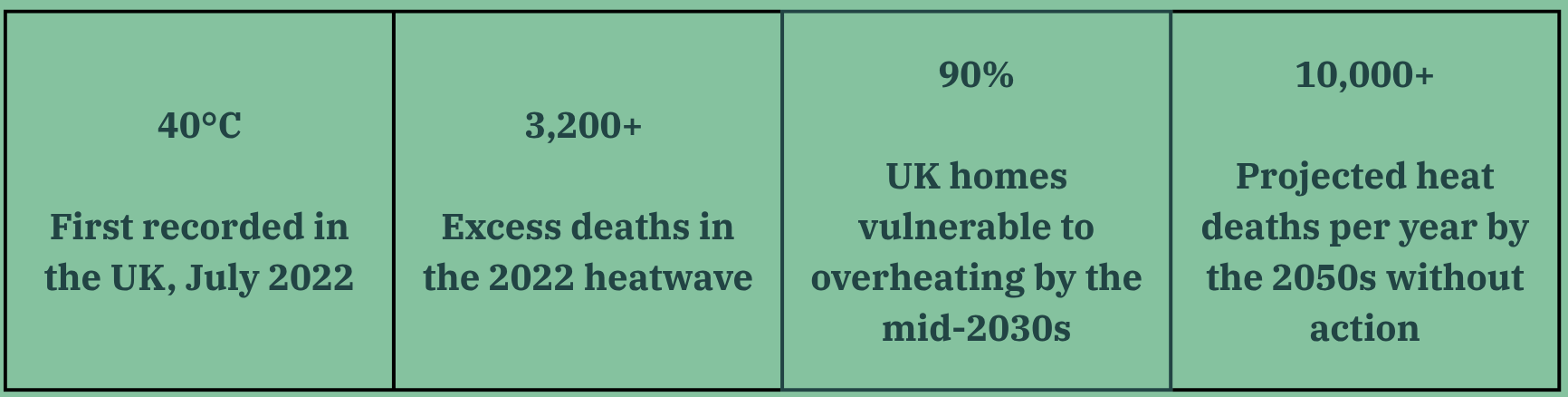
Three compounding factors make this urgent for social landlords specifically.
1. Dense urban areas trap heat far above surrounding neighbourhoods. A large number of social housing sits within them.
2. Vulnerable residents, including older people, young children and those with cardiovascular or neurological conditions, are disproportionately present in social housing tenancies and face the greatest health risk.
3. Retrofit programmes focused solely on energy efficiency and cold-weather performance, can actively worsen overheating by trapping summer heat inside homes.
HOW IT WORKS: A FOUR-STEP APPROACH FROM RISK TO ACTION
The programme combines two powerful existing resources: property-level heat risk data that already exists for every home in the UK, and Good Homes Alliance’s (GHA) proven intervention research covering the full range of solutions for each property type. Together, these produce a tool your housing team can use directly, without commissioning new research or paying consultant day rates to reach a conclusion.
The data layer is the same used by banks and insurers to assess climate risk, with 30-year forward modelling against Met Office UKCP18 climate scenarios
FOUR DECADES OF COMBINED RESEARCH BEHIND THE METHODOLOGY
By the end of May 2027, each participating organisation will have a complete overheating risk picture for their portfolio, a property-level intervention plan matched to home type at building-by-building level, and the regulatory evidence trail their board and the RSH will ask for. The intervention tool is structured by home archetype and local environment, evaluated by Loughborough University, and is yours to use independently after the programme concludes.
WHAT PARTICIPANTS RECEIVE
A Map Impact HeatView heat exposure risk score (1-100) for every property, with 30-year forward modelling against UKCP18 climate scenarios
Resident vulnerability overlay - dual-priority risk register ready for board reporting
Targeted intervention plan per property, structured by archetype and environment
Cooler Homes Playbook
Board assurance with evidence trail for RSH consumer standards compliance
A digital intervention tool developed by Good Homes Alliance, validated on test cases by Loughborough University, and structured around your stock
Input into the methodology, so the programme reflects your stock and your challenges
A knowledge event at Loughborough University to hear the latest overheating research from academic partners and GHA, setting the evidence base for the programme
The data to manage overheating risk already exists for every property in the UK. The question is whether you access it as part of a programme that generates shared learning and sector-wide credibility or commission it alone at greater cost, without the playbook, without the research partnership, and without the regulatory standing that comes from being part of a recognised national initiative.
Who will lead the programme?
The programme is led by Alex Willey, Project Director at Healthy Homes Hub.
With over 15 years of experience in housing strategy, asset performance and sustainability.
Join the Cooler Homes programme
To express interest or discuss how the programme applies to your organisation, please contact alex@healthyhomeshub.uk or fill out this form.