The Wealth of Mental Health - Ongo Talk
6th October 2026
Ongo runs its own counselling service because mental health was the barrier stopping tenants from using its employment and skills support.
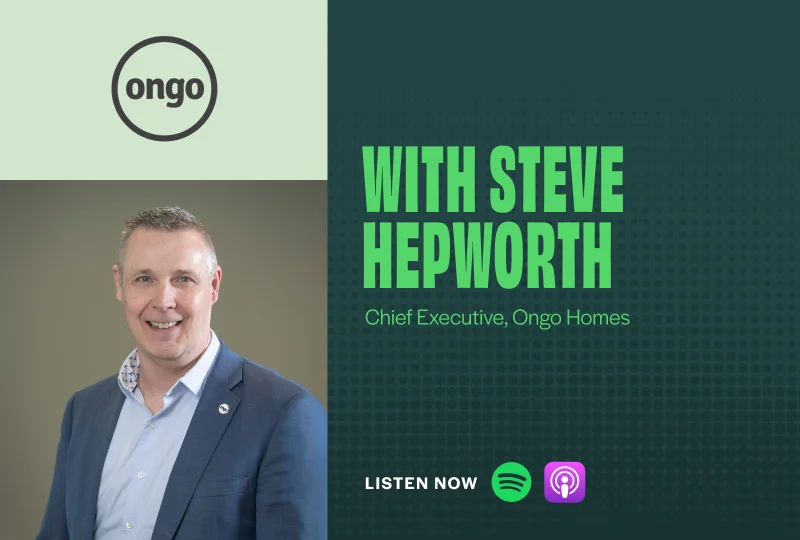
Host: Helen Greig, Operations Director, Healthy Homes Hub
Guest: Steve Hepworth, Chief Executive, Ongo Homes
At a Glance
OngoTalk was launched in 2023 after Ongo’s employment and skills teams found that mental health problems were stopping people moving forward, with NHS waits of up to two years in some areas. Eight counsellors registered with the British Association for Counselling and Psychotherapy now work inside the same team, and the service is free to Ongo tenants.
A survey of Ongo’s roughly 12,000 tenants drew over 1,500 responses, around 13%, and 52% said mental health and wellbeing support was important to them.
Supervising counsellors, including student placements, needs a certain scale, so organisations without it may do better to buy in a service or learn from Ongo’s experience.
Show notes
Employment and skills support stalls when mental health barriers go unaddressed. That finding led Ongo to launch OngoTalk in 2023. After lockdown, a growing share of the people using Ongo’semployment and skills services were held back by mental health problems, alongside the financial worries, relationship breakdown and housing issues the teams already supported. With NHS waiting lists of up to two years in some cases, Ongo built its own team of eight counsellors, all registered with the British Association for Counselling and Psychotherapy and embedded within the skills and personal development team. The service is free to Ongo tenants.
Counsellors are trained across a full range of approaches rather than cognitive behavioural therapy alone. First appointments typically take a few weeks to arrange, not months. Crisis and trauma response is not offered, and the NHS remains the route for people in crisis. Demand exceeds capacity, so overspill goes to trusted associate counsellors, and placements are offered to counselling students from a local university. Students are interviewed before starting, hold student membership of the professional body and are supervised throughout.
The employment and skills team, recruitment agency and counselling team share an open reception area at the Scunthorpe head office, deliberately without a formal desk, so that the first point of contact does not act as a barrier. Around 1,000 people a year use employment and skills support, and between a quarter and a third of them also use counselling. Some tenants use counselling only. Housing management teams also refer tenants where issues such as hoarding affect their ability to work with them. In 2024 to 2025, 354 people used OngoTalk across about 12,000 tenancies.
Impact is measured for individuals rather than across the tenant base. Most people supported into employment are tracked for six months, and around two thirds of those on the employment and skills route reach a positive outcome. On one estate in Barton upon Humber, a wider community programme including a community centre, youth activities, links to health services and access to mental health support was followed by lower turnover and fewer empty homes, antisocial behaviour halved and rent arrears reduced significantly. Those results reflect the whole programme, not counselling alone. The ONS has reported that, among people not working when they started NHS Talking Therapies, employment advisor support alongside therapy was associated with monthly earnings £105 higher after three years. The English Housing Survey shows households reporting a mental health issue rising from 17% in 2013 to 2014 to 38% in 2023 to 2024, and in a small Altair survey 82% of respondents linked rent arrears and financial difficulty to tenant mental health, both as cited in a National Housing Federation blog. The Keep Britain Working review estimates that ill health related economic inactivity costs the UK £212 billion a year.
The service is funded through Ongo Communities, a charity established in 2013 and seeded each year by Ongo Homes with just over £1 million, rising with CPI and paid from surplus. The charity separately bids for grants and contracts from the Department for Work and Pensions, Jobcentre arrangements, local councils and other funders. In its best years that has added over £500,000, and last year it was under £400,000, with European Social Fund income no longer available. The Ongo Homes Board sets the broad priorities, and ring fencing the money keeps spend easy to track and keeps housing management and community work distinct. The tenant survey informs where that money goes.
Ongo does not treat OngoTalk as a standalone service. It is one part of an employment and skills offer, and it is open to offering the service to small local employers and to discussing paid or shared arrangements with other social landlords. Clarity about purpose, outcomes and resourcing is the main advice for landlords considering a similar service, and quality supervision cannot be reduced.
Landlords interested in taking the conversation further can contact Steve Hepworth at Steve.Hepworth@ongo.co.uk.
Practical steps for housing providers
Record where mental health barriers are stopping tenants from engaging with employment, skills or housing support, to establish whether a need exists before designing a response.
Ask tenants directly which community and wellbeing services matter to them, and use the responses to set spending priorities.
Compare local NHS mental health waiting times with how long tenants can realistically wait, and identify where a timely alternative would change outcomes.
Locate any counselling or wellbeing support alongside existing employment, skills and housing teams, with clear referral routes in both directions.
Define the boundaries of the service in advance, including that crisis and trauma response remains with statutory services, and make this clear to referrers.
Test whether qualification, supervision and management standards can be sustained at your scale before building a service, and consider buying in or learning from an established provider where they cannot.
Agree the outcomes, the measures and a protected funding route before launch, and where possible measure results within a defined area to see the effect on housing management outcomes.