

A Sector First: Healthy Homes Hub and Centre for Mental Health Launch Mental Health in All Housing Policies
18th February 2026
Jenny Danson
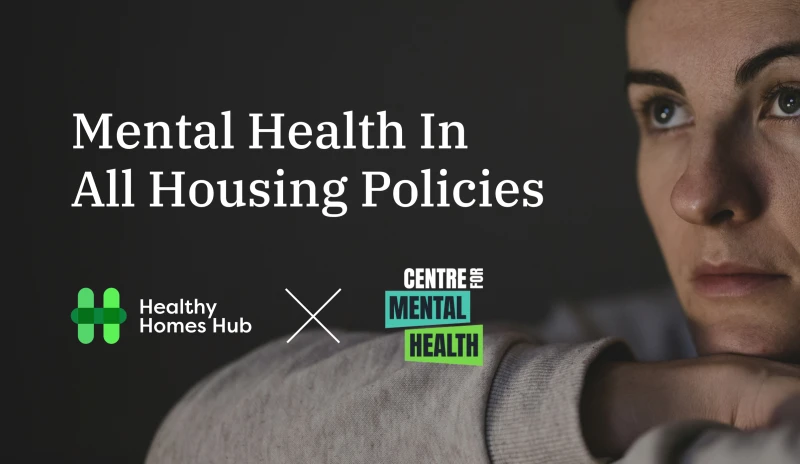
For too long, housing policy and mental health have been treated as separate conversations.
They aren’t.
One in three people in social housing lives with a long-term mental health condition. Yet many housing related policies still assume a resident who can always read and respond immediately, open the door without hesitation, and navigate complex processes under pressure.
That gap matters.
Every letter we send, every repair process we design, every tenancy decision we make has a mental health impact, whether we intended it or not.
That is why Healthy Homes Hub has partnered with experts from Centre for Mental Health to launch two new member resources designed to help embed mental health into housing policy and operation at every level:
Mental Health in All Housing Policies – One Page Framework
Mental Health in All Housing Policies – Practical Checklist
Together, they make one principle explicit - housing policy requires a mental health policy.
Why This Matters Now
We are seeing the same patterns across the sector.
Damp and mould cases that escalate; “no access” that becomes enforcement; letters that create anxiety instead of clarity; repeat complaints rooted in confusion, distress or overwhelm.
Mental health factors are often present but rarely designed for.
Our aim with this material is to empower housing providers to design and run services that protect and promote mental health, rather than unintentionally making things worse, especially for those already struggling.
Introducing: Mental Health in All Housing Policies
The One-Page Framework sets out seven key principles that every housing policy should be tested against:
Safety and stability
Choice and agency
Trauma-informed practice
Communication and follow-through
Joined-up, evidence-informed working
Workforce wellbeing
Community and connection
It reframes what success looks like - not just volumes delivered or timescales met, but residents feeling safe, listened to and in control. Staff feeling confident and supported. Systems that reduce escalation rather than generate it.
This framework moves from theoretical guidance to a policy-design tool, enabling housing professionals to challenge assumptions before they become embedded practice.
Alongside the framework, the Practical Checklist turns principle into action, and is designed to be used repeatedly, not downloaded and forgotten.
It works across 10 core areas:
Home standards and security of tenure
Repairs, compliance and retrofit
Choice, agency and co-production
Trauma-informed practice
Communication standards
Information needs and adjustments
Partnership working with health services
Staff wellbeing and capability
Measurement and review
Community and belonging
It asks probing questions such as:
Have we built in protections for people admitted to hospital or in acute mental distress, so they don’t lose their tenancy by default?
Has this policy been co-designed or tested with residents, including people with lived experience of poor mental health?
Have front-line teams had practical training on how to understand trauma and to apply this policy in a trauma-informed way?
Are we avoiding language that shames, blames or intimidates?
Does this policy explain how staff should record mental health–related needs or adjustments in a respectful way, with consent?
Do we recognise the emotional impact on staff of dealing with distress, crisis or conflict?
Have we defined what “good” looks like in a way that includes resident experience (not just volumes and timescales)?
Does this policy connect to wider work on safe, inclusive communal spaces and neighbour relations?
From Compliance to Care
Housing has rightly focused on physical standards: EPCs, damp and mould, safety compliance, decarbonisation.
But mental health runs through every one of these.
A repair process can reduce stress or intensify it; a retrofit programme can build agency or remove it; a letter can create clarity or anxiety.
The question is not whether housing impacts mental health, it is whether that impact is intentional.
This mental health framework asks a simple but powerful question:
If this policy were experienced by someone in acute distress, would it feel safe, respectful and manageable?
If not, the design needs to change.
What This Means for the Sector
Our collaboration with Centre for Mental Health signals an important shift.
Healthy homes are not only about fabric and temperature, they are about psychological safety, stability, belonging and dignity.
If we want:
Fewer avoidable escalations
Fewer complaints driven by anxiety or confusion
Less wasted capacity
More stable tenancies
Stronger resident relationships
Then mental health must be embedded into policy design.
Access the Resources
Both documents are now available to Healthy Homes Hub members:
Mental Health in All Housing Policies – One Page Framework
Mental Health in All Housing Policies – Practical Checklist
Please use them in board discussions, policy reviews, and before the next escalation, not after it.
Because housing policy shapes daily experience, and daily experience shapes mental health.
Unlock all content
This is the 1 of 3 articles you can access for free. Become a member to unlock unlimited access to our full content library.