


The Healthy Homes Hub Summer Ideas Exchange
19th June 2026
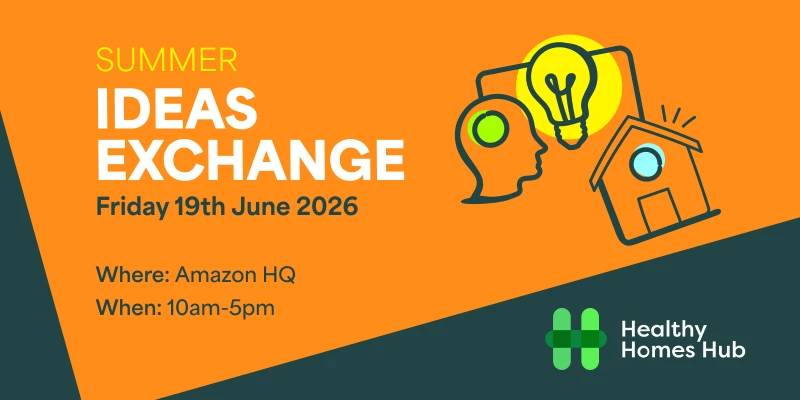
Join us for the Healthy Homes Hub Summer Exchange
Date Friday 19th June, 2026
Time: 10.00 AM, for 10.30 AM start, with refreshments and networking until 5:30PM
Location: Amazon's Head Office, London
Cost: FREE and Exclusive to Healthy Home Hub Members (All Housing Providers are FREE members of the Healthy Homes Hub)
Register for your free ticket here
The Healthy Homes Hub Summer Ideas Exchange is a dynamic event bringing together housing professionals, industry experts, and academics to explore how we can create healthier, more efficient homes. With a focus on best practices, research, innovation, and real-life experiences, this event offers a unique opportunity to collaborate, share knowledge, and drive meaningful change in housing.
As we navigate the intersection of health, efficiency, and sustainability, this event will provide thought-provoking discussions, practical takeaways, and networking opportunities. We aim to inspire new approaches to managing homes and policy.
Register here
Why attend?
We've called it an Ideas Exchange because it's not just about listening—it’s about sharing, debating, and shaping the future of healthier homes together. It’s a two-way dialogue where fresh perspectives, best practices, and innovative solutions come to life.
Be a more informed client – Gain the knowledge to ask the right questions, challenge assumptions, and make smarter decisions about housing and health.
Stay ahead of the curve – Get insider insights on the latest research, policies, and innovative solutions driving healthier, more efficient homes.
Network with peers – Connect with housing leaders, health experts, and innovators to exchange ideas and forge new partnerships.
Discover practical solutions – Learn from real-world experiences and find out how you can apply best practices in your own work.
Reflect and recharge – Step away from daily pressures and take the time to think strategically about the future of housing and health.
The event concludes with the opportunity to network, a chance to connect, reflect, and build partnerships to advance the healthy homes agenda.
What will you learn:
This event is designed to equip attendees with actionable insights and practical knowledge to drive meaningful improvements in housing and health.
Who is this aimed at?:
Housing professionals looking to expand their knowledge of healthy homes.
Asset managers and developers exploring best practices in creating healthier, more resilient homes.
Sustainability and decarbonisation experts interested in integrating health-focused strategies into housing.
Policy makers and regulators seeking to understand the links between housing, health, and efficiency.
Health professionals and researchers interested in housing’s role in improving well-being.
Anyone inquisitive about how housing, sustainability, and health interconnect.
Agenda
10.00 Arrive, coffee and networking
10.30 Welcome & Introduction
10:40 - 11:00 Lived Experience
Maria McCafferty, social housing resident
We begin the day with a powerful personal story.
11.00 - 11.10 Grab drink and move to break outs
11:10 - 12:10
Choice of sessions
1. Safety & Compliance – Are we safer yet? Rethinking compliance in a data-rich world
Ryan Dempsey, TCW
In recent years, safety in social housing has risen sharply up the agenda, driven by new regulation, increased scrutiny, and rapid growth in data and technology solutions. But with more tools, more data, and more pressure: are we actually improving safety outcomes, or simply increasing complexity?
This session will offer a fresh perspective on balancing innovation with simplicity, and how to ensure safety strategies deliver real-world impact for residents.
2. GeoSpatial – Beyond the Front Door: Embedding Neighbourhood Climate Resilience into Retrofit
Richard Flemmings, Map Impact
Rick Thompson, ODC
Thomas Wharton, Regenda Homes
Retrofit has traditionally focused on the fabric of individual homes, but climate resilience requires us to look beyond the front door. Heat, flooding, green infrastructure, and the wider urban environment all play a critical role in shaping how homes perform and how residents experience them.
This session will explore how housing providers can use geospatial data to better understand climate risks and make more informed decisions about homes, neighbourhoods, and investment priorities. It will include an introduction to the role of mapping and place-based data in housing, highlighting how these tools can support healthier homes and stronger climate resilience. It will also feature a case study from Regenda Homes, sharing how the organisation is using geospatial analysis to understand heat risk across its homes and communities.
3. The Plymouth Living Lab: Co-Designing Digital Health with Residents
Dr. Kieran Green (Community Engagement Researcher, Plymouth Community Homes/University of Plymouth)
Rachael Fox (Partnership Project Manager, Plymouth Community Homes & Livewell SW)
Professor Sheena Asthana, Director, Centre for Health Technology and Co- Director, Centre for Coastal Communities, University of Plymouth
Chair: Mark Chadwick, Fusion21
The Plymouth Living Lab is an innovative partnership between Plymouth Community Homes and the University of Plymouth’s Centre for Health Technology. At its heart, the Lab is about testing digital health technologies with and for the people who need them most — social housing residents often living with the greatest health inequalities. This session will explore:
Co-design and engagement: how academics, health professionals, and residents have come together to shape trials, ensuring technology is empowering rather than imposed.
Pilots in practice: early findings from two digital tools — Community Connections (tackling loneliness and building social networks) and behavioural sensors (detecting unusual patterns in the home and alerting carers/families to risks).
Agency and empowerment: why this matters — for residents managing chronic conditions, for housing providers shaping services, and for tech developers designing solutions with people rather than for them.
12:10 - 12:20 Move to main room
12.20 - 1.15 Modernising Critical Services: Lessons from HM Passport’s Digital Transformation
Stacey Jarrett, AWS
Over eight years, HM Passport Office transformed one of the UK’s most critical public services while continuing to process millions of passport applications without interruption. In this session, Amazon Web Services’s Stacey Jarrett will share key lessons from this journey, including how to modernise legacy systems, build in-house capability, and design for resilience by identifying and addressing failure points early.
For housing providers balancing day-to-day service delivery with large-scale change, this session offers practical insights into how data, technology, and strong partnerships can support transformation while keeping essential services running.
1.15 - 2.00 Lunch - Enjoy networking opportunities and refreshments
2.00 - 3.00
Choice of sessions
1. Making data work harder - from sensors to smarter decisions
Eilidh Hughes, Senior Policy Advisor, Department for Energy Security & Net Zero
Barry Lynham, Managing Director, Knauf Energy Solutions
This session explores what is stopping organisations from turning data into better decisions. Moving beyond temperature and humidity, we will look at how measured performance data, including Heat Transfer Coefficient (HTC), can provide a more accurate understanding of how homes actually perform and help target investment where it will have the greatest impact.
Drawing on practical examples, we will explore how measured data can reveal significant gaps between modelled EPC ratings and actual performance, transforming everything from prioritising retrofit works to improving financial models, reducing risk, and even offering residents clearer insights into their energy costs.
The speakers will also examine how this work is shaping emerging government policy and guidance, and what this means for housing providers looking to adopt a more evidence-based approach to decarbonisation.
2. A showcase on data, responsibility, and readiness
Mike Craggs – Development & Asset Management Innovation Lead MCIH
Kieran Poynton – Director of Data and Analytics, Bromford Flagship
Chair: Mark Wood, AICO
We often say we are data led, focused on insight, early warning, and prevention. Yet the use of sensor data across social housing remains limited.
This roundtable explores a simple but uncomfortable question: why?
Is it tenant trust and consent?
Uncertainty about the benefits?
A lack of mandate or regulation?
Perhaps this isn’t about technology at all, but organisational readiness. This is not a sales pitch or a search for a neat answer. It’s an honest conversation about whether we’re ready to manage risk in people’s homes, not just on paper – and what that means for healthier homes.
3. Lessons from real homes: the health impacts of retrofit in practice
Dr Tiffany Yang, Research Programme Director, Born in Bradford, Bradford Institute for Health Research
Chair: Stuart Smith, Commercial Director, Zehnder
This session shares early insights from a major NIHR-funded study led by the Born in Bradford programme, tracking over 400 social homes before and after energy efficiency upgrades. Combining real-time monitoring with resident feedback, the research explores how changes to insulation, heating, and ventilation impact indoor air quality, temperature, humidity, and ultimately, health outcomes.
Drawing on the first winter’s data, Dr Tiffany Yang will present emerging trends across different building types and households, alongside early insights into how residents are experiencing these changes.
3.00 - 3.15 Break
3.15 - 4.15 Closing keynote: Overheating, Net Zero and Health Inequality: Learning from HEARTH
Professor Rajat Gupta, Director of HEARTH, Oxford Brookes University
Chair: Luke Hurd, MD, CHIC
This keynote explores the work of HEARTH, a transdisciplinary programme examining how homes can adapt to extreme heat while still meeting Net Zero goals. Vulnerable residents are often least able to adapt, unable to improve ventilation, add shading, or leave overheated homes, increasing health inequalities.
HEARTH brings together climate science, building engineering, health, and social research to understand overheating risk from region to room. Through climate modelling, occupant surveys, and health impact analysis, it examines which mitigation strategies, from shading and ventilation to nature-based solutions and cool materials, deliver the greatest benefit.
4.30- 6.30 Close and Networking Drinks
Attendance is FREE as part of Healthy Homes Hub membership.
Places are limited to 100
Join us as we work to #MakeHousingBetter!
To learn more about becoming a Healthy Homes Hub member, contact: jenny@healthyhomeshub.uk
Unlock all content
This is the 1 of 3 articles you can access for free. Become a member to unlock unlimited access to our full content library.