Switched Off: The Renewable Energy Homes Never See
13th October 2026
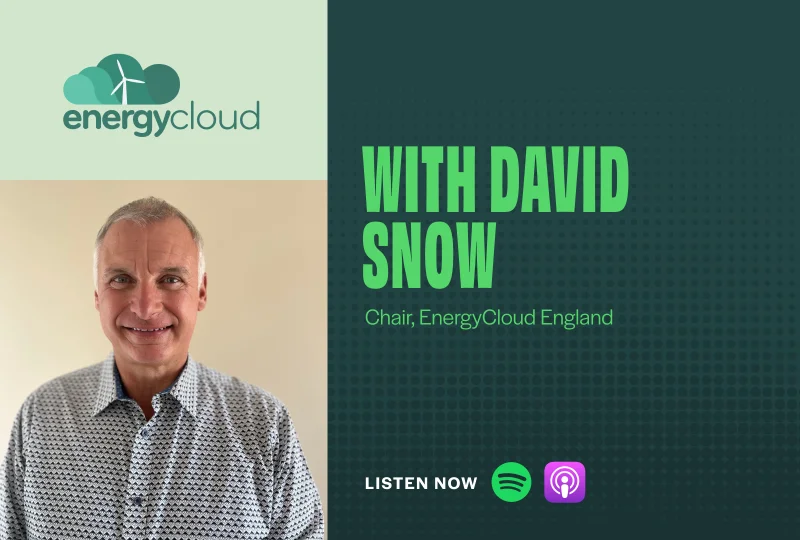
David Snow, CEO of EnergyCloud England, explains how curtailed wind power could heat homes for tenants living in fuel poverty, and why social housing providers are starting to take note.
At a Glance
£1.5 billion of renewable energy was curtailed, switched off, in the first six months of 2026, equivalent to roughly £3 billion a year, with the constraint penalties paid to generators landing on every household's energy bill.
EnergyCloud redirects that surplus energy into homes in fuel poverty through automated immersion controllers on hot water tanks, storage heaters, and demand flexibility messaging, funded through retailer credits rather than new charges.
Healthy Homes Hub and Yorkshire Housing are working with EnergyCloud to scale the model across social housing in England, following schemes already established in Ireland, Northern Ireland and Scotland.
Host: Jenny Danson, CEO and Co-Founder, Healthy Homes Hub
Guest: David Snow, CEO, EnergyCloud England
In the first six months of 2026, 5,600 gigawatt hours of renewable generation, worth an estimated £1.5 billion, was switched off because there was nowhere for it to go, a rate that projects to roughly £3 billion a year. Official government figures put three million households in England in fuel poverty, while the charity National Energy Action estimates the true figure at six to seven million, using a measure of 10 per cent or more of household income spent on energy bills. The two problems, an abundance of wasted clean power and millions of households unable to afford to heat their homes, sit side by side without a mechanism connecting them.
Wind farms are paid a guaranteed level of generation under contract, so a turbine ordered offline still triggers a penalty payment, a cost passed through to consumer energy bills. Periods of high generation also strain the transmission network, adding maintenance and repair costs that land on bills in the same way. In the Shetland Islands, the Viking wind farm is regularly curtailed while nearby households struggle to heat their homes, one of the clearest examples of energy waste and fuel poverty overlapping in the same postcode.
EnergyCloud, a not for profit initiative operating in England, Scotland, Northern Ireland, Ireland and Germany, works to route curtailed and surplus renewable power to households in fuel poverty rather than letting it go to waste. Homes with a hot water tank can have a controller fitted to the immersion heater, turning stored hot water into a form of energy storage that activates automatically when surplus generation is available. Storage heaters serve the same purpose in homes without a tank. Where no storage exists, a messaging platform prompts households to run appliances such as washing machines during surplus periods instead. Meters still record that usage, so retailers, working with Ofgem and the National Energy System Operator, apply bill credits for the energy consumed during those windows, moving towards what EnergyCloud terms a zero social tariff, free energy for households in fuel poverty at times of surplus.
The model began in Ireland roughly four years ago, drawing on the food redistribution charity Food Cloud, which channels surplus supermarket and restaurant food to people in need before it is thrown away. Hundreds of thousands of homes are now part of the Irish scheme, with every retailer providing bill credits. Northern Ireland's system operator is engaged in developing a zero tariff, and housing associations in Scotland, including in the Shetland Islands, are working with EnergyCloud on the same problem. In England, where David Snow has led EnergyCloud's operation for a few months, interest is building among the National Energy System Operator, distribution network operators and retailers, several of which are pairing the scheme with community investment projects.
Healthy Homes Hub and Yorkshire Housing are working with EnergyCloud to establish how the model can scale across social housing in England, at what is still an early stage for the initiative in this country. The approach depends on properties that can accommodate storage or flexible demand, so homes with combi boilers or poor insulation, where fuel poverty is often most acute, currently see no benefit and instead need retrofit and storage heater installation, work already under way in parts of the social housing sector through existing grant schemes. Offshore wind capacity is forecast to triple over the coming years and solar generation is expanding rapidly, meaning the volume of curtailed energy, and the potential to redirect it, is set to grow substantially.
Registered social landlords wanting to be part of that next wave can register their interest by contacting Healthy Homes Hub at jenny@healthyhomeshub.uk
Practical steps for housing providers
Map existing stock for hot water tanks and storage heater capacity, since these properties are best placed to benefit from an automated surplus energy scheme.
Flag combi boiler and poorly insulated properties separately, as these will need retrofit and storage upgrades before residents can benefit from a surplus energy scheme.
Review tenant communication channels to check whether a demand flexibility messaging service, prompting appliance use during surplus periods, could reach residents without storage.
Cross reference tenants already known to be in fuel poverty against the household income measure rather than relying on EPC rating alone, since a home with a higher rating can still contain a household in fuel poverty.
Open a dialogue with the relevant regional network operator to understand local curtailment patterns and grid constraints affecting the area.
Build financial sustainability into any pilot from the outset, not only carbon savings, so a scheme can continue without depending on short term funding.
Track prepayment meter households specifically, since these residents are least able to access existing demand flexibility benefits such as cheaper overnight tariffs.