

How Quickly Does Your Home Cool Down? The Research That Could Change How We Think About Energy Flexibility
14th July 2026
Jenny Danson

It sounds like a simple question: once you turn the heating off, how quickly does a home get cold? But for Jordan Townsend, a PhD researcher at Loughborough University nearing the end of his doctorate, that question sits at the heart of one of the most significant challenges in the energy transition. How we answer it will determine whether social housing residents can benefit from cheaper, cleaner energy, or whether the flexibility revolution passes them by entirely.
Healthy Homes Hub spoke with Jordan about his research, what he has found so far, and why it matters for housing providers thinking beyond EPC ratings and retrofit programmes.
The problem with the grid that we are not talking about enough
As the UK adds more renewable energy to the grid and more homes switch to heat pumps and electric vehicles, a new pressure is building in the system. The cables and substations supplying electricity to neighbourhoods were not designed for this level of electrified demand, and upgrading them will cost billions over the coming decades.
One way to reduce that pressure is demand response: shifting when homes draw on electricity, so that energy use aligns more closely with when renewables are generating. Rather than everyone running their heat pump at 6pm, homes could be pre-heated earlier in the day and then allowed to coast through the peak period, with occupants barely noticing the difference.
"The key way to do that with heating," Jordan explains, "is to understand how our homes cool down when the heating is turned off, because the context has changed. Before, the question was about long-term, steady-state performance. Now we need to know: how quickly will it cool down in two hours? Will the occupants notice? Can we fairly automate a demand response event for an occupant with a heat pump without making them uncomfortable?"
That is what Jordan has spent two years trying to find out.
Heating up and cooling down: the experiment
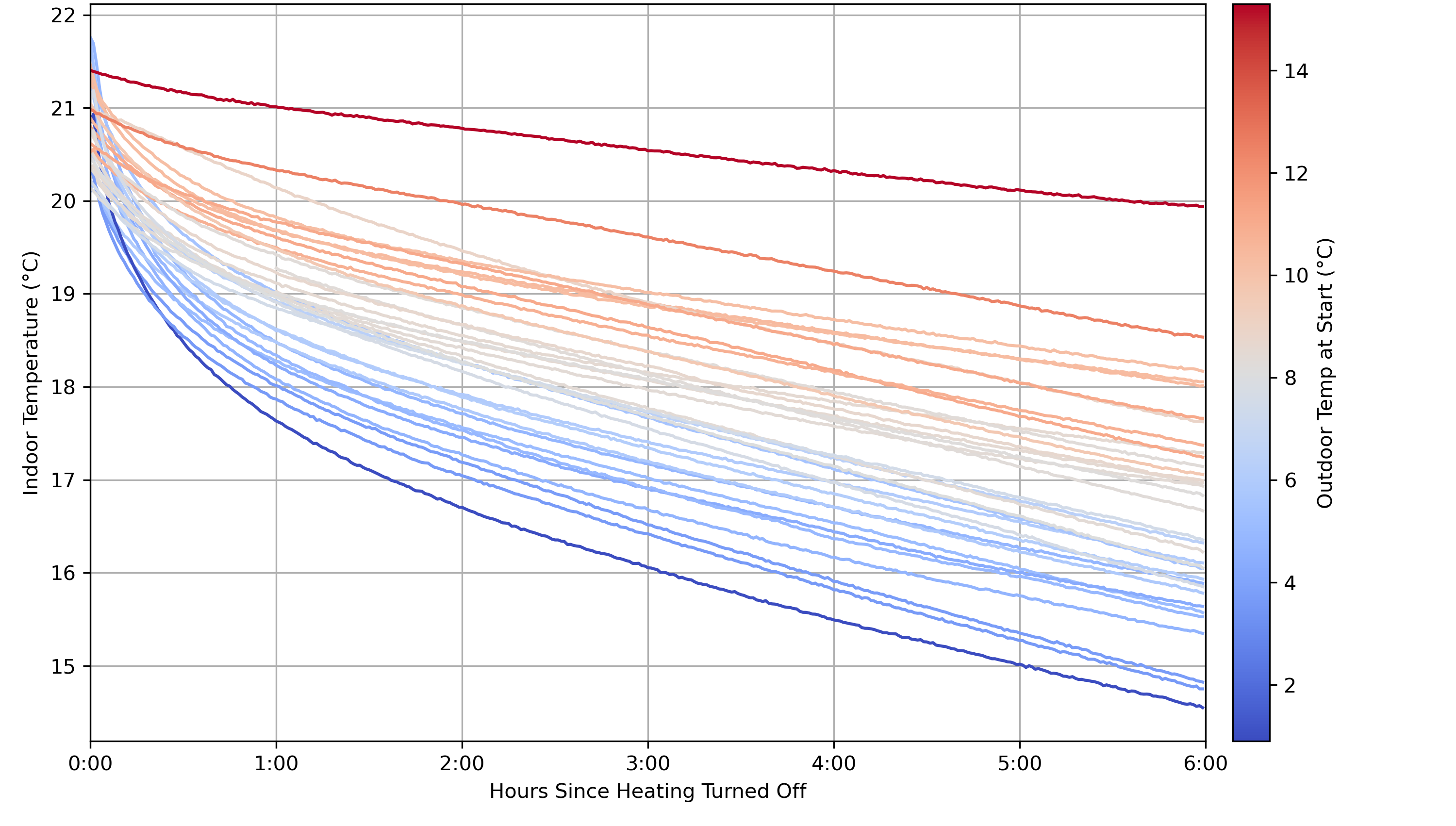
Working with the test houses on the Loughborough campus, Jordan has heated the building to 21c and then allowed it to cool down more than 100 times over two winters. Each time, he varied different conditions: the heating system, the sensors used, where those sensors were placed, and other factors affecting how the building responds. The result is a detailed picture of the cool-down curve and what influences its shape.
The practical application is the development of new metrics that can tell you how useful a home is likely to be for demand response. Two candidates are the
Cool-down rate (how fast the temperature drops over a set period) and the
Comfort threshold duration (how long the home can coast before dropping below 19c, a widely used minimum comfort standard).
Getting these metrics right matters because they will underpin any future system that automates flexibility on behalf of residents.
"Each and every home can become part of the energy transition," Jordan argues. "Social housing, poorly performing housing, all different types of buildings can get the benefits from energy flexibility, have reduced bills, have access to renewable energy. If we can't figure this out, we're going to get the doom and gloom of saying our bills are rising because of renewable energy, but we can make it cheaper."
The surprising finding: sensors matter more than we thought
One of Jordan's most surprising findings has nothing to do with insulation or heating systems. It is about the sensors used to measure temperature, and it has implications for every dataset that researchers, landlords, and energy companies are currently using to model home performance.
Where a sensor is placed in a room, how high it sits on the wall, whether it is a lightweight exposed sensor or a thermostat encased in plastic: all of these factors have a far bigger effect on the resulting cool-down metrics than most people have assumed.
"I found that these parameters have a huge impact and can completely warp the metrics that you use," Jordan says. In some cases, simply changing the sensor type caused the measured cool-down time to quadruple, from around 20 minutes to over an hour and a half. That is not a minor calibration issue; it is a difference that would completely change how you classify a home's flexibility potential.
His recommendation is a sensor on each floor as a minimum, reflecting the fact that upper and lower floors in typical UK homes can have very different thermal mass and cool down at quite different rates.
What gets left out of the models
Another strand of Jordan's work concerns what models currently ignore. Furniture, for example, is almost never included in thermal performance models, because on long timescales it makes little difference. But on the two-hour timescales relevant to demand response, the thermal mass of a bookshelf full of books, or the difference between a sparse and a fully furnished room, could be meaningful. Jordan is planning experiments to test this directly.
Similarly, the distinction between floors matters. A ground floor with solid construction retains heat differently from a timber-framed upper floor. Models that treat a home as a single thermal unit will miss this, and may either overestimate or underestimate the flexibility available.
"The problem is that the models we have are not good enough, even just with one building," Jordan says. "We need to know what to include in these models on this short timescale, because that is the big new contextual constraint."
Towards an Energy Flexibility Certificate
The next stage of Jordan's work, beginning as he completes his doctorate, is the development of an Energy Flexibility Certificate (EFC). The concept is designed to sit alongside, rather than replace, existing measures like the Heat Transfer Coefficient¹, giving homes a rating for their short-term flexibility potential rather than just their long-term energy efficiency.
The certificate would give landlords, energy companies, and grid operators a standardised way to understand what a home can offer to the system, and crucially, to do so in a way that is fair to occupants who may have no interest in actively managing their energy use.
"How can we morally act for them on their behalf with these decisions without them knowing and automating these processes in a fair manner?" Jordan asks.
For social housing providers managing large portfolios, this is not an abstract question. It goes to the heart of how flexibility is deployed for residents who are more likely to be fuel poor, more likely to include older or vulnerable people, and less likely to have the time or confidence to engage with smart energy systems directly.
Why this matters for social housing providers
The energy flexibility agenda is moving quickly, driven by grid constraints, the growth of heat pumps, and initiatives from energy companies offering time-of-use tariffs and demand response rewards. Social housing providers are increasingly being drawn into this space, and many are already piloting demand response schemes with technology partners.
The risk, if the underlying measurement and modelling work is not done properly, is that the homes of residents who most need to benefit from lower bills are the ones whose flexibility is either not captured or not fairly valued.
Jordan's research is still in progress, and the Energy Flexibility Certificate is a project for the year ahead. But the direction of travel is clear: a new way of rating homes that could sit alongside EPC and similar measures, and that could open up the value of energy flexibility to every home in a social landlord's portfolio, regardless of age, construction type, or energy efficiency rating.
Questions for housing providers to reflect on
If your organisation is deploying IoT sensors or smart thermostats across your housing stock, do you know where those sensors are placed, and whether their position and type is consistent enough to generate reliable data about thermal performance?
As demand response schemes and time-of-use tariffs become more common, how is your organisation thinking about the governance question: who decides when a heat pump is turned off in a resident's home, and on what basis?
Could the homes in your portfolio with the poorest energy efficiency ratings still have value in a flexible energy system, and are you aware of the emerging tools and frameworks that might help you quantify that?
Key takeaways
The cool-down curve. Understanding how quickly a home loses heat on a two-hour timescale, rather than over a whole heating season, is the key to unlocking demand response for residential buildings, including social housing.
Sensor choice and placement can skew results dramatically. Data collected from poorly positioned or inappropriate sensors can misrepresent a home's flexibility potential by a factor of four. Housing providers deploying IoT monitoring should take note of how measurement decisions affect the data they receive.
Every home could have flexibility value. Unlike energy efficiency retrofit, which is harder and more expensive for older or harder-to-treat homes, thermal flexibility is available to all building types. The research suggests that social housing providers do not need to wait for full retrofit before their stock can participate in a smarter, cheaper energy system.
Notes
¹ The Heat Transfer Coefficient (HTC) is a measure of how much energy a building loses per degree of temperature difference between inside and outside, expressed in watts per Kelvin (W/K). It captures the overall thermal performance of a building's fabric over long timescales and is used in energy models and EPC calculations. Jordan's work does not seek to replace the HTC but to complement it with a new metric suited to the much shorter timescales relevant to demand response, typically two hours or less.
This article draws on a recorded conversation between Healthy Homes Hub Founder and CEO Jenny Danson and PhD researcher Jordan Townsend, conducted in July 2026. Jordan is nearing completion of his doctorate at Loughborough University, where he is part of a team of four researchers working on thermal flexibility and energy flexibility certification. Findings are from ongoing research; the Energy Flexibility Certificate project is planned for the coming year. His doctorate is co-sponsored by the Department for Energy Security and Net Zero.
Image credit: Jordan Townsend
Unlock all content
This is the 1 of 3 articles you can access for free. Become a member to unlock unlimited access to our full content library.