

When Tech Meets Tenants: The Psychology of Housing Technology
9th December 2025
Lee Reevell
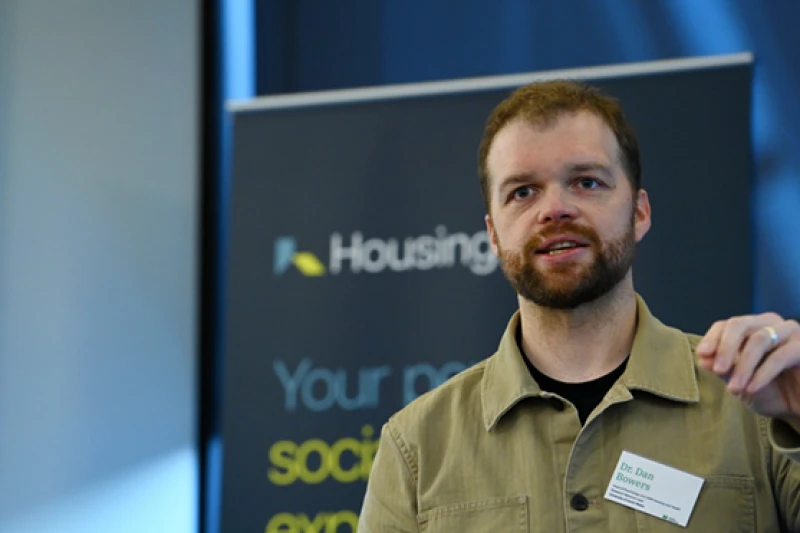
The closing keynote at our Healthy Homes Hub Winter Ideas exchange event took a deliberately different perspective. Dr Dan Bowers, Head of Psychology at the University of South Wales and board member of United Welsh Housing Association, challenged the audience to think harder about what happens when sophisticated technology meets the complex reality of social housing.
His message was uncomfortable but essential: technology alone won't solve our problems, and treating behaviour change as the last slide in a presentation fundamentally misunderstands the challenge.
Before discussing technology adoption, Dr Bowers set the scene with research from Trivallis, a housing association in Rhondda Cynon Taf. Their internal report on current challenges painted a stark picture: massive strain on mental health services, high levels of vicarious trauma among staff, deteriorating property conditions, rising rent arrears, and increasing antisocial behaviour including organised crime.
Meanwhile, other statutory services are stepping back. Support from social care, mental health teams, the NHS, and public health has become progressively harder to access. Housing associations find themselves filling gaps they weren't designed to fi ll, with staff who haven't been trained for this level of complexity.
"In Wales, there's no mandatory training framework for people in these roles," Dr Bowers noted. "They're dealing with this complexity, doing the job, but they haven't been trained to do it in any particular coordinated, professionalised way."
The consequences are predictable. Around 65% of frontline housing staff report feeling at risk of burnout. Staff face physical risks—"there's more of a chance of being attacked these days"—and the emotional toll of witnessing difficult situations with no clear solutions.
This context matters enormously. When we talk about deploying new technology, we're asking people already stretched to breaking point to take on additional work. The staff having those final conversations with tenants are managing all of this simultaneously.
Collaboration Is Harder Than It Looks
Dr Bowers' team ran a consensus event bringing together housing professionals, community police, social workers, Welsh Government representatives, and local authorities. They asked: what would improve collaboration?
The top priorities were revealing. Improved data and information sharing between organisations came first, supported by 84% of participants. A whole-systems approach including lived experience came second. Third was better understanding of different roles and responsibilities—participants noted they typically only spoke toother services during a crisis, making proactive collaboration almost impossible.
Training and communities of practice ranked highly, alongside a fundamental desire: for housing to be treated as an equal partner alongside other frontline services.
The interviews that followed painted a vivid picture of daily reality. Police no longer attend welfare checks with housing officers. The same officer no longer works the same patch, destroying relationship continuity. Navigating other agencies takes days rather than minutes. Yet despite everything, staff remain values-driven—"helping people live good lives, to stay well, is important and rewarded."
The Tenant Perspective on Technology
Research from across the sector reveals consistent themes in tenant responses to retrofit technology. A report from Pobl and colleagues identified a broad range of reasons for refusals, while work by Dr Deborah Morgan at Swansea captured a troubling sentiment: some tenants feel like guinea pigs rather than partners.
The barriers are both practical and psychological. Communication and information gaps leave tenants uncertain about what technology does and how to use it. Digital exclusion affects many. The disruptiveness of installation matters—"I've just decorated and now you want to do this?"
Perhaps most importantly, the lack of choice in social housing creates specific psychological resistance. A proven way to put someone off something is to remove their sense of control. When the choice is essentially "have it or don't have a home," the psychological conditions for positive technology adoption are absent.
Research into "active homes"—properties generating their own energy—found they sometimes challenged tenants' expectations of what home means. The ability to adjust heating provides comfort and cosiness that goes beyond simple warmth. Dr Bowers illustrated this with a personal example: coming home on a wet Welsh evening and immediately turning up the heating, knowing it's not optimal, because that's what home feels like.
"I know I shouldn't do it. I know it's bad. I still do it. And my kids love it—that's part of their experience of home."
The Second Chocolate Bar Paradox
Behaviour change is frequently treated as a downstream problem—perfect the technology, then "just do the behaviour change." Dr Bowers argued this fundamentally misunderstands human psychology.
"Sometimes I go home and I eat a first chocolate bar, and I go, that was good. I'll have a second chocolate bar—knowing full well it's not good for me, it's bad for my teeth. Just telling people you should behave this way isn't enough to change their behaviour consistently."
Technology acceptance models offer some guidance. The UTAUT framework identifies predictors of technology adoption: performance expectancy (how good will it be?), effort expectancy (how hard to use?),social influence (what do people like me think?), facilitating conditions (is help available?), hedonic motivation(is it pleasant?), and price value (is it worth it?).
But these factors are mediated by age, gender, and experience. There probably isn't one combination of words or presentation approach that will work for everyone. And crucially, in social housing contexts, populations tend to have lower socioeconomic status, higher vulnerability, and less choice in other aspects of life—all factors that shape technology acceptance differently.
Following the Line Back
Dr Bowers posed a critical question: is it only the tenant who needs to accept the technology?
The answer is clearly no. From policy through funding, procurement, communication, installation, and ongoing maintenance, every stage involves people who must understand, accept, and effectively implement the technology. The tenant is simply the last person in a long chain of potential failure points.
"Funding comes out, all the housing associations go 'some money, I'll have some money,' they get some money, they draw it down, and then they say 'what's in the catalogue? What can we buy?' And then it doesn't match anything else we've got—'don't worry about it, fine.'"
This creates situations where the funding tail wags the organisational dog, adding complexity rather than creating coherent systems.
Dr Bowers referenced PhD research by Lucy O'Shea examining powered wheelchair adoption—a parallel challenge of technology meeting complex human needs. The research revealed that everyone in the supply chain, from designers through prescribers to end users, actively engages in a learning process when interacting with new technology. When any part of that chain breaks down, outcomes suffer.
A value stream mapping exercise with housing professionals confirmed similar dynamics. Different parts of the supply chain operated on different assumptions about what other parts were doing. Communication broke down at specific points. Local capacity and knowledge existed but wasn't being harnessed effectively.
Three Problem Statements
Dr Bowers concluded by outlining three areas where psychology could contribute:
Evidence: A systematic review found only eight relevant studies on technology acceptance in social housing—from an initial pool of 1,633 papers. Those that existed showed limited focus on user experience and poor data quality. The research is lagging far behind industry practice. Primary studies in this specific context are urgently needed.
Ecosystem: The landscape is complex and poorly understood as a whole. Everyone understands their piece, but nobody sees the complete picture. Mapping the psychological factors across the entire supply chain—using approaches like the powered wheelchair research—could identify testable propositions for improvement.
Enablers: Practical tools are needed. Dr Bowers' team is developing simulation-based training to help different parts of the system understand each other's reality, putting policymakers in frontline scenarios and vice versa. They're also working on screening tools that could identify the two or three specific barriers most relevant to a particular tenant, rather than delivering generic information.
The Uncomfortable Truth
The keynote offered no easy answers. Technology and retrofit remain vital—warm homes, better monitoring, and improved efficiency genuinely improve lives. But the path from innovation to impact runs through people: overstretched staff, sceptical tenants, fragmented systems, and the irreducible complexity of human behaviour.
"There's probably no silver bullet," Dr Bowers acknowledged. "But there might be a series of sensible, testable interventions that are incremental—little by little."
The audience was left with a challenge: to see technology deployment not as a technical problem with a behavioural add-on, but as a fundamentally human challenge that happens to involve technology. The distinction matters more than it might seem.
Unlock all content
This is the 1 of 3 articles you can access for free. Become a member to unlock unlimited access to our full content library.