Spotlight: Vico Homes Rethinks The Repairs Service
12th November 2026

Vico Homes, was recently recognised at the Housing Executive Magazine Awards for the performance of its responsive repairs service. Jenny Danson spoke with George Temple, who leads Property Services, about the changes behind those results and what other landlords might take from them.
A growing service that has kept its pace
Vico Homes owns over 32,000 social rented homes. Repairs are delivered by an internal service provider of around 300 colleagues.
The area that Vico Homes covers has widened considerably, from its roots in Wakefield. In recent years the organisation has grown into Lincolnshire, further into West Yorkshire through Leeds and Bradford, and out to the East Riding, including Hornsea, Bridlington, Beverley, as well as York and North Yorkshire.
Demand has grown with it. The service completes around 110,000 jobs a year, and at the time of the conversation had completed roughly 2,600 more jobs than at the same point last year. Around 1,400 homes were added to the total home count last year alone.
Despite that growth, the average end to end time for all responsive repairs sits at around six days, and the right first time rate is around 95%. It was this combination of scale and speed that formed the basis of the award nomination.
Starting with the people
When George took on the service, sickness absence was relatively high. Last year it was reduced by around 50%. This has enabled greater work activity through more productive days at work.
This was achieved without tightening policy. The organisation’s sickness and absence policy is broadly based on NHS principles. The change came through closer working with HR, a visible management presence, regular huddles and team leader sessions, all set out in a clear engagement plan.
Language has been part of that shift. The service deliberately avoids describing its trades teams as “operatives” and “frontline”.
“Frontline implies that it’s almost military, but we’re dealing with customers and their homes.” George Temple
The engagement plan also carries focused technical sessions whenever regulation changes. Recent examples include changes to gas regulations on permitted pressure drop tolerances, where engineers were supported through the calculations, and briefings on Awaab’s Law.
Putting the tradesperson in charge of the appointment
Perhaps the most distinctive feature of the Vico Homes model is what it does not have (at this stage): an automated scheduling system. The service uses a systems thinking approach instead.
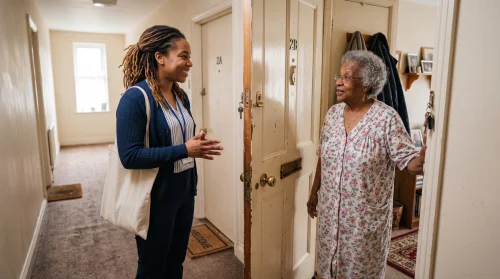
Repairs are raised through the contact centre or, for around 150 common job types, by customers themselves through the online portal. The job then goes directly to the engineer, who contacts the customer to agree a mutually convenient appointment.
“That point of contact really helps establish a rapport between the customer and the engineer. It can also help partially diagnose the issue in advance of attendance.” George Temple
A plumber discussing a slow leak on a toilet, for example, can establish beforehand whether the problem is likely to be the ball valve or the diaphragm, and make sure the right part is in the van. That conversation is a large part of why the right first time rate is so high.
Many tradespeople have worked in the same homes for years and know the households well. Once on site, they are encouraged to ask whether anything else needs attention. A joiner fixing a kitchen drawer front might check the hinges on the other units or a faulty window handle, so one job number can cover three or four tasks and the customer avoids another call to the contact centre.
Jenny, who has managed DLOs and worked on the contractor side, recognised the frustration this approach removes.
“The biggest challenge has always been: why are all these people telling us what we need to do? I know those homes. I know pretty much what’s in them. Turning up and it’s not the job you thought, so you haven’t the materials or not the right trade is soul destroying when you feel like you are not achieving anything for the day.” Jenny Danson
Removing friction from the working day
Small changes to how materials are sourced have released significant time. Working with its local supply partner, Jewson Partnership Solutions, the service has introduced the Avail app, an online ordering catalogue that tradespeople now use as their main route for ordering materials and replenishing van stock. It removes the need to drive between merchants across a large service area.
New equipment has supported the change. A SkyVac gutter vacuum system has markedly increased productivity on gutter clearance, to the point where the team now carries out proactive gutter cleans in streets with a high number of deciduous trees. Demand arising from overflowing gutters has fallen as a result.
Using data to develop people
Turnover across Property Services is low, from tradespeople through to team leaders and assistant delivery managers, and much of the promotion is from within. A team leader academy helps tradespeople who want to move into an office-based role, building their confidence with technology before they make the step.
One delivery manager has introduced an anonymised leaderboard into Performance Development Conversations. A joiner can see where they sit among the 20 joiners on the team, alongside measures such as jobs completed per day and average cost per job, while every other name remains greyed out.
Independent customer satisfaction feedback, gathered through Sabio, is used in the same spirit. It allows managers to recognise tradespeople who consistently receive strong feedback, support those whose scores are lower, and spot wider trends. Jenny asked whether there was any link between the number of jobs a tradesperson completes and the satisfaction they receive; it is a question the team is now looking into.
Breaking down silos
Property Services sits within the Customer and Communities directorate, alongside Customer and Wellbeing and Customers and Neighbourhoods. George describes the aim as being to “smash those silos”.
With the assets team, there is now a clear shared understanding of what counts as capital and what counts as revenue work, and which hazards can be resolved through planned programmes. That matters as the kitchen replacement programme grows towards around 3,000 homes a year.
With housing and neighbourhoods colleagues, the service works on legal access and on identifying “silent customers”. Last year only around 30 to 40 households across the whole stock had not engaged with the organisation in any way over twelve months, with no gas service, electrical test or other contact. Each was then offered a targeted, proactive tenancy visit.
George also chaired work with Wakefield Council and West Yorkshire NHS to bring together health, council and housing data. The analysis identified one community in the former mining village of Featherstone where COPD and damp and mould appeared together among Vico Homes customers, and 667 homes have been identified for targeted contact. The planned improvements team is now leading engagement with those households, inviting them to come forward rather than imposing inspections or works.
What others can take from it
None of these changes relies on a single piece of technology. Together they reflect a consistent view: that trusted, well supported tradespeople who know their homes and their customers will deliver a faster and more reliable service, and that removing small frustrations from their day pays back many times over.
Healthy Homes Hub will continue to share examples of practice like this from across our membership. If your organisation has made changes to its repairs service that others could learn from, we would be glad to hear from you.
Image credit: George Temple
Unlock all content
This is the 1 of 3 articles you can access for free. Become a member to unlock unlimited access to our full content library.