

Health Risk Has No Owner in Most Housing Associations
16th September 2026
Jenny Danson
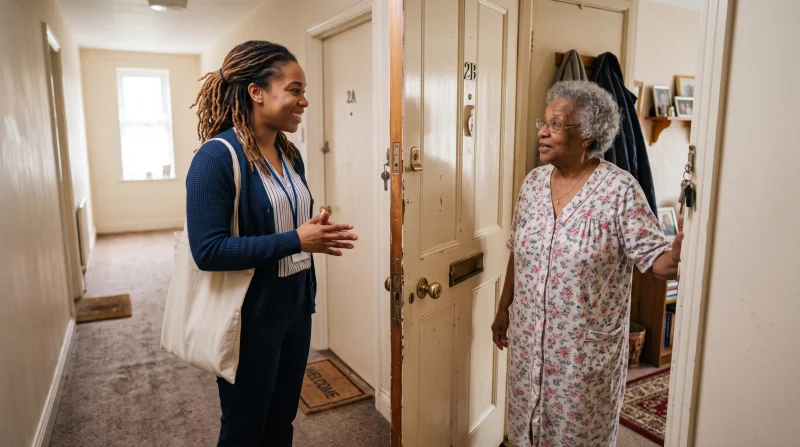
Evidence from two new strategic roles suggests that without dedicated accountability for resident health outcomes, risk accumulates silently across organisational silos.
At a glance
Both Riverside and Bromford Flagship Live West have created dedicated healthy homes posts placed within strategic asset management but explicitly designed to bridge reactive delivery and long-term investment planning, a combination that neither function currently achieves on its own.
Both roles are designed to give someone protected space to analyse how investment decisions affect resident health, a function that cannot happen inside a service structured entirely around operational targets and closure rates.
Both practitioners argue that health and dignity in the home should never be treated as optional, and that the sector needs both the courage to invest, replace or rebuild rather than patch indefinitely, and a national framework that puts health, not just warmth and EPC, at the centre of housing investment.
Most housing associations can tell you how long a repair took. Fewer can tell you whether the home is healthier as a result.
That gap is not accidental. It reflects how housing organisations are structured, what they measure, and who, if anyone, is responsible for the connection between building condition and the health of the people living in it. Two new roles, at Riverside and Bromford Flagship Live West, are a direct response to that accountability gap.
What the structure currently produces
Repairs, compliance, planned works, asset strategy, neighbourhoods and income teams each carry defined responsibilities and reporting lines. That division is a rational response to regulatory and operational pressure. It also makes it very difficult for anyone to hold a whole-picture view of a single resident’s home.
Recall rates, repeat visits to the same address and complaint volumes that track specific properties rather than specific repairs all point to a model that treats symptoms without resolving underlying conditions. Awaab’s Law has placed a statutory framework around some of those failures, but the structural conditions that produce them predate any single piece of legislation. Teams under operational pressure cannot step back to ask bigger questions about what a home is doing to the person living in it. That thinking requires space that the current model does not provide.
Placement as a design decision
Both organisations placed their healthy homes function within strategic asset management. The intent was not to remove it from day-to-day delivery but to create a role that bridges both.
At Riverside, the role is described as straddling investment strategy and reactive repairs. The postholder works closely with damp and mould teams, heating teams and repairs operatives, learning the pressures they face and finding where change is achievable. Work on ventilation illustrates the approach: rather than treating maintenance as a standalone compliance task, air quality outcomes have been connected to the investment programme across teams that would not otherwise share that framing.
At Bromford Flagship Live West, the role follows the same logic. Formed by combining the former disrepair and damp and mould teams, the healthy homes function brings operational delivery directly into the structure, covering stock condition surveying, planned works and hazard case management under HHSRS, with close links to neighbourhoods, occupational therapists and adaptations. Sitting under strategic asset management while leading delivery teams gives the role access to long-term planning data and direct accountability for what happens on the ground.
A deliberate feature of both roles is that they create space for longer-range thinking about how investment decisions affect resident health. At Riverside this is formalised: the role carries no operational targets. The principle, that someone needs distance from day-to-day operational pressure to ask what the work is actually achieving, applies to any function designed to bridge strategy and delivery.
What changes when the question changes
The operational impact of this reframing is concrete. A family in Cannock had reported a recurring kitchen leak for months. Successive visits each produced a repair. The underlying source was not found. The family’s circumstances, including a child with autism for whom disruption to routine was acutely distressing, were not factored into how the case was managed. The job would be logged, worked on and closed. Then reopened.
When the case was reviewed by the healthy homes team, the starting question was different: what does this household need in order to live well in their home? A surveyor found the missed defect. The family was moved temporarily while substantive work was carried out, and a planned kitchen replacement was brought forward. The repair cycle ended. The family felt heard, possibly for the first time in months. Trust, which had been eroding through every failed visit, was restored.
This is not a resource-intensive model. It is a question of who holds accountability for the outcome, and whether the organisational structure gives them the authority and information to act on it.
The case for honesty and strategic vision
Both practitioners, when asked what single change would make the biggest difference to residents’ health, pointed beyond organisational practice to wider failures of will and policy.
The view from Bromford Flagship Live West centred on honesty. The sector needs to evaluate its homes clearly and act on what it finds. There are homes that no longer meet the standard residents deserve, and the response should be investment, replacement or rebuilding, not indefinite patching. Health and dignity in the home should never be optional, a framing that sits largely outside the regulatory and investment frameworks the sector currently operates under.
The view from Riverside was structural. The current policy environment is built on compliance metrics and EPC ratings. These drive necessary improvements but they are fragmented, and that fragmentation plays out in how landlords plan and invest. A national strategic vision that embeds health, rather than just warmth or energy performance, at the centre of housing investment would give the sector a common framework to plan against. The Warmer Homes Plan points in that direction but its scope does not yet extend to the full range of conditions that determine whether a home supports resident health.
For the Healthy Homes Hub, these arguments are connected. Honest assessment of stock, combined with a policy framework that makes health outcomes central to investment decisions, would shift the sector from managing symptoms to preventing them. The structural question raised by both roles applies to every housing association, not just those with a named post.
Practical steps for housing providers
Map where health sits in your organisation. Identify which team, if any, holds a complete picture of building condition, resident vulnerability, repair history and outcomes. If no one holds that picture, that is the starting point.
Review how repairs teams are measured. If KPIs focus on speed and closure rates, examine what they are not capturing. Rising recall rates and repeat-visit patterns on the same properties signal that root causes are not being resolved.
If making the case for a dedicated function, consider both placement and scope. Access to long-term investment planning matters, but so does direct connection to reactive delivery. A role that bridges both is more useful than one anchored to either side alone.
Examine whether any function in your organisation currently has protected space, free from operational targets, to analyse how investment decisions affect resident health outcomes. If not, consider how that analysis gets done and by whom.
Evaluate stock condition with honesty. Where homes no longer meet a standard that supports resident health and dignity, the response needs to be investment, replacement or rebuilding, not repeated short-term repairs.
Ensure ventilation and air quality are treated as health and compliance priorities, connected to the investment programme rather than managed as standalone maintenance tasks.
Review how cases involving repeat visits or unresolved complaints are assessed. A case management approach that starts from resident need, rather than repair specification, may resolve long-running issues that the standard model is not designed to close.
Image credit: Adobe Stock
Unlock all content
This is the 1 of 3 articles you can access for free. Become a member to unlock unlimited access to our full content library.