
Predicting Damp Before It Spreads
17th March 2026
Jenny Danson

What better data and analysis could change about how housing providers prevent damp and mould.
Damp and mould are not new problems in UK housing. What has changed is the level of scrutiny and expectation around how landlords identify, assess and prevent harm. Health is now central to housing regulation and operational decision making, rather than a secondary consideration.
Recent research led by Professor David Glew and Dr Adam Hardy at the Leeds Sustainability Institute highlights why this shift matters. Their work focuses on how damp and mould are currently surveyed, how risk can be predicted using existing housing data, and what this means for healthier homes at scale.
The findings raise important questions for housing providers about data quality, professional practice and the limits of technology when used in isolation.
Surveying damp and mould remains inconsistent
One strand of the research reviewed professional damp and mould survey reports used by housing providers. The results showed significant variation in approach, depth and confidence.
Some surveys were detailed and evidence based. Others were brief and heavily reliant on individual judgement. Even among experienced surveyors, there was little consistency in how underlying causes were identified or recorded.
Dr Hardy notes that surveyors were generally confident diagnosing visible mould, but far less certain about why it had formed. In many cases, reports used vague language, such as “may be caused by”, without clear conclusions.
For landlords, this creates a structural problem. Investment decisions, remediation strategies and resident communication can all hinge on survey outputs that are not standardised or comparable.
While best practice guidance for damp surveys already exists, the research found it is often seen as too complex or time consuming to apply in day to day operations. This creates a gap between what is theoretically recommended and what is practically delivered.
The implication is not a lack of effort, but a lack of alignment. Without a clearer, more practical standard approach, data coming into organisations will continue to be variable.
Using existing data to predict risk
The second part of the research explored whether damp and mould risk could be predicted using data housing providers already hold, rather than relying solely on in home sensors.
Using historic remediation records alongside EPC data, the research team trained a machine learning model to identify patterns associated with damp occurrence. The model produced a risk score for individual homes, predicting the likelihood of damp before it becomes visible or severe.
The results were strong. The model was able to distinguish higher risk homes with a high degree of accuracy, even using imperfect data sources such as EPCs.
Importantly, the model did not assume that poorer EPC ratings automatically equate to higher damp risk. In fact, some better rated homes also showed elevated risk, particularly flats, where ventilation performance is often weaker.
As Dr Hardy explains, the algorithm does not “know” what an EPC band represents. It simply identifies patterns in the data. This helps avoid assumptions and exposes where intuition does not match reality.
The research also highlighted the limits of current datasets. Occupant behaviour, household size and heating practices were not included, largely because this data was not available in a usable form. The team sees this as a critical next step.
Sensors are useful, but not sufficient
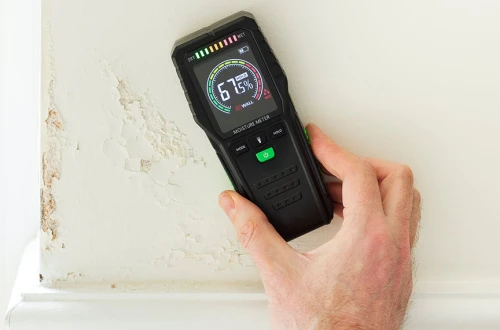
The discussion around damp and mould increasingly includes sensors and remote monitoring. While these tools can add value, the research cautions against treating them as a standalone solution.
Sensors can be moved, incorrectly placed or poorly interpreted. Without validation and context, they risk providing false reassurance rather than meaningful insight.
Professor Glew is clear that sensors should be part of a wider toolkit, not a substitute for professional judgement or asset knowledge. “Installing sensors does not discharge responsibility,” he notes. “They need to be interpreted properly, alongside other data.”
There is also a cost consideration. At scale, whole stock sensor deployment is expensive. Using existing asset and repair data to target intervention may deliver greater value, particularly where resources are constrained.
Measuring what residents breathe
A further strand of work looks beyond visible mould to airborne mould spores. Using air sampling devices, the team measured mould and bacteria levels inside homes before and after remediation and ventilation upgrades.
Early results show elevated spore levels in many homes, exceeding reference thresholds used in other environments. While there is no agreed domestic standard, the findings underline the potential health implications of poor indoor environmental quality.
The research also highlights how variable airborne mould levels can be, changing with ventilation, weather and activity. This reinforces the need for careful interpretation and repeated measurement rather than one off testing.
What this means for housing providers
Taken together, the research points to a clear conclusion. Preventing damp and mould is less about finding a single technical fix and more about improving the quality, consistency and use of data.
Standardised surveys, organised asset data and proactive analysis create the conditions for earlier intervention. Technology can support this, but only where it is part of a clear strategy.
Behaviour also matters, but it must be supported by the home itself. Asking residents to manage moisture without providing adequate ventilation or realistic options simply shifts risk rather than reducing it.
Practical steps for housing providers
Review damp and mould survey templates to ensure they are consistent, practical and focused on identifying root causes.
Invest in organising existing asset, repair and remediation data so it can be analysed and compared across stock.
Use predictive analysis to prioritise inspections and interventions before damp becomes severe.
Treat sensors as decision support tools, not proof of compliance, and ensure there is capacity to analyse the data they generate.
Focus on everyday design and maintenance details, such as ventilation, furniture layout and moisture management, that directly affect residents’ health.
Damp and mould prevention is increasingly about anticipation rather than response. Better data, used well, gives housing providers the opportunity to act earlier and deliver healthier homes by design, not by chance.
Unlock all content
This is the 1 of 3 articles you can access for free. Become a member to unlock unlimited access to our full content library.