
Rethinking Who 'General Needs' Housing Serves
22nd September 2026
Jenny Danson
Amplius and Harry's Pledge are pushing housing providers to mainstream accessibility into everyday relets and employment policy, not treat it as a specification reserved for new build.
At a glance
General needs housing is designed around an assumed customer without significant mobility, sensory or care needs, even though around 25% of people report a disability.
Around 100 organisations have committed to Harry's Pledge since it launched five years ago, each choosing which of four commitments on accessible design, workplace flexibility and carer support it can meet.
Research published in 2024 found that more than 40% of parents of disabled children have thought about suicide, prompting the charity Harry's Pals to match parent carers with counsellors at the point of crisis.
General needs housing is designed around an assumed customer, typically someone without significant mobility, sensory or care needs. Around 25% of people report having a disability, and only around 8% of homes are estimated to be visitable. The effect reaches beyond the household directly affected. It limits who can visit a disabled resident, and who that resident can visit in turn, including elderly relatives who depend on being visited rather than travelling themselves.
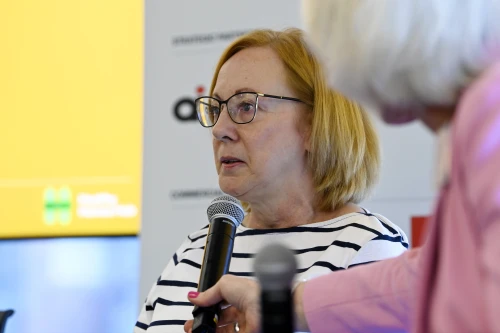
Julie Doyle has spent more than 30 years in the sector and now leads Amplius, formed through the merger of Longhurst Group and Grand Union. Her grandson Harry, now 11, has profound disabilities following strokes at birth, and needs equipment and care around the clock. The family's terraced home in Coventry could not accommodate that equipment, or the wheelchair access Harry would need as he grew, and carers visiting to help left little space that felt separate from his condition.
Redefining what 'general needs' actually means
Amplius is applying an accessible lens across its existing stock, not only new development, treating this as future proofing rather than provision for a narrow group. Low cost, discreet fittings, a reinforced fixture that doubles as a grab rail, a planter that doubles as something to hold on to, are becoming standard in relet properties rather than reserved for individual adaptations. Some organisations signed up to the pledge have introduced internal champions who review services and buildings through this lens, and accessibility is beginning to be tracked as a performance measure alongside completion numbers, though this remains uneven across the sector.
The reasoning extends beyond residents who currently identify as disabled. A resident recovering from a hip or knee replacement, or a parent managing a buggy on the doorstep, benefits from the same low cost fittings.
Amplius has recently been named a strategic partner to Homes England to deliver 1,000 homes a year, a scale at which the balance between volume and accessibility becomes a live investment choice rather than an abstract principle.
From a Healthy Homes Hub perspective, this points to a shift already underway in stock condition. Accessibility becomes a routine feature of relet standards, not an adjustment made only once a resident's needs become acute.
A pledge organisations can commit to on their own terms
Harry's Pledge asks organisations to commit to what they can manage across four areas, building and adapting homes beyond minimum accessibility standards, supporting employees with caring responsibilities, making workplaces and offices accessible, from hearing loops to step free access, and backing campaigns on disability and care. None is compulsory. Around 100 organisations have signed up since the pledge launched five years ago.
An early campaign for Changing Places toilets, facilities large enough for a hoist and an adult changing bench, made enough progress to shift the pledge's main campaigning focus. Around a quarter of a million people need access to one, without which trips out are limited by fear of an accident. An all party parliamentary group backed by the pledge is now seeking government funding for counselling for parents given a diagnosis that their child's life will be short or life limiting.
The workforce case for flexibility
The workplace strand of the pledge responds to a demographic reality as much as a measurable loss of staff. Around one in six people will become a carer at some point in their life, often while remaining in paid employment. Carers UK puts the figure at around a quarter of a million carers leaving employment each year, often highly skilled people who cannot get enough flexibility to combine paid work with caring. Charlesworth left a marketing role after her employer would not adjust her hours following Harry's diagnosis, and now audits organisations on their carer friendly policies. The changes asked for are typically modest, job shares, adjustable hours, and the ability to attend medical appointments without using annual leave.
Support at the point of diagnosis
Harry's Pals, the charity Charlesworth set up after struggling to find counselling support following Harry's diagnosis, matches parent carers with counsellors, often at the point of crisis and via referrals from hospitals and hospices. Research published by the University of Birmingham in 2024 found that more than 40% of parents of disabled children have thought about suicide, and one in 12 have made a plan to end their life.
None of this depends on new legislation. It depends on providers treating accessibility, adaptation timeliness and carer flexibility as ordinary measures of performance, not exceptions handled case by case.
Practical steps for housing providers
Build accessibility features into void and relet standards, not only new build specifications.
Track accessibility as a measure of performance, alongside completion numbers, in development and improvement programmes.
Clarify statutory responsibility for adaptations with local authority and social care partners, so families are not left waiting years for a decision everyone already agrees is needed.
Review the flexibility offered to staff with caring responsibilities, including job shares and adjustable hours. Carers UK research on the workforce cost of inflexibility: carersuk.org
Build referral relationships with charities that support parent carers at the point of crisis. Harry's Pals: harryspals.co.uk
Draw on research into parent carer mental health when designing support pathways. University of Birmingham study: birmingham.ac.uk
Consider signing Harry's Pledge, a free commitment that lets organisations choose which of four areas, accessible building, workplace flexibility, accessible offices and campaigning, they can act on: harrys-pledge.org.uk/sign-up
Unlock all content
This is the 1 of 3 articles you can access for free. Become a member to unlock unlimited access to our full content library.