
Behind the Front Door: Maria McCafferty’s Story
24th June 2026
Jenny Danson
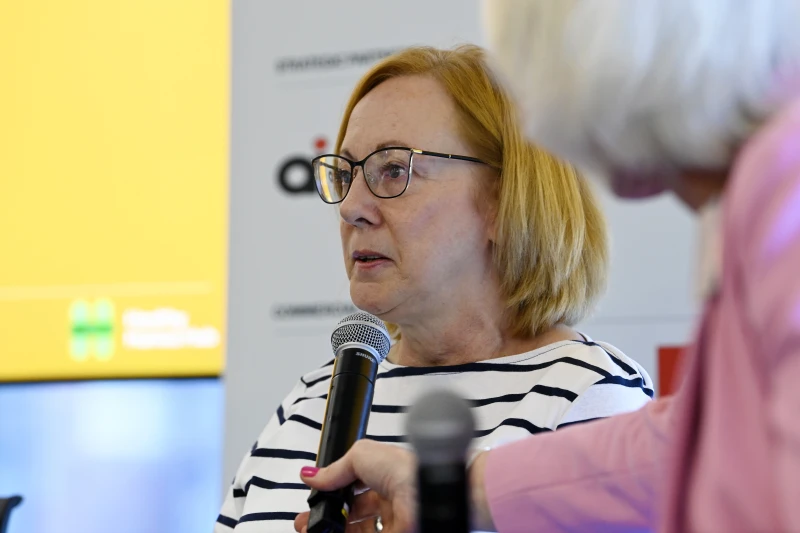
At the start of every Healthy Homes Hub Ideas Exchange, Jenny Danson likes to ground the room in the reason everyone is there. The sector talks a lot about funding gaps, about stretched resources, about strategic asset management strategies. All of it matters, but none of it means very much if it does not change what happens behind somebody's front door.
So the day began with Maria.
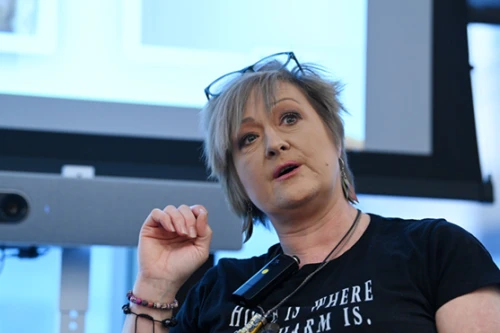
Maria has been a social housing tenant for 36 years, living in the same home in Scotland. It takes real courage to sit on a stage in front of a room full of professionals and talk about something this personal, but everyone there was willing her to do it.
It was not easy for Maria. She explained that she was nervous, and there were moments on stage where she had to stop and gather herself before continuing. That struggle to find the words mattered as much as the words themselves.
Maria had a stroke at 21. She has has arthritis in her hands. The things many people never stop to think about, tying a shoelace, opening a window, getting out through a front door, have become daily obstacles for her. She described what that does to a person over time, and that she feels like a prisoner in her own home.
Falling through the gaps
It was not necessarily any single failure but the space between the systems meant to help. In England, someone in Maria's position can in principle look to the Disabled Facilities Grant. In Scotland there was no equivalent route that worked for her. She has been waiting for an occupational therapist assessment since September. Those who work in housing know how long these backlogs can run, and behind every day of delay is a person whose world is quietly getting smaller. Each part of the system was, in its own way, trying to do the right thing, but people still falling through the gaps between them.
Maria said she understood that housing used KPIs, but she reminded everyone that behind each one is a person. A missed target is not an abstraction. It is somebody waiting since September for an assessment, somebody who cannot open a window, somebody whose hands hurt too much to open their front door. The sector measures performance in numbers because it must, but it should never forget that the number is Maria.
Waiting for a home that works
Maria is also on the waiting list for an adapted home, and has been for a long time, made longer by how few adapted properties exist and how rarely they become available. She compared her situation to COVID, except that her version has no end date. The isolation, the loss of contact with the outside world, the sense of being shut in, all of it has simply become how she lives now.
Maria told Jenny she feels she has lost both her independence and her dignity. The two travel together. When someone cannot leave their home on their own terms, something more than mobility is taken away.
Owning her own home was never an option either. Maria said she could not get a mortgage, and that shared ownership was not realistic for her circumstances. She was direct about what that means for people like her: there needs to be more housing built and adapted specifically for people in her position, not as an afterthought but as a part of supply.
Small changes, life-changing impact
Asked what would change if the system worked the way it should, Maria's answer was not a great ask. Electronic openers on doors that did not make a noise and disturb her neighbours every time she closes her door. Windows that are easy to open. Simple technology and sensors built into the home so that support can reach her. Most of it is the kind of thing that, designed in from the start, would barely register as a cost.
The population is ageing, and the homes built and adapted today need to be ready for the people who will live in them tomorrow. Opening a door should never be the thing that decides whether somebody can have a life and stay connected to the people around them.
The person behind the strategy
A conference stage cannot solve everything Maria is facing. What the sector can do is refuse to let her experience stay invisible while their strategies move forward. The funding models, the asset plans, the technology partnerships, they only earn their place if they reach the person on the other side of the front door.
Unlock all content
This is the 1 of 3 articles you can access for free. Become a member to unlock unlimited access to our full content library.