
NHF Board Leadership Conference Reflections: Climate Risk, Governance and the Homes We Are Responsible For
12th March 2026
Jenny Danson
I left the National Housing Federation Board Leadership conference with a mixture of reassurance and unease.
Reassurance because the conversation has moved on. Climate change is no longer being spoken about as a distant environmental issue or a technical bolt on to net zero plans. It is firmly in the room when we talk about risk, governance and long term organisational stability.
Unease because, if we are honest, most of us are still finding our feet.
The session began with a poll asking how confident people felt about their organisation’s approach to climate related risks. The majority sat somewhere in the middle. Progress is being made. But very few felt completely confident.
That feels about right.
Climate change as a health and board level issue
Climate change is now being framed as both a health issue and a board level issue. The regulator’s sector risk profile now explicitly references extreme weather alongside transition risks linked to the move to net zero. That shift matters. When something appears in the regulator’s risk profile, it stops being theoretical.
The figures shared in the session were sobering. Around 6.3 million homes are currently at risk of flooding, rising to 8 million by 2050. Importantly, the nature of flooding is changing, with more emphasis on surface water flooding. That means homes that have never historically flooded may now find themselves vulnerable. On overheating, research following the 2022 heatwave showed that the vast majority of homes experienced overheating. What we once described as unprecedented will soon become typical. There is even credible modelling suggesting that excess summer deaths could overtake excess winter deaths within the next few decades.
For those of us working in housing and health, that should make us think.
The healthy home of the future
We have rightly focused on cold homes for years. But the climate dial is shifting. If we do not prepare for overheating, for flood recovery, for mental health impacts after extreme weather, then we are not truly safeguarding residents’ wellbeing. A healthy home in 2035 will need to cope with very different environmental pressures than a healthy home in 2005.
There is also a harder edged economic reality to this conversation. Climate risk is not just about damaged homes and disrupted lives. It is about borrowing costs, insurance premiums, material shortages and energy volatility. The estimate that the UK could see a significant loss in GDP if warming continues beyond 1.5 degrees may feel abstract, but the consequences are not. We have already experienced what energy insecurity can do to inflation and to household budgets.
For housing providers, that translates directly into rent arrears, cost pressures and financial strain.
In other words, climate risk does not sit neatly alongside other risks. It amplifies them.
What good governance looks like
Good governance in this space is less about technical mastery and more about integration. Where do climate risks sit within the risk register? Are they regularly discussed in audit and risk committees? Do they meaningfully influence asset strategy, regeneration decisions and financial stress testing? Or are they still largely confined to sustainability teams and annual strategy documents?
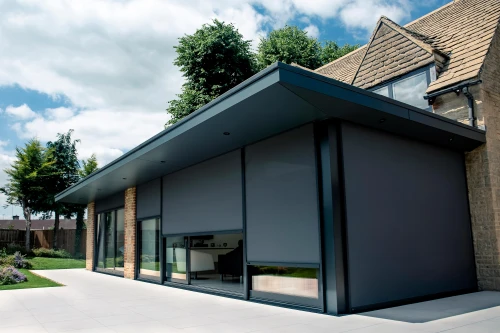
The distinction between decarbonisation and resilience is particularly important. Installing heat pumps reduces emissions, but it does not make a home flood resilient. Improving insulation supports energy efficiency, but without ventilation and shading we may exacerbate overheating. The future of retrofit cannot be one dimensional. Health, carbon and climate resilience need to be considered together, in one coherent conversation.
Availability and interpretation of data
Data is now far more publicly available on flood risk and heat exposure than many boards realise. (We have many examples in our Geospatial Hub). The challenge is not just access, but interpretation and application.
Understanding where you have strong data, where you have gaps and where you are relying on assumptions is a great starting point. And we should not underestimate the value of resident insight. In flood prone communities in particular, lived experience often tells a richer story than historic models.
Will boards start to consider disposing of homes in high risk areas? We are not seeing widespread evidence of that yet, but the fact that the question is being asked signals how seriously climate risk is now being taken. These are not easy conversations. But avoiding them would not be responsible governance.
Key takeaways - a maturing and broadening mindset
So what do I take from all of this?
Firstly, that the sector has matured in its climate conversation. We are no longer talking solely about carbon targets. We are talking about physical risk, economic resilience and long term viability.
Secondly, that confidence will grow not from having all the answers, but from consistently asking the right questions. Where are we clear? Where are our blind spots? Are climate related risks genuinely influencing the decisions that shape our homes and communities?
And finally, that this is fundamentally about health. If a home cannot cope with heat, flood or energy instability, it cannot truly be described as healthy. Climate resilience is not an environmental add on. It is part of our duty of care.
The climate is changing whether we feel confident or not. The question is whether our governance is changing quickly enough to keep pace.
Unlock all content
This is the 1 of 3 articles you can access for free. Become a member to unlock unlimited access to our full content library.