Where Housing Providers Shape What Residents Eat
27th October 2026
Jenny Danson
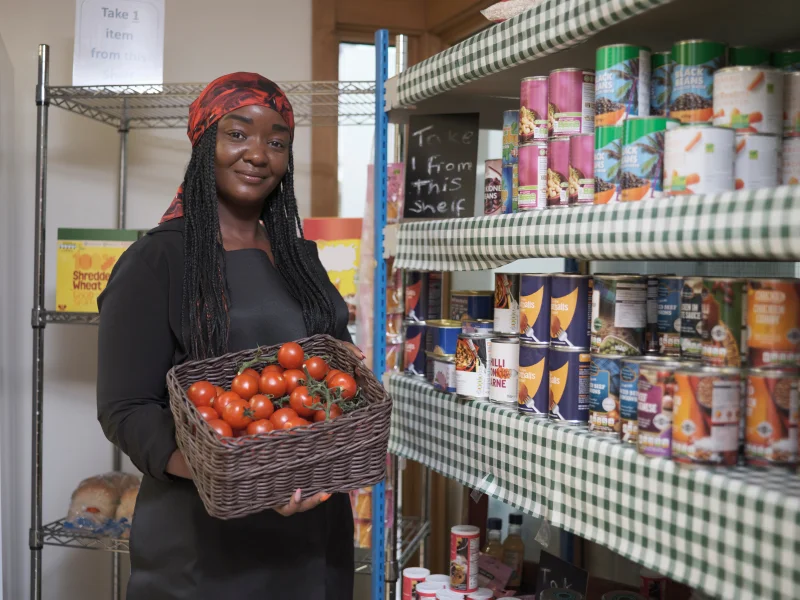
Shop ranges, storage, cooking facilities and unused community space raise the cost of eating well for households on the tightest budgets, and housing providers influence several of them.
At a glance
Eating well costs more for households on the tightest budgets because of the food landscape around an estate, including the range in local shops, transport, storage and cooking facilities, and community kitchens that are locked.
Food Ladders, a framework developed at the University of Sheffield, sets out three rungs of support: crisis relief, capacity building and community-led projects. Capacity building prevents crisis and has the least provision.
Councils deliver the Crisis and Resilience Fund, so the local council is the first point of contact for housing providers who want to pool resources rather than start new schemes.
Estate layout and shop ranges set the cost of a meal
Food security depends on more than income. A household also needs a shop it can reach, a range of fresh food at a price it can afford, and the means to carry, store and cook what it buys. Together these make up the food landscape around a home: the transport, retail and social infrastructure that determines what food reaches a household.
Estate design shows how this works in practice. On one Sheffield estate, the lifts stop at alternate floors, so residents rarely meet neighbours on other levels. Wide lawns separate the blocks and cannot be used for play. The nearest shops, including a small supermarket with a shelf or two of fruit and vegetables, stand at the edge of the estate.
For an older resident, that means a lift that may not be working, a long walk across open ground and a heavy load home. Residents who do not know their neighbours can also find the journey less secure.
Shelf space in shops of this kind reflects margins as well as demand. Processed foods and snacks earn more and keep longer than fresh produce. Households under financial pressure buy what is cheap, quick and easy to carry, which is often less healthy, and food comes to be treated as fuel.
Cooking and storage facilities add a price premium
Some social housing tenants cannot afford a gas standing charge, and some homes come without a cooker, leaving a kettle and perhaps a microwave. Many small flats have no freezer, so food cannot be cooked in advance and kept.
Buying in bulk lowers the cost per portion, but only for households that can afford the larger pack. Smaller packs cost more per portion.
The stress of finding food, and of feeding others, is compounded by isolation, because there is no money left for eating with other people.
Food Ladders organises support in three rungs
Food Ladders is a framework developed by Dr Megan Blake, Senior Lecturer in Human Geography in the School of Geography and Planning at the University of Sheffield. It organises support in three rungs.
The first is crisis support for people without enough to eat now. The second, capacity building, is for households that have enough this week but could tip into crisis after one setback. It includes food clubs that stretch a budget, help with cooking and benefits, and shared meals that introduce new foods without risk and build links between neighbours. The third is self-organised transformation, in which residents decide what would improve their area, whether an allotment on unused grass or a craft session.
The side rails of the ladder are the local authority, the local food partnership and housing associations. They provide structure, step in directly at the bottom and assist higher up when asked. The approach starts from what residents already have and need, rather than requiring households to demonstrate failure before help is offered.
Capacity building is the rung that prevents crisis, and it is the one with least provision. A toolkit for local authorities and local food networks was launched by the University in September 2024.
Food events as a route to health and benefits advice
Food is also an entry point. A food club, a meal or a barbecue brings residents through the door, and conversation follows. Those events can carry health information, such as hearing tests and blood pressure checks, and advice on benefits that residents may not know they can claim.
The interventions are modest: a community coordinator, a small discretionary budget and a space that is not locked. Some community rooms and kitchens sit empty because access is controlled by a gatekeeper, after earlier users did not look after them. Space that residents can use, and feel ownership of, is more likely to be looked after.
Demand on local provision is not expected to fall
Food insecurity has eased from its recent high but remains widespread. The Food Standards Agency's Food and You 2 survey found 25% of adults in England, Wales and Northern Ireland food insecure between October 2022 and January 2023. The wave with fieldwork from May to August 2025 found 21%.
Most food bought for eating at home in the UK comes from supermarkets. Climate pressure on crops adds risk to prices, and households with the smallest budgets have the least room to absorb them.
Where housing providers can act
Councils deliver the Crisis and Resilience Fund, which combines preventative support with help in a financial crisis. It was introduced in England in April 2026. The local council, usually through its public health team, is the first point of contact for housing providers who want to pool resources rather than start new schemes.
Provision already runs in many areas. A new food club a street away from a running one adds little, and one of the most useful contributions a landlord can make is a room for an existing organisation to host a food bank or food club.
From a Healthy Homes Hub perspective, kitchen facilities, storage and the use of communal space are housing decisions with direct consequences for diet, isolation and health. Housing providers control many of the places where communities could meet, and some of those places are locked.
Practical steps for housing providers
Contact the local council, starting with the public health team, to find out how the Crisis and Resilience Fund is being used locally and whether resources can be pooled.
Find out what already exists before building anything. Local food partnerships are listed by nation: https://www.sustainablefoodplaces.org/members
Walk the estates and note which community rooms, kitchens and open spaces are locked, who holds the keys and who would use them if they felt ownership.
Offer space to an organisation that already runs food provision, rather than setting up a new service.
For larger estates, consider funding a community coordinator to connect residents with local food activity, the council and advice services.
Use food events to share health and benefits information, such as blood pressure checks, hearing tests and benefits advice.
Review the kitchen facilities homes provide, including a cooker and somewhere to store food.
Food Ladders framework and toolkit for local authorities and local food networks: https://geofoodie.org/food-ladders-toolkit-welcome/
Image credit: Adobe Stock
Unlock all content
You have reached your limit of 3 articles. Register for FREE to keep reading.