

Designing Estates Where Children Belong
21st April 2026
Jenny Danson
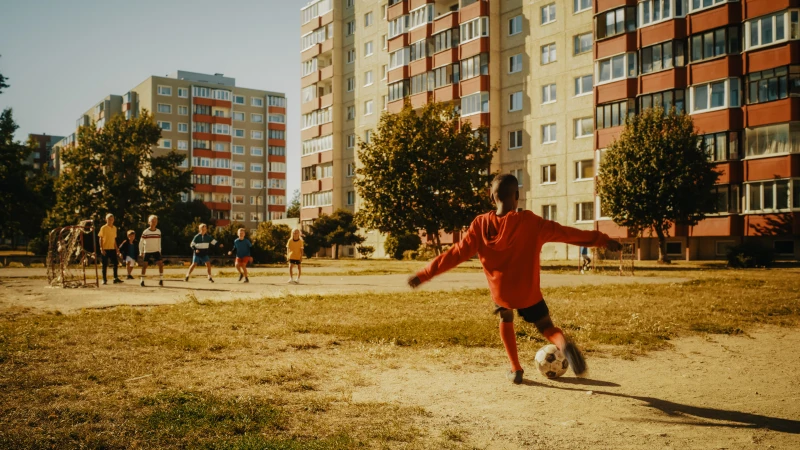
Housing providers shape not only homes but the social and physical conditions that determine whether children can play safely where they live.
The conversation about healthy homes often centres on damp, ventilation, overheating and decarbonisation. These are essential issues. But the space immediately outside the front door is equally influential in shaping long term health outcomes.
Alice Ferguson, co-founder of Playing Out, and campaigner Jasmine argue that children’s everyday play has been unintentionally designed out of many neighbourhoods.
For housing providers, this is not a marginal concern. It goes to the heart of prevention, equity and community resilience.
From play streets to estate policy
Playing Out began 17 years ago with a simple intervention: short term street closures to allow children to play safely near home. The model demonstrated demand and feasibility. It also exposed a wider truth. In many neighbourhoods, independent outdoor play had already become unusual.
The play street approach was never intended as a permanent solution. It was a practical way of showing that children want to use the space outside their homes and that communities can accommodate that use when the environment allows it. Over time, the initiative evolved into a broader challenge to what Ferguson describes as “no ball game culture”, a pattern of signage and policy that treats active play as a management problem.
That culture is not confined to streets. On housing estates, particularly those built at higher density, shared outdoor areas often sit at the centre of tension. Courtyards and communal gardens are marketed as amenities, yet when they are used energetically by children, objections can follow. Landlords are then required to respond.
The most common visible response is the installation of “no ball game” signs or reminders that nuisance clauses apply in shared areas. These measures may appear minor, but they send a clear signal about how space is expected to function.
When rights frameworks collide
The debate sits at the intersection of two legal and policy principles.
Article 31 of the United Nations Convention on the Rights of the Child recognises a child’s right to play and to participate freely in cultural and recreational life. The UK has ratified the Convention, and it has been incorporated into domestic law in Wales and Scotland.
The interpretation of Article 31 is explicit that children require access to appropriate physical environments in order to realise that right.
Alongside this sits the well-established right to quiet or peaceful enjoyment in housing law. Implied into every tenancy, this protects the tenant’s occupation from undue interference by the landlord. It secures undisturbed possession. It does not create a guarantee of silence between neighbours, nor does it require landlords to eliminate the ordinary sounds of residential life.
Confusion between these principles can distort decision making. Where quiet enjoyment is interpreted as a duty to prevent disturbance between residents at all costs, management responses may become disproportionate. Yet quiet enjoyment concerns landlord conduct, not the suppression of lawful everyday activity.
In practice, the tension is rarely about absolute rights. It is about interpretation, balance and leadership.
Power, complaints and proportionality
Jasmine’s experience illustrates how quickly matters can escalate. After moving into a new build development with a communal garden, families used the space as expected. As children grew older and more active, complaints were raised. Without prior consultation, “no ball game” signs were installed.
What followed was not a single disagreement but a prolonged process of complaint, escalation and internal review. The issue travelled from neighbourhood management to corporate leadership. Along the way, questions arose about lease terms, risk of liability and the landlord’s role in policing behaviour.
For households in social housing, the implications can feel more serious. Letters referencing nuisance provisions or tenancy obligations carry weight. Even where enforcement action is unlikely, the perception of risk alters how parents allow their children to use shared space.
At the same time, providers must respond to residents who feel disturbed. The challenge is not whether to act, but how. Complaints data can offer insight into patterns, whether linked to specific layouts, acoustic conditions or communication at letting stage.
Without that analysis, signage becomes a default solution.
There is also an operational dimension. Repeated complaints and counter complaints absorb staff time and resource. Proactive clarity about expectations, rights and proportionate response can reduce that cycle.
Design choices shape behaviour
Many of these disputes are foreseeable. Estate design frequently prioritises vehicle access and parking. Shared space is enclosed and overlooked at close range. Sound carries. In such environments, active play and residential sensitivity sit in close proximity.
Alternative models exist. Developments that locate parking at the edge and treat central space as genuinely communal tend to normalise children’s presence. Activity becomes part of the intended function of the estate rather than a deviation from it.
Where design does not accommodate informal play, management tools are used to regulate it. Over time, this reinforces a view of children as conditional users of shared space.
Through its ProPlay Housing Network, supported by Clarion Futures, Playing Out has worked with housing associations to review signage, tenancy wording and policy framing.
In some cases, providers have removed blanket prohibitions and replaced them with guidance emphasising reasonable use. These changes are modest but symbolically important.
A broader health question
The decline of everyday outdoor play intersects with wider public health concerns. Rates of childhood inactivity remain high. Screen time dominates leisure for many young people. Social isolation among both children and parents has become more visible since the pandemic.
For households without private gardens, the estate is the only immediate outdoor environment. Restrictions on its use therefore have unequal impact. Children in more constrained housing circumstances experience the greatest limitation.
None of this suggests that shared space can be used without consideration for others. Noise and conflict are real. But the framing of play as inherently problematic narrows the scope for balanced resolution.
Strategic implications
For boards and executive teams, the issue sits within estate strategy, asset design and neighbourhood management practice.
Are development briefs clear about the intended use of communal space?
Is tenancy language proportionate and legally accurate?
Are complaints reviewed in light of rights frameworks and design context?
Healthy residential environments depend not only on compliance standards but on how space is lived in. Children’s visibility in shared areas is one indicator of whether that environment is functioning as intended.
The question is not whether tensions will arise. It is whether organisational responses embed exclusion or manage competing needs in a way that reflects both legal duties and long-term wellbeing.
Practical steps for housing providers
Audit estate signage and tenancy clauses to ensure restrictions are proportionate and consistent with housing law.
Clarify internal guidance on the scope of peaceful enjoyment.
Analyse complaints data alongside estate layout and acoustic factors.
Integrate expectations around informal play into development briefs and neighbourhood management policy.
Align messaging across housing management, community and asset teams.
A practical resource is already available to support this work. Playing Out has published guidance for housing providers and community partners that covers how to support play near homes and address barriers in shared space.
This includes a toolkit and case examples on enabling play streets and informal activity outside the front door, alongside templates and advice on consultation and engagement.
The full resource can be accessed via the Playing Out website, where it sits alongside manuals and support material designed to help landlords and neighbourhood teams embed play-friendly approaches in estate policy and practice.
Unlock all content
This is the 1 of 3 articles you can access for free. Become a member to unlock unlimited access to our full content library.