
The Heat is on... launching our new Climate Resilience Hub
17th September 2026
Healthy Homes Hub's new hub responds to a wetter winter and a record run of summer heatwaves, helping providers prepare homes and communities for both extremes.
At a Glance
UK housing is contending with a compressed climate pattern, increasingly described as two extreme seasons rather than four, following one of the wettest winters on record and a confirmed run of five consecutive UK heatwaves this summer.
Homes designed around retaining winter heat are now also having to manage overheating, a risk the second phase of Awaab's Law is expected to bring into regulatory scope alongside its existing focus on damp, mould and underheating.
Retrofit and construction work face their own narrower temperature windows, since many building products and materials have defined ranges for safe and effective installation.
UK social housing has moved from planning for climate change to living with it. One of the wettest winters in decades has been followed by a confirmed run of five consecutive UK heatwaves and a record number of days above 30 degrees, a pattern increasingly described as two extreme seasons rather than four. The second phase of Awaab's Law is expected to extend into overheating, expanding regulatory focus beyond damp, mould and underheating. Healthy Homes Hub has launched its tenth specialist hub, a Climate Resilience Hub backed by RE:GEN Group, to treat adaptation as a present-day operational issue rather than a longer-term policy question.
The winter period brought longer drying times, damp and mould, flooding concerns and anxiety triggered by repeated amber weather warnings. Climate impacts reach beyond the home too: reduced crop yields this year, in the UK and internationally, have contributed to higher food costs, an effect not always connected back to weather at first glance.
Summer heat has created a different set of pressures. On one RE:GEN Group retrofit scheme, insulation originally fitted to retain winter heat left a resident sleeping poorly during this summer's heatwaves and worried for an elderly relative, after years of wanting the work done specifically to keep heat in. Construction teams working on such schemes have had to manage hydration breaks, seek shade and adjust access to lofts and roof spaces, since many building products and materials have defined temperature ranges for safe installation.
Homes do not operate in isolation from the networks around them. Local energy capacity, transport links, drainage and green space all shape how well a community withstands extreme weather, and housing providers, local authorities and energy companies often work to different timescales, budgets and targets. Local area energy plans offer one practical route to a shared, long-term view across a region, helping align housing investment with wider infrastructure rather than treating flooding, energy costs and drainage as separate, unconnected problems.
The Climate Resilience Hub aims to keep discussion of adaptation and mitigation focused on health outcomes for residents rather than political debate, and to make the subject accessible rather than the preserve of technical specialists or policymakers. In practice, this will take the form of regular discussion between the two hosts on live climate headlines, guest contributions from within housing and beyond, and articles and opinion pieces published on the hub's website from RE:GEN Group and other contributors across the sector.
Call to Action
Housing providers, local authorities and others working on community resilience are invited to contact the hub directly, via Andy Cameron-Smith (andy@healthyhomeshub.uk), to take part in future discussions.
Practical steps for housing providers
Review retrofit and installation specifications to address both heat retention and heat dispersal, rather than optimising for winter performance alone.
Build seasonal temperature limits into retrofit and installation programmes, since many products and materials have defined ranges for safe or effective application.
Extend site safety planning to cover sustained high-temperature working, including hydration breaks, shaded rest areas and adjusted access windows for loft and roof work.
Identify residents at greater risk from heat, including older people, young children and those with underlying health conditions, alongside existing winter cold checks.
Treat damp, mould and overheating as connected, year-round risks within stock condition surveys, rather than as separate seasonal issues.
Engage with local area energy planning processes to align housing investment with wider regional energy, transport and drainage infrastructure.
Build in regular opportunities to share lessons and setbacks with other housing providers, rather than addressing climate adaptation in isolation.
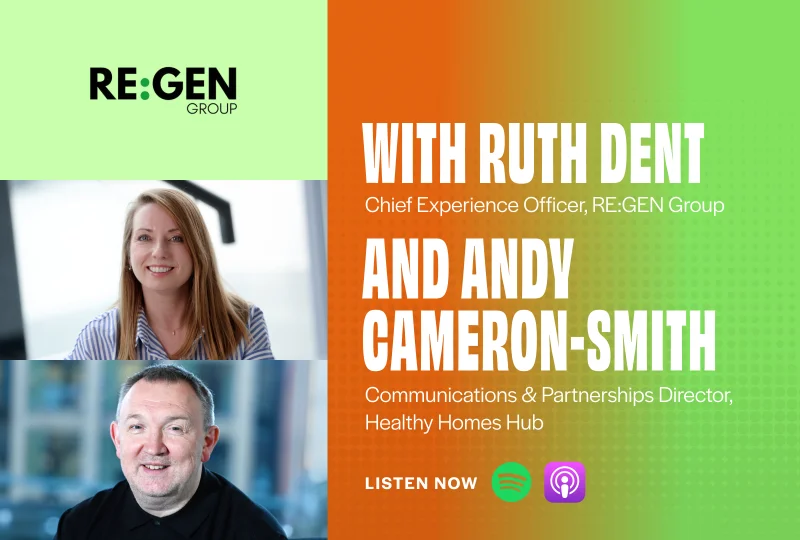
Host: Andy Cameron-Smith, Communications and Partnerships Director, Healthy Homes Hub
Guest: Ruth Dent, Chief Experience Officer, RE:GEN Group