
*SPECIAL MINI SERIES* Episode 4 of 6 What Hackney Taught Us About Retrofitting Flats
28th September 2026
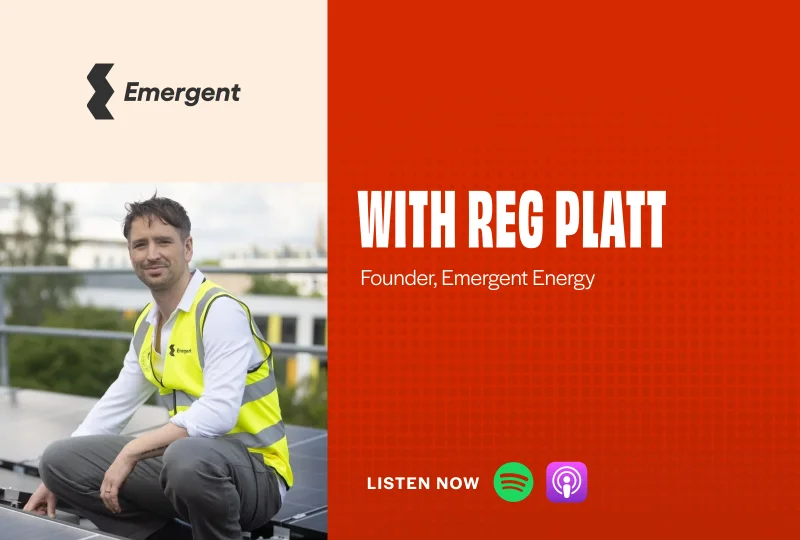
Part of the podcast series bringing Healthy Homes Hub and Energiesprong UK's playbook, 'Deploying Innovative Retrofit Funding Models in the Social Housing Sector' (also available as an audiobook), to life, on how a data led microgrid model has let Emergent Energy deliver rooftop solar savings to residents across 750 Hackney flats without any additional wiring in the home.
Host: Emily Braham, Director, Energiesprong UK
Guest: Reg Platt, Founder and Chief Executive Officer, Emergent Energy
At a Glance
Emergent Energy's microgrid model distributes the value of rooftop solar to residents in flats through a supply and billing arrangement, not physical rewiring, solving the split incentive and cost problem that has historically kept solar off retrofit flats.
The Hackney scheme, a megawatt of solar across 27 blocks and 47 microgrids serving 750 flats, gives residents a guaranteed 15 per cent saving against the Ofgem default tariff, and works identically for renters, leaseholders and communal supplies.
Emergent operates under the electricity licence exemption regime, following a five year process with Ofgem to change industry codes, meaning no electricity regulation liability sits with the housing provider.
Solar has historically been kept off flats not by a lack of demand but by a wiring rule. Metering and wiring regulations required rooftop solar to be plugged into the landlord supply, sending the bulk of the generation into low on site usage or an export deal that was often too much hassle to arrange, while residents received no benefit at all. Emergent Energy's microgrid model removes that constraint without any additional wiring or hardware in the flat itself. Instead, a data and software led supply arrangement distributes the value of solar directly to residents, communal areas and other loads within a block, an approach now proven at scale in a flagship project with Hackney Council.
Under the model, participating flats become electricity customers of Emergent, supplied with a blend of solar generated on the roof and electricity bought from the grid. Because that blend is sold close to the retail price rather than the wholesale price, it generates significantly more income per unit of generation than exporting would, income that in turn supports the financing of the installation. Residents on the scheme receive a guaranteed 15 per cent saving against the Ofgem default tariff, a discount that moves in step with the cap so the saving holds regardless of how the wider market shifts.
The Hackney project is, on this account, the largest of its kind in the flats sector. A megawatt of solar has been installed across 27 blocks, ranging from three to six storeys, organised into 47 individual microgrid systems and reaching 750 flats across three estates. Hackney funded the capital cost of installation, and Emergent holds a long term concession contract to operate the microgrids, repaying that capital with a return over the life of the agreement. The model treats renters, leaseholders and communal landlord supplies identically, and housing providers retain discretion over which properties are prioritised, useful where a scheme is being used to target specific EPC outcomes.
Emergent operates under the electricity licence exemption regime, which permits supply in defined circumstances without a full supply licence. For a housing provider, this means no electricity regulation liability or compliance responsibility sits with them, since all of it rests with Emergent. Reaching that position took a five year process working with Ofgem, after existing industry codes were found not to support this kind of project in the way the underlying legislation intended. A three year exemption to trial an alternative approach, granted specifically to prove the model, preceded a wider change to the industry codes for the whole market.
Hackney's own contribution is treated as central to the project's success, with committed political leadership combined with officers able to coordinate stakeholders across the organisation. Practical advice for other providers new to this route is to start with the simplest workable version of a scheme, adding complexity once delivery is proven rather than building in every feature from day one, and to carry out full diligence on how regulatory risk and liability are allocated before signing any long term agreement.
Practical steps for housing providers
Check whether a proposed solar solution for flats requires additional wiring or hardware in each home, since that is often what makes retrofit installations on older blocks too expensive or invasive to proceed.
Ask exactly which risks, electricity regulation, installation and ongoing operation, sit with a delivery partner and which remain with the landlord, since that determines both liability and whether funding can sit off balance sheet.
Confirm how a proposed saving is set, and whether it moves with a recognised reference tariff, so residents have a saving that stays meaningful as energy prices change.
Establish whether a model works identically for renters, leaseholders and communal supplies, since flats typically include a mix of tenures that a scheme needs to serve without complication.
Where a scheme cannot reach every property immediately, agree with the delivery partner how properties will be prioritised, for example against EPC targets, so the reasoning can be explained to residents.
Build in time for the regulatory and legal groundwork before committing to a delivery timetable, since novel electricity supply models can take significantly longer to approve than the installation itself.
Treat the choice of delivery partner as a long term relationship rather than a one off procurement, and look for evidence of committed leadership and cross organisational buy-in on both sides.