
*SPECIAL MINI SERIES* Episode 3 of 6 Delivery Lessons from the Together Housing Pilot
25th September 2026
Part of the podcast series bringing Healthy Homes Hub and Energiesprong UK's playbook, 'Deploying Innovative Retrofit Funding Models in the Social Housing Sector' (also available as an audiobook), to life, on how splitting the value of solar and battery installations between landlord and tenant is what let Together Housing's pilot scale beyond a handful of homes.
Host: Emily Braham, Director, Energiesprong UK
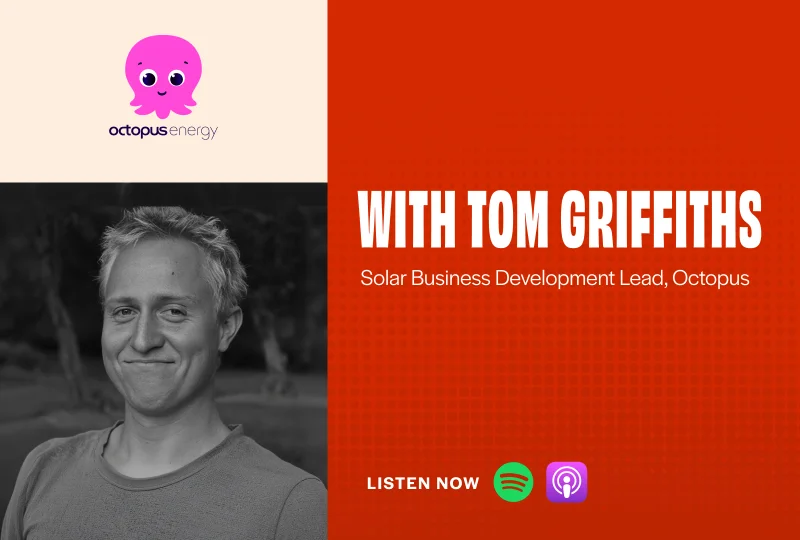
Guest: Tom Griffith, Social Housing Partnerships Lead, Octopus Energy
At a Glance
Tenant Power addresses the barrier that stalled Octopus's earlier Zero Bills model: a sub-meter and a fixed 30 per cent discount off the standard variable tariff let landlords earn a return from the battery's grid flexibility, instead of passing all the benefit to the tenant with none coming back.
Together Housing, whose five years of trialling an earlier version of this approach fed directly into how Tenant Power was designed, is now scaling to 1,500 properties with West Yorkshire Combined Authority funding, and the model has since been extended to 12 partner landlords covering over 100,000 properties.
Installing solar and battery at scale in one area can strain a local substation even though each individual system falls under the threshold that would normally need a distribution network operator application, so early engagement with the network operator is treated as essential to rollout.
Tenant Power is designed to solve the scaling problem built into Octopus's earlier Zero Bills tariff, where a home fitted with solar, battery and a heat pump gets a guaranteed zero energy bill for five to ten years. Under that model, the full financial benefit sits with the tenant and none returns to the landlord, which makes it difficult to fund installations across a large stock. A sub-meter is the mechanism that changes this: it bills all of a tenant's consumption on a standard variable tariff at a fixed 30 per cent discount, while the landlord's solar and battery are separately optimised and traded on the grid to generate a revenue stream back to the landlord.
Together Housing spent five years trialling an earlier version of this approach before it and Octopus designed Tenant Power together, launching it in summer last year. Together Housing now has funding from West Yorkshire Combined Authority to install the model across 1,500 properties, and the offer has since been extended to 12 partner landlords whose combined stock exceeds 100,000 properties.
Residents keep the choice of energy supplier throughout. The discount holds at 30 per cent regardless of how much a property actually generates or how sunny a given month has been, giving tenants a fixed, visible benefit rather than one that depends on tracking a monitoring portal. Octopus's existing customer base and brand recognition are cited as a factor in persuading residents to switch, alongside being upfront with residents that some homes will be reached sooner than others under a phased rollout.
Concentrating solar and battery installations within one area is described as the main practical constraint on scaling the pilot further, even though each system sits under the size threshold that would ordinarily be approved automatically without a distribution network operator application. Early engagement with the network operator, sharing the full list of planned addresses in advance, is what allows load calculations and any necessary grid upgrades to be identified before installation begins. Smart control of when batteries charge and discharge is also being explored with network operators as a way of easing the constraints installations would otherwise be assessed against.
The closing advice for a provider new to this is not to plan installations purely against compliance targets and dates. Tenant communication, ongoing maintenance and the eventual cost of replacing equipment need to be factored in from the outset, since a rollout that meets a target on paper can still leave residents unclear about what has changed or how to benefit from it.
Practical steps for housing providers
Ask whether a proposed tariff or offer gives the landlord any return once installed, not just savings for the tenant, since a model with no return can be hard to scale across a large stock.
Check what mechanism, such as a sub-meter, sits behind any offer that claims to split value between landlord and tenant, since that is what actually enables the split.
Where installations will be concentrated in one area, contact the relevant distribution network operator early with a full list of planned addresses, rather than after works have begun.
Confirm residents retain the choice of supplier throughout, and be upfront with them about why some homes may be reached sooner than others under a phased rollout.
Draw on the experience of landlords who have already piloted a similar model before designing a new one from scratch.
Plan for the full lifetime of any installation, including maintenance and eventual replacement costs, not only the point of installation.
Treat tenant communication as part of the delivery plan from the outset, so residents understand what has changed and how to benefit from it, not as something to address afterwards.