
*SPECIAL MINI SERIES* Episode 2 of 6 Unlocking Affordable Clean Energy for Social Housing
23rd September 2026
Part of the podcast series bringing Healthy Homes Hub and Energiesprong UK's playbook, 'Deploying Innovative Retrofit Funding Models in the Social Housing Sector' (also available as an audiobook), to life, on how a supplier funded solar and battery model can remove both the upfront cost and the asset ownership question from a landlord's side of the ledger.
Host: Emily Braham, Director, Energiesprong UK
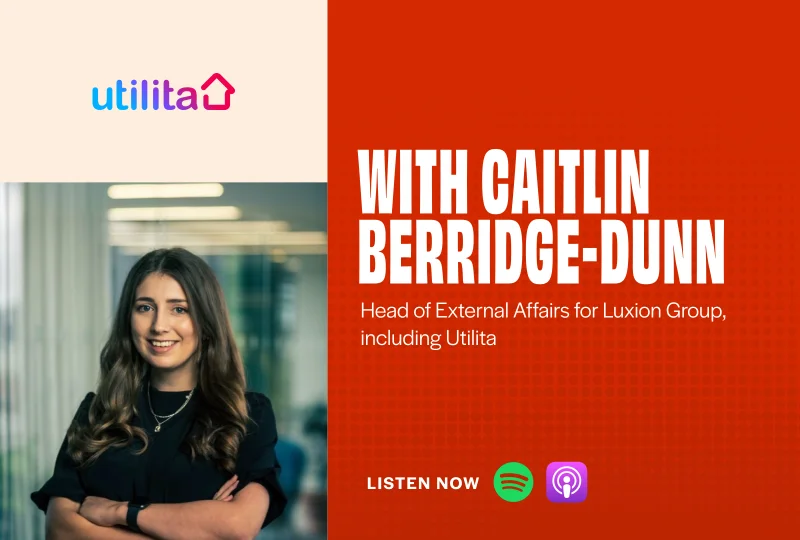
Guest: Caitlin Berridge-Dunn, Head of External Affairs, Utilita
At a Glance
Social Spark funds, owns, installs and maintains solar and battery systems on social homes over 25 years at no upfront cost to the landlord, with residents given the choice, not the obligation, to switch supplier for the saving.
The model works whether or not a tenant switches: those who move to Utilita save around 20 per cent against the price cap, while surplus solar generation is exported regardless, which is what de-risks the investment on Utilita's side.
Prepayment customers, often assumed to be disengaged, showed 89 per cent take-up in an early demand flexibility trial, a pattern Utilita says now shapes how it designs and communicates offers like this one.
Social Spark removes both the upfront cost and the asset ownership question from a landlord's side of the arrangement. Utilita funds, owns, installs and maintains solar and battery systems on a social home for a 25 year period, with no capital outlay and no borrowing required from the landlord. Residents are then given a choice, not an obligation: they can switch to Utilita and pay a daily subscription set at around 20 per cent below the energy price cap, or stay with their existing supplier.
The model is built to work either way. Surplus solar generation is exported and monetised regardless of whether a resident switches, which is what de-risks the investment on Utilita's side instead of tying it to take-up. For residents who do switch, the saving works out at close to 350 pounds a year on Utilita's example figures, delivered through a fixed daily charge rather than a variable tariff.
Two separate agreements sit behind the offer: one between Utilita and the landlord covering installation and maintenance of the asset, and one between Utilita and the resident covering supply. At the end of the 25 year term, a landlord can take ownership of the paid off system or renew the scheme with new equipment. Provision is also built in for right to buy sales, so an agreement can transfer or a system can be bought out as part of a property sale.
Prepayment customers are often assumed to be a disengaged group, a pattern this data does not support. An early demand flexibility trial for prepayment customers saw 89 per cent of those enrolled take part in at least one event, a response Utilita attributes to savings appearing immediately on a meter instead of arriving later on a bill. Fixed daily charges under Social Spark are also credited with giving these households more predictable costs, without the bill shocks that can follow a volatile wholesale market.
Building resident trust relies on translating consumption into pounds and pence, not technical units such as kilowatts, and on working through a landlord's existing relationship with tenants during installation, rather than approaching residents cold.
The closing advice for a provider new to this is not to wait for the next round of grant funding before acting, since grant funding is not expected to reach every home that needs it. Unlocking private capital extends what is achievable beyond what public funding alone allows, without ruling out a continued role for grant support alongside it.
Practical steps for housing providers
Establish whether a proposed funding partner will own and maintain the asset itself, since that is what removes both capital outlay and borrowing from the landlord's side of an agreement.
Check how an investment model is designed to perform if take-up among residents is low, not only when it is high, since a model that only works at high switching rates carries more risk.
Ask how savings are presented to residents, in pounds and pence against a clear point of comparison, so the benefit stays understandable as energy prices change.
Review whether the model already accounts for right to buy sales, including how any agreement or asset transfers when a property changes ownership.
Treat prepayment and low income residents as an engaged audience when designing communications, not as a group requiring lower expectations.
Confirm what happens to the asset and the agreement at the end of its term, including options for renewal, transfer or landlord ownership.
Weigh opportunities to bring in private capital alongside available grant funding, rather than waiting for the next funding announcement before acting.