Empty Boxes: The Price of Furniture Poverty
20th October 2026
Moving tenants into homes without a bed, cooker or fridge carries a cost to health, tenancies and the public purse that furnished tenancy schemes are designed to remove.
At a Glance
Furniture poverty is a health issue as well as a housing one: around a million people are missing three or more essential items, and around a million children live in households that cannot afford basic furniture and appliances.
A rental model for furnished tenancies needs no capital outlay from the landlord, yet only around 3% of social lets are furnished, against 30% in the private rented sector.
The Crisis and Resilience Fund brings three years of planning certainty, but local welfare scheme closures and cash only provision for furniture risk leaving gaps, and the sector ask remains legislation for at least 10% of general needs social homes to be furnished.
Moving a tenant into a home with no bed, cooker, fridge or floor covering is a health decision as well as a lettings one. Without a bed, sleep and musculoskeletal health suffer. Without a fridge or cooker, fresh food cannot be stored or prepared, and medication that needs refrigeration has nowhere to go. Clothes kept in bin bags, bare floorboards and the absence of curtains wear on mood daily, and the effect on mental health carries into physical health. In hot weather, no curtains, blinds or fridge freezer removes the basic means of keeping cool. End Furniture Poverty’s 2026 research describes furniture poverty as a public health crisis.
Around a million children live in households that cannot afford basic furniture and appliances. Poor sleep affects concentration, attainment and behaviour at school. Without a table and chairs there is nowhere to do homework or eat together, without a washing machine school clothes are hard to keep clean, and without a cooker a child has no chance to learn to cook. Embarrassment about an unfurnished home leads to social isolation, for adults who avoid hosting visitors and for children who cannot have friends to stay. Work on children’s beds is valuable, but missing items elsewhere in the home affect children as much as adults.
The groups most often recognised are people leaving homelessness or temporary accommodation, people fleeing domestic abuse and care leavers. Existing tenants are also affected. Austerity, Covid and the cost of living crisis have removed savings, and support available five, ten or fifteen years ago has gone, so a broken cooker or an outgrown bed can go unreplaced for years. End Furniture Poverty is preparing a larger paper on furniture poverty and survivors of domestic abuse, with further work planned on children and older people.
Around 3% of social lets are furnished, against 30% in the private rented sector. The recommendation in the Blueprint for Furniture Provision in Social Housing is that at least 10% of socially rented homes are offered furnished, aimed at the most vulnerable tenants, many of whom are likely to be on benefits long term. Landlord benefits include lower rent arrears, because tenants do not take on debt to buy items, longer tenancies and lower void costs. The cost benefit analysis finds that furnished tenancy schemes save the public purse over double the investment, and that local authority crisis support including furniture and appliances saves over £14 across the wider public purse for every pound spent.
The current model is rental, which removes the capital outlay that older purchase based schemes required. Under Furniture Flex, run by FRC, a sister charity of End Furniture Poverty, there is no joining fee and no minimum number of properties. Items are chosen with a housing officer through an online portal, from a single appliance to a full package, and the weekly charge is applied to the tenant’s account as a service charge that can be met through benefits. Items can be kept for six weeks or six years and returned one by one if circumstances change. The landlord signs up tenants, applies and collects the service charge and pays the invoice, while repairs go to FRC directly. Torus, North Tyneside Council and Stockport Homes Group run established schemes, St Leger Homes and SNG are more recent, and Orbit and Jigsaw are considering pilots.
The Crisis and Resilience Fund replaced the Household Support Fund from April 2026, giving local authorities three years of funding, including discretionary housing payments, and an emphasis on root causes rather than short term responses. Planning certainty is the main gain. The risks are that authorities close local welfare schemes on the assumption that the new fund covers them, leaving nothing to restart from when funding ends, and that “cash first” becomes cash only. The fund guidance states that furniture and appliances should be provided as delivered and installed items, but more authorities are choosing cash, which can be spent on other urgent pressures before the item is bought (see The Limits of Cash First). Provision remains a postcode lottery in England, where over a third of local authorities offer no local welfare assistance, against the statutory Scottish Welfare Fund and the Welsh Discretionary Assistance Fund.
The sector ask is for legislation requiring social landlords to provide at least 10% of general needs stock as furnished, so that support does not depend on postcode or landlord. Until then, progress depends on individual landlords introducing schemes.
Practical steps for housing providers
Review how many new tenants move in without a bed, cooker, fridge, washing machine or floor coverings, and record the figure alongside arrears and tenancy sustainment data.
Treat missing furniture and appliances as a health indicator at lettings and tenancy checks, in the same way as damp, mould and cold homes.
Identify the tenants most likely to be on benefits long term and test whether a furnished tenancy would suit them, with items offered by need rather than in fixed packages.
Consider a pilot in an area with no local welfare scheme, with agreed measures for arrears, tenancy length and void costs.
Check whether existing tenants, not only new ones, can obtain a replacement cooker, fridge or bed when one breaks.
Establish what crisis support the local authority offers, whether furniture and appliances are provided in kind or as cash only, and how tenants are referred.
Involve finance, service charge and lettings teams early, so that charging, collection and referral processes are agreed before a scheme starts.
Host and guest
Host: Jenny Danson, CEO and Co-Founder, Healthy Homes Hub
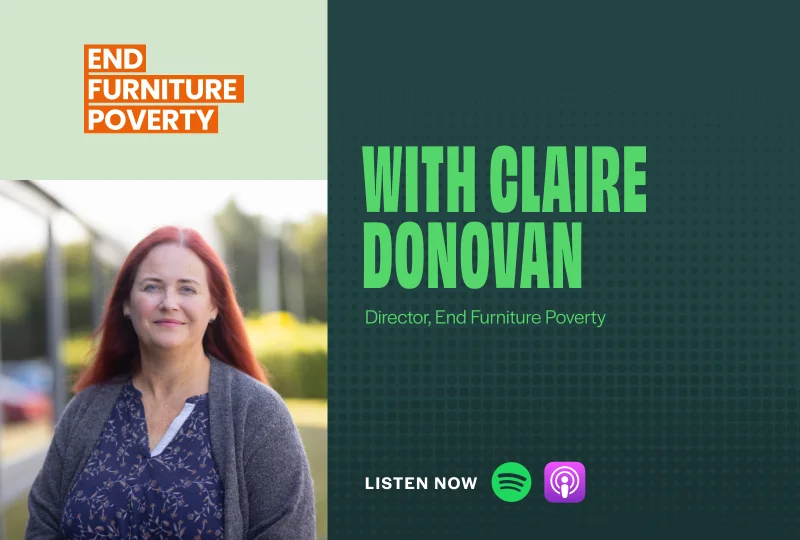
Guest: Claire Donovan, Director, End Furniture Poverty