
Understanding, Acting and Collaborating for Cleaner Indoor Air
19th November 2025
Jenny Danson
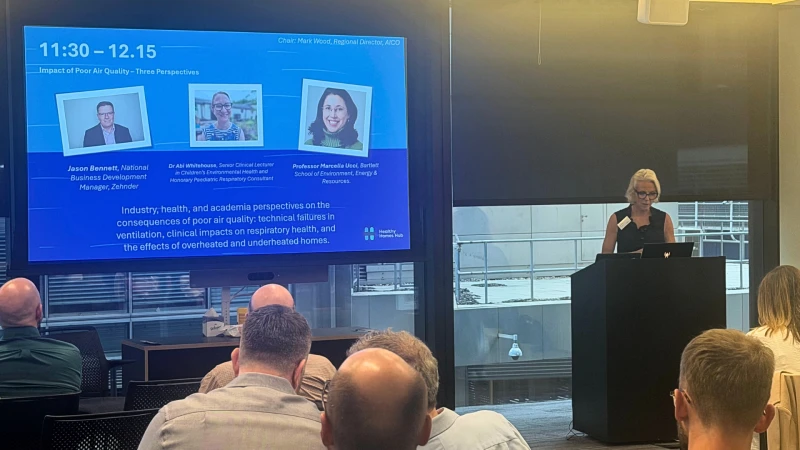
The air we breathe inside our homes has a profound impact on our health - yet indoor air quality (IAQ) remains one of the least understood aspects of housing performance. At Healthy Homes Hub’s Air Quality Day, an expert panel featuring Jason Bennett from Zehnder, Dr Abi Whitehouse, and Professor Marcella Ucci explored what needs to change in policy, practice, and mindset to make healthy indoor environments the norm rather than the exception. Chaired by Jenny Danson, the session brought together housing providers, contractors, health professionals, and researchers, all with one shared aim: to bridge the gap between what we know about air quality and what we actually do about it in people’s homes.
Setting the scene – Air quality as a health imperative
The discussion opened with a reminder that air quality is not simply a comfort or compliance issue. It is a public health concern. Poor indoor air can contribute to respiratory illness, cardiovascular problems, and worsened mental health, particularly for children, older adults, and those with pre-existing conditions.
As Jenny noted in her introduction, “If we want to stop people getting ill because of their homes, we have to treat air as seriously as water or energy.”
That framing shaped the rest of the conversation. Each panellist brought a different lens, technical, scientific, and behavioural, but all agreed that joined-up action between housing and health is the only way forward.
Jason Bennett (Zehnder): Raising the bar on ventilation and competence
Representing the manufacturer and installer perspective, Jason spoke about the crucial link between ventilation design, installation, and long-term performance. He warned against a “fit-and-forget” culture where systems meet regulations on paper but fail to deliver healthy outcomes in practice.
“Ventilation isn’t just about ticking a compliance box,” he said. “If systems aren’t installed or maintained correctly, residents won’t feel the benefit and we’ll have wasted both money and trust.”
Jason highlighted the increasing importance of competence, certification, and training in the supply chain, especially as Awaabs Law and new IAQ standards tighten expectations on landlords. He pointed to the growing need for upskilling operatives in areas such as commissioning, maintenance, and resident engagement.
He also emphasised the role of data and sensors. With affordable IAQ monitoring now available, housing providers can finally see what’s happening inside homes...humidity, temperature, and CO₂ levels and use that insight to prevent issues like mould before they occur.
“Reactive repairs cost far more than prevention,” he said. “Data allows us to act before a complaint ever lands.”
Dr Abi Whitehouse: The science of air quality and health
Dr Abi Whitehouse, an academic and clinician, built on that point by outlining the evidence linking indoor pollutants with serious health impacts. She explained how moisture, particulate matter (PM2.5), nitrogen dioxide, and volatile organic compounds interact to create complex health risks that are often invisible.
“Indoor air is typically two to five times more polluted than outdoor air,” she said. “Yet we spend around 90% of our lives indoors, mostly at home. We can’t afford to ignore that.”
Abi called for more integration between health and housing datasets, arguing that without shared information we cannot accurately target interventions. She also urged organisations to build routine IAQ measurement into asset management and retrofit programmes.
Crucially, she reminded the audience that while technology helps, human behaviour is central. “We can design perfect systems,” she said, “but if people can’t use or maintain them easily, or don’t understand their purpose, the benefits are lost.”
Her closing thought resonated strongly with the audience:
“Every damp wall, every under-ventilated room, is a health inequality. We have the evidence, now we need the will to act.”
Professor Marcella Ucci: Behaviour, design, and co-creation
Professor Marcella Ucci brought a behavioural and design perspective, challenging the sector to think beyond hardware and compliance. She argued that awareness, understanding, and everyday practice are just as important as engineering solutions.
“We still talk about ventilation as a technical fix,” she said. “But air quality is deeply human, it’s about how people live, heat, and ventilate their homes.”
Marcella’s research explores how cultural habits and household dynamics shape IAQ outcomes. For instance, some residents avoid using fans due to noise or cost concerns, while others block vents to stop draughts. Without understanding these behaviours, she said, retrofit and ventilation programmes risk failure.
She advocated for co-design approaches that bring residents into the process from the start, listening to their experiences, co-creating solutions, and making technology intuitive.
“Education should be empowering, not patronising,” she said. “People want to do the right thing, but they need tools and information that fit real life.”
Marcella also discussed global examples of healthy housing programmes, where community education has been as powerful as regulation in improving air quality.
Shared challenges and opportunities
Across the panel, several common themes emerged:
The skills gap remains one of the biggest barriers, with shortages in qualified ventilation engineers, surveyors, and compliance professionals.
Partnership working between housing, health, academia, and manufacturers is essential to build the evidence base and accelerate change.
Data sharing between organisations and across sectors is key to identifying at risk homes before residents get ill.
Education and communication need to be improved at every level: from operatives and contractors to housing officers and tenants.
The discussion made clear that policy momentum is building with Aawabs Law, PAS2035, and the upcoming revisions to Building Regulations all signalling a shift towards measurable, health-centred standards. But the panellists agreed that regulation alone will not solve the problem.
“We can’t regulate compassion or curiosity,” Marcella said. “Real progress comes when we all take responsibility for the air in our homes.”
Looking ahead
As the conversation drew to a close, Jenny summarised what many in the room were thinking: that improving air quality is both a moral and practical priority. It demands collaboration, investment in people, and the courage to try new approaches, from pilots and data projects to health partnerships and community engagement.
Events like Air Quality Ideas Exchange show what happens when different disciplines come together to share expertise. The next step is translating that momentum into everyday practice across housing organisations.
The message from the panel was unambiguous:
Clean air is fundamental to healthy housing and healthy housing is the foundation of a healthy society.
Unlock all content
This is the 1 of 3 articles you can access for free. Become a member to unlock unlimited access to our full content library.