

Warm, Clean, Carbon-Negative: Why Not Straw?
21st July 2026
Jenny Danson
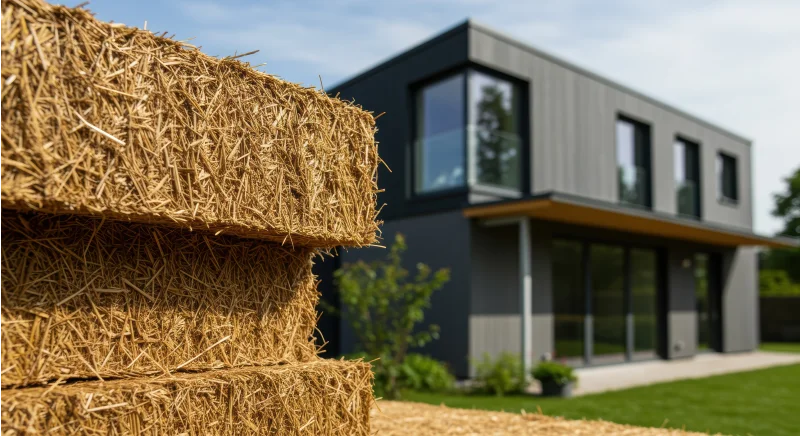
Why a material capable of building 640,000 homes from domestic waste remains on the margins of the UK construction sector.
At a glance
The UK produces five million tonnes of waste straw annually, enough to build 640,000 three-bedroom homes, yet only around 40 straw construction projects are currently active.
France has approximately 500 straw construction projects under way, with Austria, the Netherlands and Germany all significantly ahead of the UK in scale of adoption.
A 12-storey, 65-apartment straw building completed in Malmö demonstrates that the material is now viable for multi-storey residential construction at scale.
Straw construction has crossed a significant technical threshold. The shift from hand-stacked bales to precision-manufactured straw panels, developed and refined over the past decade, means that multi-storey buildings, logistics facilities and apartment blocks are now being constructed from compressed straw at a scale that would have been practically impossible a generation ago.
The largest straw building in the world, a 155,000 square metre logistics centre completed in the Netherlands and designed by Danish practice Henning Larsen using panels manufactured by EcoCocon, represents the upper end of what the technology now permits. A 12-storey apartment block in Malmö, with 65 homes and integrated solar panels, demonstrates equivalent capability for residential use.
In the UK, there are approximately 40 straw construction projects active. In France, there are around 500.
What the material offers
The performance case for straw is well established in the research literature and increasingly demonstrated through completed buildings. Straw walls deliver high levels of thermal insulation, reducing both energy use and running costs. Internal clay plaster and external lime finish emit no VOCs and actively adsorb pollutants from indoor air, with direct implications for air quality and respiratory health. The material also performs well acoustically, with sound reduction indices of 42 to 53 dB recorded in testing.
On fire safety, the evidence is unambiguous. Formal tests conducted to EN 1365-1, the EU and UK standard for loadbearing walls, show clay and lime plastered straw walls achieving fire resistance of 120 to 135 minutes without failure. UK Building Regulations (Approved Document B) require a minimum of 30 minutes fire resistance for residential structures up to five metres and 60 minutes for buildings up to 18 metres. Plastered straw walls, including loadbearing external wall configurations, meet or exceed both thresholds. The density of compressed straw eliminates the oxygen required for rapid combustion; fire smoulders rather than spreads, and it is the plaster finish that provides both the fire barrier and the healthy indoor environment.
Straw is also a renewable agricultural by-product. The UK currently has a surplus of approximately five million tonnes annually, beyond what can usefully be returned to the soil. The built environment is responsible for an estimated 39 to 40 per cent of global emissions. Straw sequesters carbon during growth and locks it into the fabric of the building, offering reductions in both embodied and operational carbon.
Poor housing costs the NHS an estimated £1.4 billion a year. For the Healthy Homes Hub, the connection between building material choice and resident health outcomes is direct: thermal performance, indoor air quality and acoustic comfort are not secondary considerations, they are health determinants.
The barriers holding adoption back
The gap between what straw construction can deliver and how widely it is used in the UK is not a technical problem. It is an institutional one.
Lenders and insurers have had little practical reason to develop straw-specific products or underwriting frameworks. The sector is small enough that it has remained outside standard risk models, and without those frameworks, developers and clients face significant difficulty in securing finance or insurance for straw projects. This creates a circular constraint: without completed projects at scale, lenders and insurers lack the evidence base to engage; without their engagement, projects at scale cannot proceed.
Planning conditions and land availability compound this. France’s more permissive planning environment and broader land availability have allowed straw construction to develop through iterative experimentation. In the UK, the cost and scarcity of land, combined with tighter planning requirements, have limited the opportunities for the kind of low-stakes pilot work that builds a body of evidence.
Professional education is a further gap. Architecture and engineering students have attended practical courses with organisations such as the School of Natural Building, but straw construction has not been embedded in undergraduate curricula. Without that foundation, the next generation of design and construction professionals enters the sector without it as a standard option.
Where movement is possible
The most immediate lever is engaging lenders and insurers directly in training and knowledge exchange. Professional development programmes that address the evidence base on structural behaviour, fire performance and long-term durability would remove barriers currently based on unfamiliarity rather than fact.
The UpStraw project, an EU-funded partnership across five countries, demonstrated what structured collaboration can produce. Alongside completed public buildings, it established a consolidated research database, secured a European Environmental Product Declaration for straw, and directly led to the formation of the European Straw Building Association and Straw Building UK.
Post-occupancy evaluation of existing straw homes, including early social housing examples built for North Kesteven Council, represents an underused resource. Structured evidence on resident experience, health outcomes and building performance over time would support both the professional and financial case for broader adoption.
The sector has built enough to know the material works. The remaining work is organisational.
Practical steps for housing providers
Review the European Straw Building Association’s project database at strawbuilding.eu and the EcoCocon project portfolio at ecococon.eu/us/projects to assess the current scale of straw construction across Europe, including multi-storey residential examples.
Explore Straw Building UK at strawbuildinguk.org for information on membership, suppliers and practitioners operating within the UK.
Where new build or retrofit projects are being scoped, commission a feasibility assessment for straw panel construction alongside conventional options, particularly for schemes with strong sustainability, health or carbon reduction targets.
Engage asset management, sustainability and development teams together: straw’s benefits span embodied carbon, thermal performance, indoor air quality and long-term maintenance, and the business case is stronger when assessed across these functions simultaneously.
Consider commissioning post-occupancy evaluation of any existing low-carbon or natural material buildings in your portfolio, to build the evidence base on resident health outcomes and building performance that the wider sector currently lacks.
Where organisations have relationships with university built environment departments, raise the question of curriculum integration directly with programme leads: the gap between an optional practical course and standard curriculum content is one of the most consequential barriers to long-term sector capacity.
Visit the School of Natural Building at schoolofnaturalbuilding.co.uk for course information, case studies and practical resources on straw construction techniques.
http://eilsuth.substack.com/
Unlock all content
This is the 1 of 3 articles you can access for free. Become a member to unlock unlimited access to our full content library.