
Reflections on delivery
26th July 2026
Paul Norman
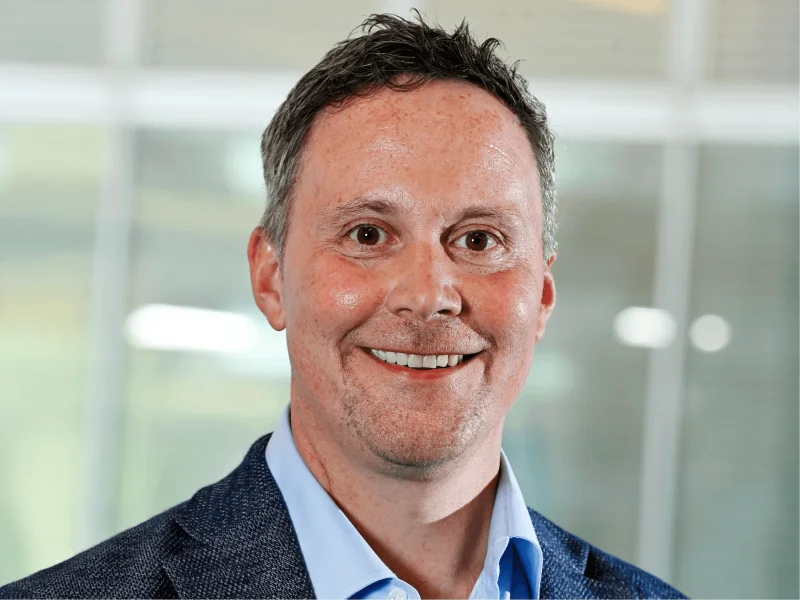
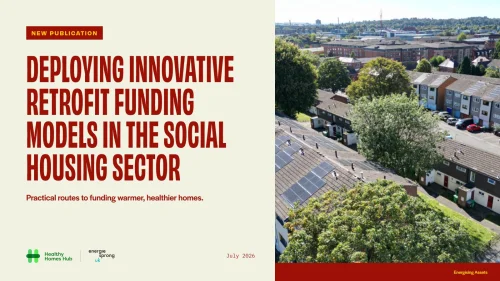
Ahead of the launch this week of our Innovative Retrofit Finance playbook we sat down with our Director Paul Norman to reflect on his career in asset management and explore why a fresh approach to funding driven by first hand-experience of delivering large retrofit programmes is needed to match the sectors aspirations.
Opening - your personal journey
You've spent over 30 years in asset management, including leading asset strategy at one of the UK's largest housing providers. What made you want to step into a role like this - advising organisations rather than leading from within one?
It is easy to use the phrase – looking for a “new challenge” and in a way that is part of it, but the biggest driver was the ability to make a difference across a number of organisations. I learnt a lot at Clarion, and it is that experience and perspective I hope to be able to share with peers so that we effect change at scale across the social housing sector.
A lot of what needs to happen in the sector we know how to do. Our real challenge is how we deliver it at scale and maintain the quality so that residents can live in healthier more sustainable homes. If I can play a small part in helping, make that happen I will be happy.
What does "a plan for every home" actually mean in practice? Where did that phrase come from for you?
We need to understand that behind each front door is someone’s home. We are not all the same, so we all want something slightly different from our home. Landlords have a duty to provide a safe and healthy home, so this means we must look beyond numbers on a spreadsheet.
Essentially what we are saying is this is a mindset. Homes are long-term assets, they last for decades so we must have a long-term plan that adapts with them, especially now in a changing climate. They also contribute to developing place, building communities and economic opportunities. This means we must consider what is the outcome of investing (or not) in our homes. It matters beyond just those four walls.
The problem - why the sector is stuck
You talk about retrofit needing to become part of long-term asset strategy rather than a standalone project. In your experience, why hasn't that happened more widely yet? What gets in the way?
We should not forget retrofit is still relatively new. The concept is understood within the sector, but we have only been delivering since the turn of this decade. So retrofit is still in its infancy. And new things take time to bed in.
Retrofit is fundamental to the health of a home as an asset. It is a health intervention to help adapt the home for a changing climate but also the changing needs of residents who see the home as more than just shelter in 2026.
Therefore, we are all learning as we progress. This is where collaboration and partnership becomes so important. Retrofit on this scale has not been done before, there is no blueprint to follow, our housing stock is very different so different approaches are needed, so the knowledge of others who have been through the process becomes more important.
We are moving beyond pilot stage, now delivery needs to come in the thousands. That is a strategic asset management challenge that requires clear thinking and understanding. It must become part of business as usual.
Finally, I think funding has had an impact. The generous government schemes have been set up as “stand-alone” finance programmes and that might have influenced some internal thinking that this is a “special project” whereas we need the finance to be part of the ongoing upgrade of housing stock across an entire portfolio.
When you look at organisations that are making genuine progress on this, what are they doing differently from those that aren't?
They are seeing and treating this as part of core asset management activity. It is a holistic approach that places the home and the outcomes for residents at the core of their activity. Retrofit is another planned works programme and needs to be seen as part of a full picture, not as we mentioned previously a special project.
Asset directors, CFOs and sustainability leads often tell us they're having different conversations about the same problem. How do you bring those conversations together — and who needs to be in the room?
A holistic approach requires input from across the board. It is easy to make this a process, but it is a very personal activity that impacts residents directly so the retrofit team needs both a financial and technical input and then also needs to have input that sees the retrofit process through the eyes of the people it really affects, and who ultimately have to live with the end product.
This requires a shared vision. When you talk to operators and housing providers who have delivered successful schemes, they tend to have the same core DNA – a shared vision from all parties involved, the delivery of better healthier homes that work for landlords and residents alike.
The Energising Assets proposition
You describe Energising Assets as a "trusted critical friend" - not a delivery contractor, not a retrofit consultancy. What does that distinction mean in practice for a housing association working with you?
In practice this is about the learnings amassed from delivery of asset programmes including retrofit that can be shared with other operators. It is literally about passing on knowledge from what works and what does not work to help inform decision-making. There is no commercial angle to win projects or anything like that, it really is the fact that I have been in an asset directors’ position and want to help advise as to how we can get better outcomes for both landlords and residents alike.
Our analysis comes with one challenge – how does the intended work benefit the resident to have a better lived experience.
You talk about three stages - strategic alignment, programme confidence and sector learning. Where do most organisations come to you, and where do you think they should be coming to you?
This is not about reinventing the wheel, neither is about working to a detailed process map. It is about an open and honest conversation about the asset challenge and potential solutions that could be delivered.
We are happy to be involved at any time in the process. The premise is simple we want our experience of delivering such projects to help inform the delivery of others.
Current conversations are at various stages and levels and tend to be dictated by the individual issues within organisations, but fundamentally it is about providing that “independent” view that will hopefully help inform the evidence base for prudent and effective decision making.
What's the hardest question you help organisations ask themselves - the one they often haven't asked before they come to you?
We have been involved in several conversations about finance. There is a lot to do and it comes with a heavy price tag. Whilst government schemes have been very generous, they are only part of the funding solution so we need to find ways for private finance to play a bigger role than it currently does. This means an understanding for investors of why social housing is a good investment vehicle and for landlords to look at different and new ways of investing in their assets to retain and increase their value.
So, it is a simple question – but it is very difficult to answer – how do we pay for it?
The funding and finance landscape
The Innovative Finance Playbook covers solar PV, batteries and renewable heat. Why those three, and what's been the biggest misconception you've encountered about how these technologies get financed?
The heat of the future is going to be electric. This is the signposting from the government, the Committee on Climate Change and most energy modellers. Because heat is at the centre of our energy system, electrified heat is how our homes are going to keep themselves warm and cool. The Warm Homes Plan has also identified a series of chosen technologies including those in your question, so we continue that question of how you pay for these technologies through the Playbook.
And the Playbook looks beyond traditional funding streams and seeks to innovate how new funding structures can support widescale deployment of these technologies, that make financial sense for housing providers to employ.
The biggest misconception is probably that people look at them individually and not as a total package. The homes of the future are likely to be self-generating energy hubs, but that only comes to fruition when you have a core fabric quality in the home, coupled with the technology in an environment that allows the low-carbon technology to work to its capacity to get the best return for both the landlord and most importantly the resident. It is about providing a systems solution for the home.
Energy as a Service and Heat as a Service models are generating a lot of interest but also a lot of uncertainty. What should a housing association CFO actually understand about these models before their board considers them?
That this is an investment opportunity and not simply a cost. This is the ability to rethink a number of issues across a new financial structure that will provide greater revenue certainty as well as a direct outcome for the resident which provides them with a warmer and more comfortable home.
As with everything there is a need to gain confidence in the model and its delivery. This is why the lessons of others is so important. We have big investment challenges ahead for the sector, and it is important we look at different ways to deliver on the funding challenges ahead, as we cannot rely on how things have been done in the past. These are new and complex challenges that require fresh approaches and thinking to overcome.
Residents and the bigger picture
Resident trust is listed as one of the key challenges in large-scale upgrade programmes. How do you make sure that doesn't become an afterthought in what is often a highly financial and technical conversation?
By placing the resident voice at the heart of it. Solutions should be designed in conjunction with residents. They understand the home and how it operates better than anyone. And when it comes to judging if interventions have been a success or not, again it is the resident view that should be at the forefront.
You might have met some metrics and KPI’s but if the resident experience is not changed and not changed for the better then really it is hard to judge the intervention as a success.
Regulatory pressure - Awaab's Law, the Decent Homes Standard - is accelerating decisions that organisations might otherwise defer. Is that a good thing, in your view?
There is nothing more important than the health and safety of residents. When systems fail then legislation needs to step in and it is important that landlords continue to place the safety of their residents at the forefront of their actions.
What we need is consistency of approach and complementary standards. Standards can raise a market a lot quicker than subsides can, so it is important we make those standards fit not just for now but for the future as well.
We have access to more knowledge than we ever have done, and we should be challenging ourselves to do more and not just deliver minimum standards.
The closing question
If you could say one thing to an asset director reading this who knows their organisation needs to act on this but hasn't yet - what would it be?
Reach out and have a conversation.
I have been in that position. I understand the pressure from multiple stakeholders and know the people that are driving the agenda forward. There is no cost in a conversation, but there could be many benefits.
Unlock all content
This is the 1 of 3 articles you can access for free. Become a member to unlock unlimited access to our full content library.