
Listening Before Retrofitting: How Co-Design Could Transform How We Tackle Overheating
8th July 2026
Jenny Danson

Most overheating research focuses on buildings: what temperatures they reach, how quickly they cool down, whether shading or insulation makes a measurable difference. Far less attention has been paid to the people inside those buildings: what they understand about heat, what they think is causing it, what they are prepared to do about it, and whether anyone has ever asked them.
Barah Rababa, a PhD researcher at Loughborough University, is doing exactly that. Working with householders in the Midlands, Barah is developing personalised cooling retrofit pathways through a co-design process that treats residents as partners in the research, not as data points. Her work sits alongside the technical monitoring studies being conducted by colleagues in the same research group, and it asks the question that the sensors alone cannot answer: what do people actually need, and will they act on it?
Healthy Homes Hub spoke with Barah about her approach, what she has found, and why the gap between what residents know and what they need to know about overheating is wider than most people in the sector appreciate.
Residents as co-researchers, not subjects
Barah's background is in architecture, with a degree in environmental design of buildings from Cardiff University. But her PhD takes a deliberately different approach from the technical modelling and monitoring work that characterises much overheating research.
"We have lots of monitoring studies, but we have to listen to the householders and understand their perspective," she explains. "I bring the householders into my research and I treat them as co-researchers, not as subjects."
The practical process began with a survey last summer, from which twelve households were selected for in-depth work. For each home, Barah conducted multi-room monitoring of indoor air temperature and window opening behaviour across the summer period. This gave her two overlapping pictures: how the building responded to outdoor temperature, and how the occupant responded to indoor temperature. Ventilation habits, window opening patterns, and the relationship between behaviour and thermal comfort were all captured.
After the monitoring period, each participant received a personalised feedback report translating the technical data into something accessible: heat maps, infographics, peak temperature readings presented in plain language, and a set of low-cost retrofit suggestions tailored to their home. Residents then gave feedback on the report itself, shaping how it could be improved.
"They told me it was very informative and more understandable than the EPC," Barah says. "So that was encouraging."
What residents actually know about overheating
The findings from Barah's co-design sessions reveal a significant awareness gap, both about the causes of overheating and about the solutions available.
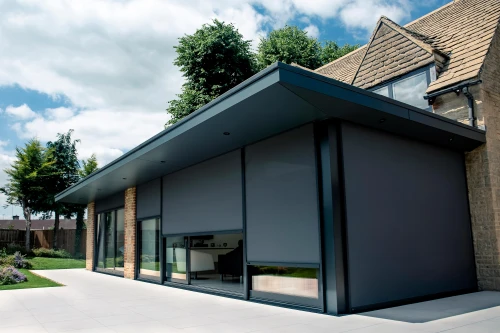
One of the most striking discoveries was that residents had no idea that external shading products such as awnings, external blinds, and shutters are available to buy in the UK. They had seen them in Spain and Portugal on holiday, and assumed they were a European solution to a European climate. The idea that the same products are available here, and increasingly relevant as UK summers warm, had simply not resonated.
There was also widespread confusion about basic cooling behaviour. Opening windows during the day is the default response to heat for most people in the UK, and it is often the right instinct. But during a heat wave, when outdoor temperatures exceed indoor temperatures, it makes things worse rather than better. Many of Barah's participants did not know this.
"People were struggling to find out how to cope with the heat wave," Barah says. "Raising awareness of how to cool their houses and how to cool themselves is the gap."
Coming from the Middle East, where managing heat is embedded in everyday culture and passed down through generations, Barah found the contrast with UK residents striking. In countries with a long history of hot summers, people carry practical knowledge about keeping homes cool: when to open and close windows, how to use shade, how to manage airflow. That knowledge simply does not exist in the same way in the UK, and there is currently no reliable public-facing resource to fill the gap.
"When I asked participants who they would approach for advice on retrofitting their home, most of them did not know who to approach or who to trust," she says. "Some said they would just do a Google search. Some said they would ask me, because I was the only one who had come to talk to them about it."
The challenge for renters and social housing residents
Barah's current research is with owner-occupiers in the Midlands, but she is clear about the limits of what owner-occupiers can tell us about the wider population.
"I'm only dealing with private owners, but I'm sure the problem is worse for people who are renting," she says. "I rent myself, so I don't have the authority to do any changes to my home. And for social housing residents, I'm sure they are struggling with the heat and the most that most of them can do is get a fan."
This is the tension at the heart of overheating in the social rented sector. The residents most likely to be vulnerable to heat, those in older properties, in flats, in homes with poor ventilation, on low incomes with no ability to self-fund improvements, are also the least able to act unilaterally. The decisions that would make their homes safer sit with their landlord, not with them.
Barah sees this as a policy gap as much as a practical one. "There is a gap between the policymakers and the landlords and the householders. We should bridge this gap for cooling retrofit."
A tool that could scale
Barah is now entering her final year, moving from data collection to deep analysis. The personalised feedback report she developed with her participants is a central output, and she plans to validate it further, not only with householders but with energy experts and policymakers, to test whether it can become a credible decision-support tool.
The ambition is for the methodology to be transferable beyond the Midlands, and eventually to be digitalised so it can be deployed at scale.
"I would love to collaborate with housing associations and come up with something really useful and informative for householders," she says. "This feedback report and the cooling retrofit pathway could be published publicly and become a source of information for householders to refer to during heat waves."
She was also struck by a visit to the Netherlands during her PhD, where she observed a retrofit demonstration flat, fully refurbished and opened up for social housing tenants to walk through and see what was possible. The idea of showing people what a cooler home looks, feels, and functions like, rather than simply describing it, resonated with everything her co-design work had taught her about how people engage with change.
Questions for housing providers to reflect on
Do your residents know what external shading products are available in the UK, what they cost, and whether they would be permitted under your tenancy terms? If not, is that a communication gap your organisation could close?
When your organisation communicates with residents about overheating, are you giving them actionable guidance on behaviour during heat events, including when opening windows helps and when it makes things worse?
Barah's research involves genuine co-design with residents, creating retrofit pathways together rather than prescribing solutions. To what extent does your organisation involve residents in decisions about how their homes are adapted for a warmer climate?
Key takeaways
The awareness gap is bigger than the sector realises. Residents in Barah's research did not know that external shading exists in the UK, did not know how to manage their homes during a heat wave, and did not know who to turn to for reliable advice. Housing providers are well placed to fill that gap.
Co-design produces better outcomes than top-down prescription. Treating residents as partners in developing cooling strategies, rather than recipients of technical decisions, generates more relevant solutions and greater willingness to act on them.
Social housing residents face a structural disadvantage. Owner-occupiers can respond to overheating risk with their own resources; social housing residents largely cannot. The case for landlord-led cooling retrofit programmes, backed by policy and funding, is clear.
This article draws on a recorded conversation between Healthy Homes Hub Founder and CEO Jenny Danson and PhD researcher Barah Rababa, conducted in July 2026. Barah is in her second year at Loughborough University, working within the ERBE research group under the supervision of Dr Ben Roberts. Her research involves co-design with twelve householders in the Midlands. A peer-reviewed paper drawing on the personalised feedback report is in preparation. Findings are from ongoing research; full analysis will be completed during her final year.
Image credit - Barah Rababa
Unlock all content
This is the 1 of 3 articles you can access for free. Become a member to unlock unlimited access to our full content library.