How Cold Could Homes Get This Winter?
18th November 2026
Jenny Danson
Understanding how insulation, heating systems, tariffs and budgets interact and how this can lead to health risks, with a free tool to help you see it for yourself!
Fuelled by wars in the Middle East, UK price cap unit rates for natural gas rose to nearly 8p/kWh on 1st October 2026, more than double the rate in 2021, and four times the lowest rates in 2016. Worse still, the latest forecasts show this rate could rise further to over 10p/kWh in January 2027. Electricity prices have also been impacted, although policy changes and some decoupling of gas and electricity prices have meant that electricity today (26.3p/kWh, or 3.3x gas) is slightly cheaper than it was in January 2026 (when it was 4.7x gas). However, the price cap flat unit rate for electricity is also expected to rise in January 2027.
With 4 in 5 social homes heated with gas boilers, and many tenants also using direct electrical heating, it raises some key questions:
How much will it cost to heat homes adequately this winter?
With limited budgets, how cold could homes get this winter?
At the same time Awaab's Law, has come into effect and this extends to damp, mould and excess cold in the social rented sector, giving landlords a 14-day window to investigate a reported hazard and a further 7 days to start repairs once a structural cause is confirmed.
So we have built a free tool that turns the physics, the cost and the risk into one clear picture. You can see for yourself here: Social Housing Thermal, Health & Price Cap Assessment Tool.
The three dials that decide whether a home is warm
Strip away the jargon and every cold-home problem comes down to three things multiplying together:
The fabric: how fast the building leaks heat (its heat loss parameter, roughly mapped to EPC band).
The technology: how efficiently a unit of fuel becomes a unit of warmth. A gas boiler running at a high flow temperature converts about 78% of the gas it burns into usable heat; the same boiler tuned to run at a lower flow temperature reaches 90%. A heat pump with a seasonal performance factor (SPF) of 3.91, the latest Octopus Cosy fleet average, turns one unit of electricity into almost four units of heat.
The tariff: what that unit of fuel actually costs, which is consistent for gas but now varies hugely between a standard variable rate, Economy 7, and supplier-specific smart tariffs built for heat pumps.
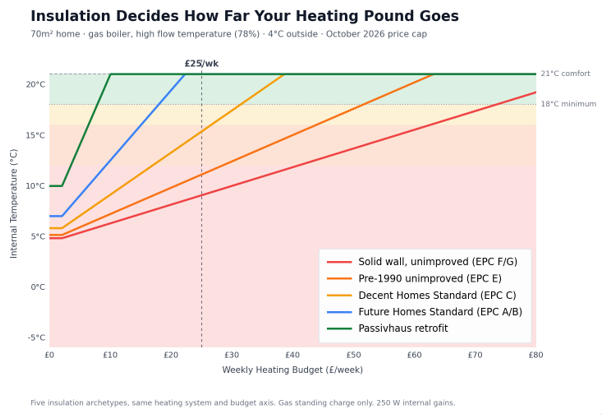
Get any one of these “wrong” and a household can be doing everything "right" (saving money, paying their bills, running their heating system) but when the temperature drops they still end up in a cold home and potentially at higher risk of damp and mould. Get all three right and the same budget stretches dramatically further unlocking comfortable, healthy homes.
All figures below use the October 2026 price cap rate (you can toggle to the January 2027price cap projections in the tool), and the tool uses a four-tier health scale, noting that the World Health Organisation recommends 18°C as the minimum safe indoor temperature, with around 21°C for vulnerable groups:
🟢 18–21°C: safe and comfortable
🟡 16–17°C: respiratory risk (asthma, COPD, infections)
🟠 12–15°C: cardiovascular hazard (blood thickens, raising heart attack and stroke risk)
🔴 Below 12°C: severe hypothermia risk
A real property, modelled through a Scottish winter
Take one archetype: a 70m² Decent Homes Standard flat (EPC C) in Scotland, on a £25/week heating budget (this is just for heating, not hot water or appliance use, or other living costs). Nothing about this household is unusual. Here's what six different configurations of the same model tell us.
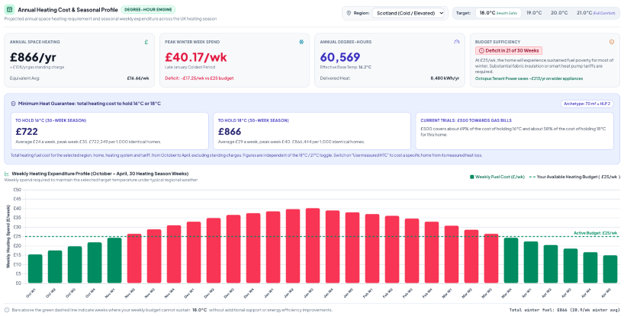
Zooming out to the whole heating season first. On a gas boiler, this home needs £866/year in space-heating fuel alone (plus £108/year standing charge) just to hold 18°C (the "health safe" line), not even full 21°C comfort. That's an average of £16.66/week, but averages hide the danger: the model's degree-hour engine shows the weekly cost climbing to £40.17/week at the late-January peak, and at a flat £25/week budget, this household runs a deficit in 21 of the 30 heating-season weeks (mid-November straight through to late March). For a Minimum Heat Guarantee, holding 16°C would cost about £722 in fuel across the season and holding 18°C about £866 (at October 2026 rates). Current trials contribute £500 towards gas bills, which covers around 69% of the 16°C cost and 58% of the 18°C cost.
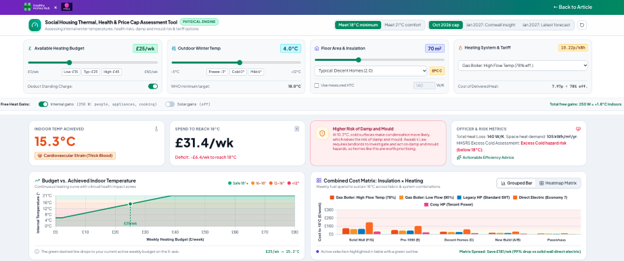
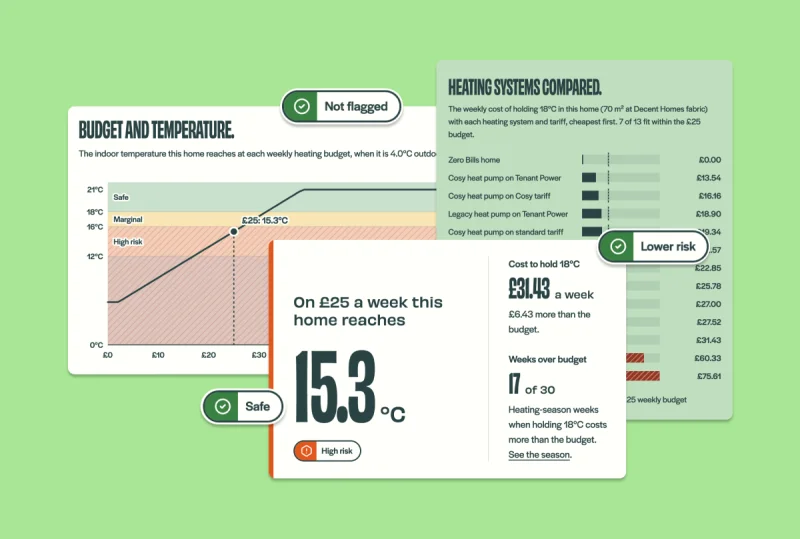
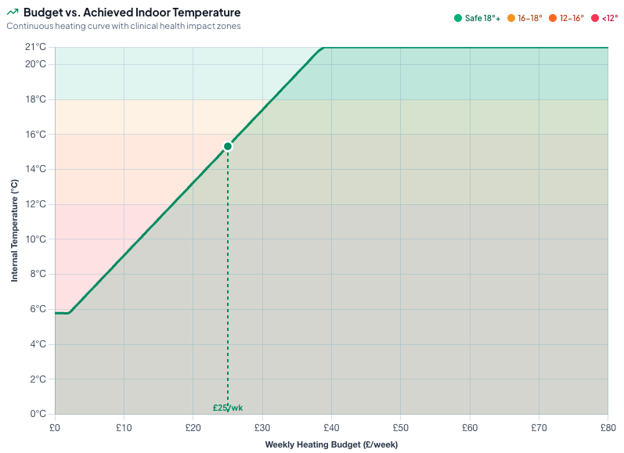
Narrow in on a single cold winter day (average 4°C outside, the same £25/week). This gas-boiler home (heat loss of 140 W/K, space heat demand of 105 kWh/m²/year) achieves just 15.3°C indoors. 🟠 Cardiovascular strain. It would need £31.40/week to hold 18°C (a £6.40/week shortfall) and £38.60/week to reach 21°C, a £13.60/week shortfall. The tool doesn't just flag this quietly: it flags a higher risk of damp and mould.
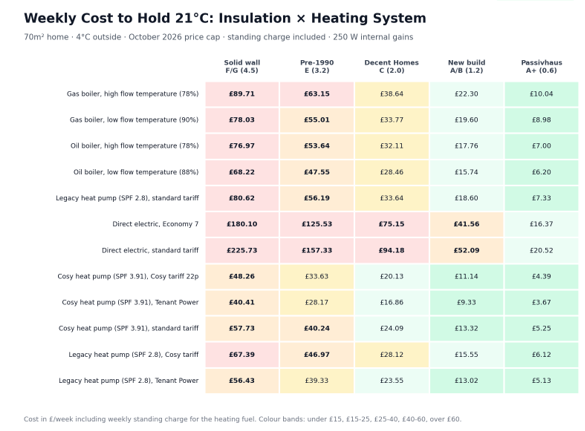
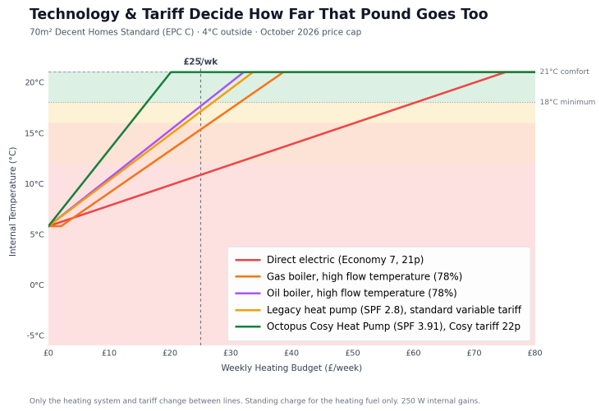
The matrix on the right side of the tool, shows the impact of the key variables in one table. The same £25/week household, if stuck with direct electric heating on a standard tariff in a solid-wall (uninsulated) property, needs £225.73/week to hit 21°C (the single worst combination the model can produce). Move that exact same direct-electric setup into a Decent Homes-standard property and the figure falls to £94.18/week. Keep the Decent Homes fabric but swap to a Cosy heat pump on a smart tariff and it falls again, to £20.13/week. There is a huge swing in cost depending entirely on which combination of fabric and technology and tariff you're looking at.
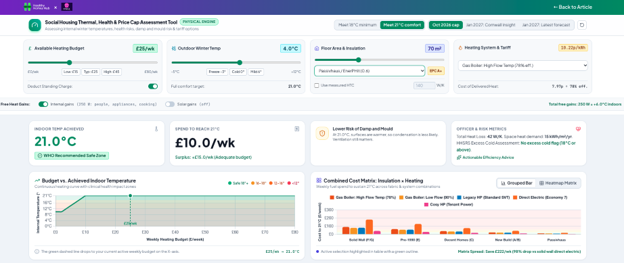
Now isolating the fabric lever. Take the same gas boiler, the same £25/week, the same 4°C outside and retrofit the building fabric alone, from Decent Homes Standard up to Passivhaus/EnerPHit (heat loss falls from 140 to 42 W/K; space heat demand from 105 to 15 kWh/m²/year). Indoor temperature jumps to 21.0°C - comfortably inside the safe zone - and the cost to reach 21°C falls to £10.04/week, a £14.96/week surplus against the same budget that left the un-retrofitted version at higher risk of damp and mould.
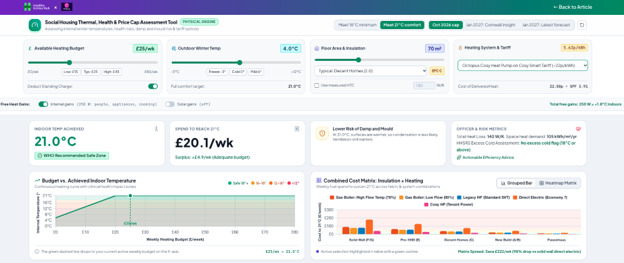
Now isolating the tariff and technology lever. Put the fabric back to ordinary Decent Homes Standard (no fabric retrofit) instead swap the heating system to an Octopus Cosy heat pump on the Cosy smart tariff. Indoor temperature: 21.0°C. Cost to reach 21°C: £20.13/week. This delivers a similar performance as insulating to new build standards on gas heated homes.
Both fabric and technology solutions can help the same property land at the same 21°C comfort level, within the £25/week budget. Neither is "the" answer but a landlord weighing where to spend the next retrofit pound now has a genuine like-for-like comparison to consider.
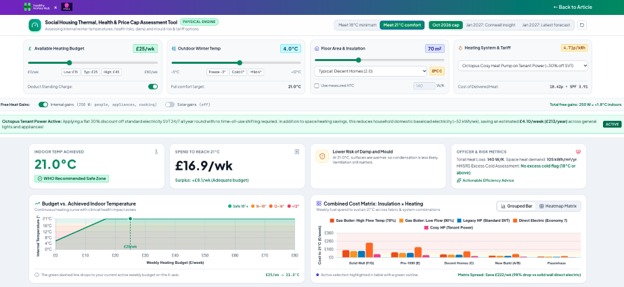
One more variant worth showing tenants directly: the same Cosy heat pump, but on Tenant Power: a flat 30% discount off the standard electricity rate available with solar and battery installations, with no time-of-use shifting required from the household. It achieves even more headroom (21°C, £16.86/week, a £8.14/week surplus) than the optimised smart tariff, but it needs no optimising against a smart tariff and the discount also knocks an estimated £4.10/week (£213/year) off the household's general lighting and appliance electricity, on top of the heating saving. Tenant Power also creates a revenue stream to the landlord from the solar and battery system to support the installation costs.
What does this mean for you?
For tenants: if your home is cold despite genuinely trying to heat it, that is evidence, not a personal failing. Solutions exist but they will require some intervention to change the status quo.
For housing officers and landlords: your stock condition survey plus your heating-system register plus an understanding of tariffs, in effect, an early-warning system for damp and mould risk before a single complaint comes in. The cost matrix above means you can rank your stock today: by region, fabric band and current heating system. It can help you know which combinations may be at higher risk of cold, damp and mould before this winter's really cold snap arrives.
For anyone planning retrofit investment: this model is a genuine argument for running fabric-first and technology-first options side by side rather than assuming one must come before the other. A Passivhaus-grade retrofit and a heat-pump-plus-smart-tariff swap can land a property in the same safe, healthy place from very different cost and disruption profiles.
Try it yourself
All the numbers and screenshots in this article come straight out of a free interactive tool: Social Housing Thermal, Health & Price Cap Assessment Tool.
It models for any UK region:
floor area, insulation archetype (solid wall through Passivhaus) and a wide range of heating systems including gas, oil, Legacy heat pumps and Octopus Cosy with a smart heat pump tariff.
the October 2026 and projected January 2027 price caps, Economy 7, Cosy smart tariffs and the year round 30% Tenant Power discount
achieved indoor temperature, health-risk band, and weekly financial shortfall or surplus against an 18°C minimum or 21°C comfort target
a flag for higher damp and mould risk and HHSRS excess cold risk
a full combined cost matrix and heatmap across every insulation × heating-system combination, and an annual seasonal cost profile showing exactly which weeks of the year a given budget runs a deficit, plus the total cost of holding 16°C or 18°C for a Minimum Heat Guarantee (current trials contribute £500 towards gas bills)
It's built for exactly the conversation this article is trying to start: not "can we afford to help," but "what lever: fabric, technology or tariff can close this specific gap, for this specific home?"
All figures in this article are illustrative model outputs for example homes, not measured data from real properties, and are provided for discussion purposes only. They should not be used as a substitute for a professional assessment or a statutory Awaab's Law investigation.
By Nigel Banks, Technical Director (Zero Bills & Low Carbon Homes), Octopus Energy
Image credit: Octopus Energy
Unlock all content
This is the 2 of 3 articles you can access for free. Become a member to unlock unlimited access to our full content library.