
HousingAI: Why It Was Built and What It Can Do
30th April 2026
Jenny Danson
A sector solving the same problems, alone
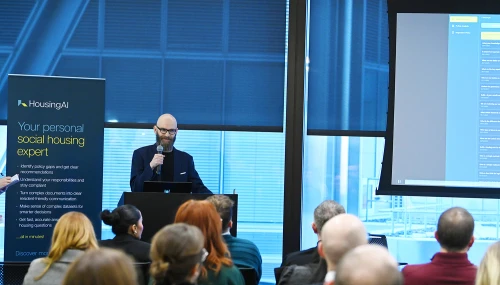
There are approximately 1,400 housing providers in England. Most face broadly the same regulatory pressures, the same stock condition challenges, and the same resource constraints. Yet as Jenny Danson, Chief Executive Officer of Healthy Homes Hub, observed: “As a sector, we end up wasting so much resource and time by not sharing, and definitely not sharing when things don’t go quite as well.”
That observation is the foundation of HousingAI. Conceived by Lee Reevell, Co-founder of Healthy Homes Hub, the platform is a purpose-built social housing AI tool designed not to replace professional judgement but to give every housing professional access to the same quality of knowledge, regardless of their organisation’s size.
What the platform does
Phil Shelton, CEO of HousingAI, describes a system that “democratises housing knowledge across the whole sector.”
At its core is a curated knowledge base of over 1,200 documents covering primary and secondary legislation, regulatory guidance, government and sector documents, best practice, and individual organisational policies.
Unlike general AI tools, which draw on whatever information is publicly available online, HousingAI is governed and fully source-attributed. Users can see exactly which documents have informed each response, and customer data is never shared or used for training.
Three user personas adapt outputs to the individual’s role: a strategic level for boards and executives, an operational level for service managers and heads of department, and a practitioner level for frontline staff. When a question requires proper legal advice, the platform says so.
“Generic AI tools give the best answers they can based on whatever knowledge they can find online. The problem is that may not be up to date or authoritative. Housing AI is curated, governed, and knowledge-based.”
The regulatory case for urgency
The regulatory environment is intensifying. Awaab’s Law came into force in October 2025, introducing fixed timescales for landlords to investigate and remediate hazards. The Competence and Conduct Standard and Social Tenant Access to Information Requirements (STAIRs) are both due in October 2026. Consumer regulation now requires proactive inspections for providers with more than a thousand homes.
Peter Hubbard, Partner at Anthony Collins, is direct about the burden this creates:
“The cost of properly preparing for and undergoing a regulatory inspection is really expensive.”
His view is that AI, deployed well, can change that. Anthony Collins is now contributing legal and regulatory commentary directly into the platform, so subscribers can stay current without paying for every query.
There is also an urgent governance problem hiding in plain sight. Phil Shelton calls it the shadow AI issue. Staff are already using tools like ChatGPT and Microsoft Copilot, often without any policy, governance, or data protection assurance in place. For many providers, a structured platform is not an optional upgrade. It is an overdue necessity.
Data, collaboration, and the airline analogy
AI cannot fix poor data. But it can help providers understand where their data is failing them. Shelton identifies a specific starting point: ensuring every property in an organisation’s stock is mapped to its correct Unique Property Reference Number (UPRN), the consistent identifier that makes cross-referencing between data sources possible. Once that foundation is secure, the possibilities widen: coordinating repairs, planning retrofit strategies, and feeding maintenance data back into development planning.
Jenny Danson draws a wider lesson from another heavily regulated sector. The airline industry, despite fierce commercial competition, shares every near-miss and incident so that the whole industry can learn collectively.
“We’re in a non-competitive area. We should absolutely be focused on residents, stopping the amount of wastage in the sector, and creating better, healthier homes with the money we have available.”
The NHS, she notes, operates in a similar environment but shares far less. Social housing can, and should, do better.
Next steps
HousingAI is at the start of its sector rollout, with pilot organisations including Clarion, Hyde, Anchor, and Raven already engaged. Development plans include a mobile application, training materials linked to the Competence and Conduct Standard, and wider collaboration with CIH, NHF, HACT, and Homes England.
“Housing AI is on its worst day today. The following day will always be better, just because we are getting more and more that we are able to share.”
The platform will only improve as more providers contribute their experience, their policies, and their hard-learned lessons.
For more information or to request a demonstration, visit housingai.uk or contact Phil Shelton at phil@housingai.uk.
Unlock all content
This is the 1 of 3 articles you can access for free. Become a member to unlock unlimited access to our full content library.