

Drone Data Challenges Retrofit’s Performance Gap
6th May 2026
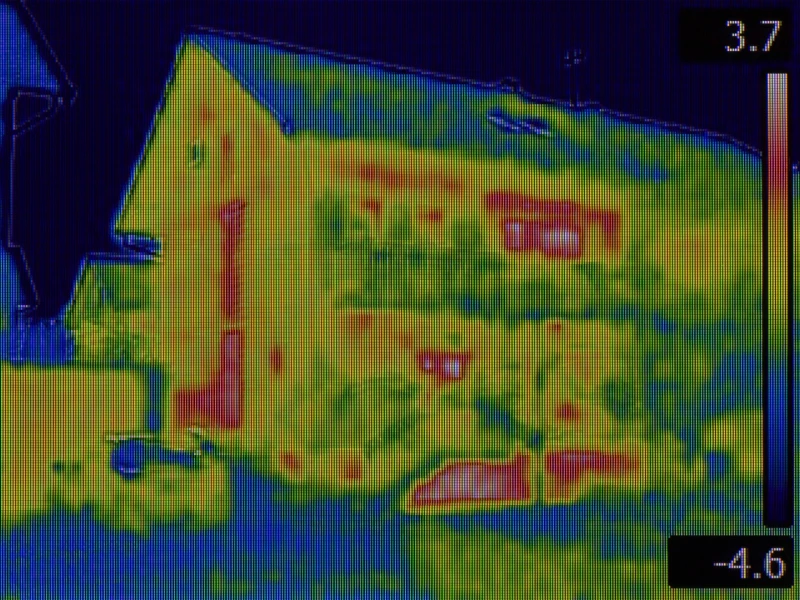
When Peabody and Kestrix independently verified retrofit outcomes using drone thermography, the findings exposed the limitations of modelled data and raised fundamental questions about how the sector measures what it pays for.
At a glance
Government is committing more than £2 billion over five years to social housing retrofit, yet independent outcome verification remains rare.
Independent drone thermography confirmed savings of approximately £520 per home annually and a carbon reduction of around 1.3 tonnes per year.
Thermal bridging was identified at 45% of scanned properties, issues absent from EPC data and outside the retrofit scope.
The accountability gap in social housing retrofit
The social housing retrofit sector is operating on an assumption: that insulation, solar panels and external wall treatments perform as modelled. In most cases, there is no independent mechanism to confirm whether they do.
This matters because the government, through DESNEZ, is committing more than £2 billion over five years to social housing retrofit under the Social Housing Decarbonisation Fund. At the same time, the National Audit Office has raised serious concerns about the quality of some energy company obligation installs, including a high rate of external wall insulation works found to have major issues.
The question housing providers need to answer is straightforward: how do you know whether the work was done well?
The Peabody and Kestrix case study
Peabody, one of the UK’s largest housing associations, has been working with Kestrix, a climate technology company, to test a different approach. As part of SHDF Wave 2.2, Peabody commissioned independent pre and post-retrofit thermal surveys across a subset of homes using drone thermography.
Kestrix captures thermal and RGB imagery of buildings from the air and applies a physics-based algorithm, the Rapid Thermal Performance Assessment (RATHPA), to interpret the results. This is not qualitative. The method converts thermal data into numerical outputs by accounting for surface materials, emissivity, reflectivity and external conditions, producing standardised assessments across large numbers of properties without requiring internal access.
The survey was structured as a blind verification exercise. Peabody did not brief Kestrix on what works had been carried out. Kestrix identified loft insulation and solar PV independently and confirmed both were performing well. Based on this, the estimated saving per home is approximately £520 a year, with a carbon reduction of around 1.3 tonnes annually.
EPC limitations and the 20% planning gap
Peabody has been transparent about the accuracy of its existing data. Modelling, built partly on EPC data, is around 80% accurate for retrofit planning purposes. The remaining 20% has direct operational consequences: wrong priorities, inaccurate contractor briefs, and resident expectations that do not match outcomes.
EPCs are a regulatory requirement under MEES and a mandatory reporting metric, but they were not designed as investment-grade planning tools. They measure cost and building performance, though not with the precision that long-term decarbonisation programmes require. A lodged EPC and a calculated EPC perform similarly in this regard: both carry the same approximate margin of error when applied to large-scale investment planning.
Kestrix does not claim laboratory accuracy. The methodology aims to reach 80 to 90 per cent of a full assessment at a fraction of the cost, and without entering properties. For asset managers prioritising thousands of homes, the value is in directing attention to the right addresses at the right time, rather than applying uniform assumptions across a portfolio.
Thermal bridging identified at 45% of properties
The most significant incidental finding from the Peabody survey was not anticipated. Outside the loft and solar scope, Kestrix identified signs of thermal bridging at window lintels in 45% of the properties scanned.
These issues did not appear in the EPC data. They were not part of the retrofit programme. But they are relevant to resident health. Thermal bridging at junctions creates persistent cold spots on internal surfaces, which increases the risk of surface condensation and mould growth. Left unaddressed, the conditions that contribute to damp are likely to persist regardless of what insulation measures have been installed.
This category of finding illustrates the potential for independent survey data to function as a building passport. Rather than setting the information aside, it can feed directly into asset management systems, inform planned maintenance schedules and allow issues to be sequenced alongside other works already on site. For repairs and planned maintenance teams, knowing the full picture of a building before attending site reduces abortive cost and improves programme efficiency.
Resident engagement and heating behaviour
The case study also highlighted the value of thermal imagery in resident engagement. Where residents were shown images of their own homes and could see clearly where heat was escaping, conversations about access and the purpose of works became more productive. Visual evidence addresses barriers that written communications do not.
Heating behaviour emerged as a separate and relevant factor. A pattern of brief, high-temperature bursts, which some residents had used in the belief it was most efficient, is associated with increased moisture accumulation and a less stable indoor environment. Understanding how residents use their homes is as relevant to health outcomes as the physical fabric of the building.
Practical steps for housing providers
Build independent pre and post-retrofit verification into procurement from the outset. Verification specified at contract stage is more effective and less costly than retrospective assessment.
Review asset data quality before committing to investment programmes. Where EPC data is the primary source, consider what gap that leaves for prioritisation, contractor briefing and resident communication.
Treat incidental survey findings as asset intelligence. Thermal bridging, patchy insulation and unresolved fabric issues identified during surveys should be recorded in asset management systems and linked to planned maintenance programmes.
Use thermal imagery as a resident engagement tool. Visual evidence of heat loss supports more informed and productive conversations about access, improvement works and how homes are used day to day.
Ask contractors how they plan to verify outcomes. Where public funding is involved, performance verification should be a standard contractual expectation, not an additional request.
Review heating advice provided to residents alongside fabric improvements. Behaviour and building performance interact, and correct heating patterns are relevant to both bill savings and indoor environmental quality.
Unlock all content
This is the 1 of 3 articles you can access for free. Become a member to unlock unlimited access to our full content library.