
Decentralised Solar That Halves Tenants’ Bills
12th November 2025
Matt Chenery
The opportunity for social housing
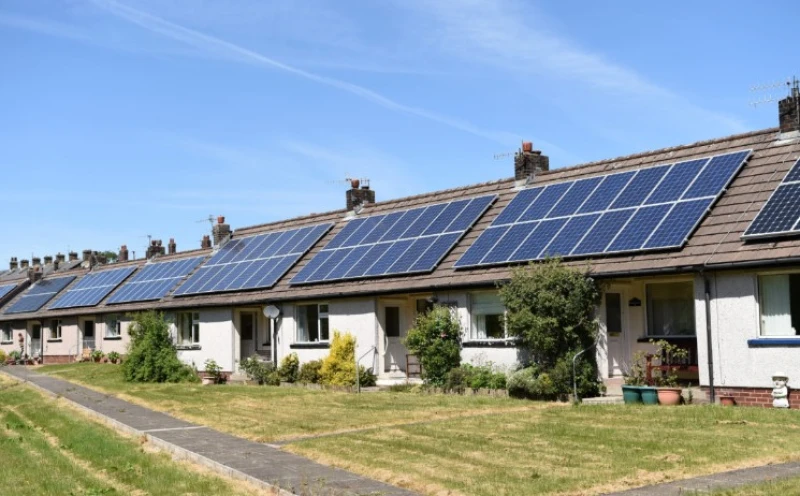
For years, rooftop solar in social housing has been held back by upfront costs, patchy funding models, and lingering distrust from past schemes. But according to Julian Wiley, founder of Zenergy Solar, the game has changed. His company’s integrated model – combining solar PV, battery storage, AI‑driven energy management, and grid trading – is now being delivered at no cost to landlords, with tenants seeing energy bills halved from day one.
“It’s total common sense to generate on your roof, use it locally, and trade the excess,” Wiley says. “We can now do that in a way that’s bankable for funders, viable for landlords, and transformative for residents.”
From handbags to heat pumps
Wiley’s route into renewables was anything but typical. After decades in fashion – “I sold 50 million handbags, and I was polluting in quite a big way” – he switched to clean energy in response to the environmental impact he saw first‑hand. Early ventures in small‑scale wind and ground‑source heat pumps were followed by a growing track record in solar, battery integration, and grid balancing.
But the journey was far from smooth. “The sector has been a solar coaster,” he recalls. “Policy changes, subsidies removed, government not behind it. We lost money a few times. But we knew the fundamentals stacked up.”
Care homes as a proving ground
A major breakthrough came through large‑scale deployments in care homes – environments with high, consistent energy use, similar in profile to a block of flats. These projects integrated ground‑source heat pumps, containerised batteries, and high‑spec black solar panels to deliver carbon‑zero buildings with around 50% lower bills.
“It works anywhere if you apply the same methodology,” Wiley says. “But the care home sector showed us how to design at both small and large scale.”
The integration of AI has been key. The system learns a building’s usage patterns, buys energy at off‑peak prices, trades surplus when prices are high, and participates in grid flexibility markets such as the National Energy System Operator’s Demand Flexibility Service and the Virtual Energy System. With portfolios of 20,000+ homes, landlords can participate in Virtual Lead Party arrangements, unlocking long‑term revenue streams to share with tenants.
Making the numbers work
The model’s financial viability rests on reframing the proposition for funders. “Banks are comfortable with greenfield solar and battery parks,” Wiley explains. “All we’ve done is decentralise that. Twenty thousand homes with rooftop PV and batteries are effectively a 100 MW solar park with a 400 MW battery – but without the seven‑year wait for a grid connection.”
Funders cover the capital cost
Tenants’ bills are cut by around 50%
Once the funder is repaid, profits are shared equally between landlord and tenant
Landlords also receive the asset itself, increasing portfolio value and helping them progress towards EPC Band C. Providers can align delivery with the decarbonisation-fund-wave-22">Social Housing Decarbonisation Fund (SHDF) (Wave 2.2 guidance PDF | July 2025 stats).
Overcoming sector hesitancy
If the model works, why isn’t it already widespread? Wiley points to three barriers: historic mistrust of solar schemes, the perceived risk of making a “wrong” procurement decision, and slow policy support.
“The only way past that is transparency,” he says. Projects should be tracked in independent systems such as eviFile, giving landlords and funders live visibility of installation, spend, and performance. The policy direction is clearer too, with Ofgem’s energy system digitalisation strategy and NESO’s Virtual Energy System paving the way for more flexible, decentralised models.
Beyond solar: heating and health
Wiley sees the model as a foundation for a “fabric second” approach – using solar revenues to fund building fabric upgrades and low‑carbon heating. He highlights the potential of far‑infrared heating for rapid comfort and fabric warming, alongside retrofit delivered to PAS 2035:2023 standards.
This link to health is critical. “It’s wrong that we have prepayment meters people can’t afford to top up,” Wiley argues. “We can use revenue share to pay off arrears or keep the lights and heating on – no one should be left in a cold, dark home.”
Scale is the unlock
The economics are strongest when delivered at volume. Larger orders reduce installation costs, remove marketing spend, and secure the best hardware at scale. Wiley’s ambition is for multiple providers to roll out similar models in parallel. “Four million social homes. If 20 or 30 companies like ours each deliver 20,000 a year, the sector could be decarbonised in a decade – and fuel poverty eradicated.”
“Every single social property has a grid connection. We can put solar on there. We can halve tenants’ bills. We can decarbonise. And it’s here now.”
Julian Wiley, Zenergy Solar
Practical steps for housing providers
Assess your portfolio for scale potential – Aggregated projects deliver better economics, faster EPC uplift and stronger negotiating power with funders.
Engage early with funders and aggregators – Ensure routes to Demand Flexibility Service participation and consider Capacity Market revenues via qualified partners.
Build in transparency and tenant protections – Use independent project tracking (e.g. eviFile) and legal frameworks that guarantee no disadvantage to residents.
Plan for “fabric second” – Leverage early solar revenues to fund insulation, ventilation, heating upgrades and mould remediation, delivered to PAS 2035/2030:2023.
Collaborate with peers – Joint procurement or shared VPP participation via Virtual Lead Party models can increase revenues and reduce risk.
Unlock all content
This is the 1 of 3 articles you can access for free. Become a member to unlock unlimited access to our full content library.