

A Plan for Every Home: Why Asset Strategy Is a Health Intervention
23rd July 2026
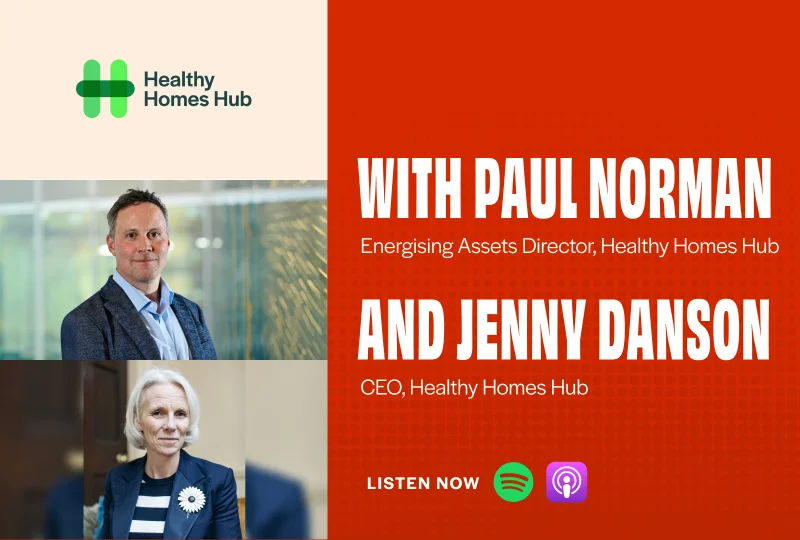
How a bottom-up planning model, and the headspace to think in decades, turns asset strategy into a health intervention.
At a Glance
- “A plan for every home” replaces annual, top down budgeting with a model built from stock condition and customer data, home by home, giving residents the same visibility into their home's future that they would expect from any other service they use.
- Energising Assets, a service for housing providers, delivered by Healthy Homes Hub, acts as a continuing voice on the shoulder across an organisation, helping asset teams, finance, execs and boards move past short-term compliance cycles and shape a genuinely long-term strategy that survives changes in leadership.
- HousingAI absorbs the routine, policy-driven share of asset strategy work, standardising compliance across the sector so it stops consuming the capacity organisations need for that longer-term work.
Host: Jenny Danson, CEO and Co-Founder, Healthy Homes Hub
Guest: Paul Norman, Director, Healthy Homes Hub (Energising Assets)
“A plan for every home” replaces annual, top down budgeting with a model built from the ground up, using stock condition surveys and customer data for each individual property. Residents gain visibility into short, medium and long-term investment in their home, comparable to tracking a parcel delivery, rather than waiting on a scrutiny panel report or a website update. Housing associations that adopt the model can scale it upward, from home to street, region and organisation, without losing detail along the way.
Deferred maintenance costs compound over decades rather than years. Letting cyclical redecoration slip lets a property's condition deteriorate as a whole, not one window at a time: painting a property's windows costs around £750, while leaving them can mean replacing those same windows for £20,000 a decade early, with disrepair claims from the same properties often surfacing in ombudsman reports. The same logic applies to damp and mould. A reactive £500 mould wash treats the mould without addressing the underlying damp, whereas a £10,000 preventative measure, spread across a 30-year asset life, comes in under £500 a year and deals with the damp itself. On a complex converted property, a full retrofit can run to £30,000 to £50,000, underlining how much more a problem costs once it has been left to become structural.
Housing associations typically draw 80% to 90% of their income from rent, and that income stays secure only while properties are properly maintained and tenancies hold. Poor conditions work against that from both directions: unresolved damp and disrepair drive complaints, compensation claims and voids, while the costs of living with ill health add pressure to household budgets already stretched between heating, food and rent. Viewed this way, resident health sits underneath the housing business model rather than beside it, and asset investment decisions carry consequences for arrears and business planning as much as for damp and disrepair.
Energising Assets, the division Paul Norman leads at Healthy Homes Hub, brings together the Hub, Energiesprong UK and Baringa Partners around organisations working through a long-term strategy. Its role is to act as a continuing voice across asset, finance, executive and board teams, helping each understand what the others are trying to achieve, since finance and asset colleagues are often solving the same problem while describing it in different language. Because the input comes from a collective rather than one adviser, a strategy is built to survive changes in personnel or political direction, rather than depending on whoever happens to be driving it at the time.
HousingAI standardises the routine, policy-driven share of asset strategy work that every provider must deliver regardless of size or region. Freed from reproducing that baseline alone, organisations gain the headspace to shape the share that reflects their own residents and places, and to work with neighbouring providers from a shared starting point rather than duplicating effort down the same street.
Practical steps for housing providers
- Map current stock condition and customer data property by property, rather than relying on organisation-wide averages, as the basis for a genuinely bottom-up asset plan.
- Bring finance and asset teams into the same room to test whether they are describing the same problem in different language before assuming a strategy conflict exists.
- Model the multi-year cost of deferring routine work, such as cyclical decoration, against the accelerated replacement costs it can trigger.
- Compare the whole-life cost of retrofit against the recurring cost of reactive repairs on the same properties, rather than judging retrofit spend in isolation.
- Set a long-term vision beyond the next regulatory deadline, then work backwards into deliverable milestones at five and ten years.
- Test a proactive maintenance approach in one estate or archetype before scaling it, rather than attempting a full transition in one step.
- Review how visible investment plans are to residents, and consider what it would take to give them the same clarity they get tracking a delivery.
Get in touch
Paul Norman, Director, Energising Assets, Healthy Homes Hub
Contact Paul: paul@healthyhomeshub.uk
Find out more about Energising Assets: https://healthyhomeshub.uk/energising-assets