
Curtailed Wind Power Could End Fuel Poverty
14th October 2026
Jenny Danson

Energy Cloud converts renewable power that grid operators would otherwise switch off into stored heat and bill credits for households already choosing between eating and heating.
At a glance
National Energy Action estimates that six to seven million UK households are in fuel poverty, roughly double the government's official figure of three million, using a measure based on the share of income spent on energy.
Energy Cloud calculates that 5,600 gigawatt hours of wind power were curtailed in the first six months of 2026, worth around £1.5 billion at retail prices.
The model already operates at scale in Ireland, where hundreds of thousands of homes receive credits from every major retailer, and Yorkshire Housing is now working with the Healthy Homes Hub and Energy Cloud to test it in England.
Renewable generation now supplies most of the electricity used in UK homes, yet a growing share of it never reaches a meter. When wind farms produce more electricity than the network can carry or the country can use, the response is to switch them off. In the Shetland Islands, the Viking wind farm stands idle for large parts of the year for that reason, while households beneath its turbines struggle to heat their homes. Energy Cloud, a social enterprise working across the energy sector, exists to close the gap between wasted energy and households that cannot afford to use it.
Two measures of the same problem
The government's official fuel poverty figure for England is three million households. National Energy Action, a charity tracking the issue for more than three decades, puts the number closer to six or seven million, measured by the share of household income spent on energy. Ten per cent or more counts as fuel poverty regardless of EPC rating, so a good EPC band can still leave a tenant in fuel poverty on a low enough income.
The cost of energy nobody uses
Energy Cloud puts curtailment at 5,600 gigawatt hours of wind power switched off in the first six months of 2026, worth an estimated £1.5 billion at retail prices, or roughly £3 billion across a full year.
That cost does not disappear. Wind farms are contracted to a guaranteed level of generation, so when told to stop, the generator is paid a curtailment penalty, recovered through everybody's bills. High generation also strains transmission networks, adding maintenance costs passed on the same way. Households already in fuel poverty are, in effect, paying towards energy nobody received.
Storage as the connecting mechanism
Energy Cloud treats surplus generation as a resource to redirect, rather than a problem to manage away, through two mechanisms. Where a household has a hot water tank, a controller switches on the immersion heater during periods of surplus, turning electricity into stored heat before it is wasted. Electric storage heaters, increasingly reinstalled as homes decarbonise, do the same job using dry storage.
For households without either, a messaging platform alerts them to surplus periods, so a washing machine or other appliance can run at a lower, or free, rate. Retailers, working through Ofgem and system operator NISO, provide bill credits, funded partly through corporate social responsibility commitments. The stated ambition is a zero social tariff, in which households most exposed to fuel poverty pay nothing for energy that would otherwise have gone to waste.
A model already tested elsewhere
The approach began in Ireland, developed from the logic of Food Cloud, a scheme that redirects surplus food from supermarkets and restaurants to charities rather than letting it go to waste. Hundreds of thousands of Irish homes now take part, with every major retailer providing credits, and Northern Ireland's system operator is exploring a similar zero tariff. In Scotland, Energy Cloud is working with housing associations in the Shetland Islands, where curtailment and fuel poverty sit side by side.
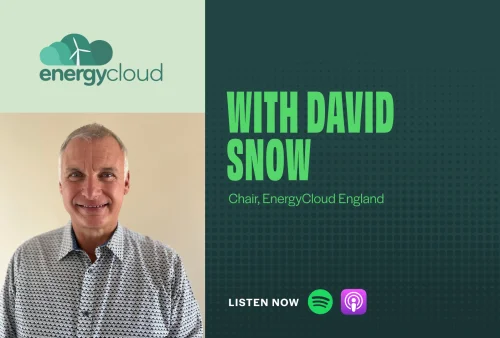
England is at an earlier stage. David Snow, an experience director at Energy Cloud with more than thirty years in the energy sector, including senior roles at BP, Siemens and SMS, has held his current role for a few months, engaging NISO, network operators, retailers and technology providers alongside housing associations. Yorkshire Housing is now working with the Healthy Homes Hub and Energy Cloud on scaling this into English social housing.
Where the model has limits
Storage and messaging do not help every household equally. Properties fitted with combi boilers have no straightforward way to store surplus heat, and poorly insulated homes may lose the benefit of any heat gained. The social housing sector is already pursuing retrofit and storage heater installation through existing grant schemes, but the hardest properties to treat may also house the tenants at highest risk of fuel poverty.
A separate equity concern runs through the wider system. Demand flexibility, shifting energy use to cheaper or cleaner periods, already benefits households that can afford batteries, electric vehicles or solar panels. Prepayment meter customers, and those in fuel poverty more broadly, are least able to take advantage of variable tariffs or storage technology on their own. For the Healthy Homes Hub, this reflects a principle that recurs across healthy homes work, that shifting energy demand only narrows the fuel poverty gap if households without means to invest in enabling technology are included in its design from the outset.
A long transition, not a single fix
Coal and gas generation could be increased or reduced to match demand. Renewable output cannot be throttled the same way, so a small amount of gas generation is held in reserve as backup while household and grid-scale storage capacity is built out. Offshore wind capacity is expected to triple in coming years if current government plans proceed, meaning curtailed volumes are likely to grow before storage and network investment catch up.
Energy Cloud's stated position is that success would mean the organisation is no longer needed, once storage is common enough and tariffs fair enough that intermediaries are not required. Reaching that point depends on the system remaining financially sustainable as well as environmentally so, since subsidy costs for new renewable capacity have themselves pushed bills up across the UK.
Practical steps for housing providers
Map tenant energy profiles against the ten per cent income threshold National Energy Action uses, rather than relying on EPC banding alone, to identify who is genuinely at risk: https://www.nea.org.uk
Review stock condition to separate homes with hot water tanks or storage heater potential from those tied to combi boilers, since the two groups need different interventions.
Ask whether existing demand flexibility offers in the area include households without batteries, solar panels or electric vehicles, or whether they are designed around those who already have them.
Speak to local network operators and retailers about curtailment patterns and any community or CSR funded schemes already active nearby.
Follow the Yorkshire Housing and Energy Cloud partnership as an early evidence base for scaling storage and messaging models into English social housing.
Image credit: Adobe Stock
Unlock all content
This is the 1 of 3 articles you can access for free. Become a member to unlock unlimited access to our full content library.