
Could EPC Data Help Us Assess Overheating? One Researcher Is Finding Out
19th July 2026
Jenny Danson

When the UK introduced Part O of the Building Regulations in 2022, it was a landmark moment: for the first time, overheating assessment became mandatory for new residential buildings in England. But Part O only applies to new homes. The millions of existing properties in the social housing stock, many of them ageing, poorly insulated, and increasingly exposed to summer heat, remain largely unassessed for overheating risk.
Marlena Swan, a PhD researcher at Loughborough University, is working on that problem. Her research asks whether the data we already hold on existing homes, primarily through EPC assessments, could be used to conduct meaningful overheating assessments at scale, without the need for the detailed modelling that is currently beyond reach for most social landlords.
Healthy Homes Hub spoke with Marlena about her research, what she has discovered about the reliability of existing models, and why the gap between a model and reality is wider than many people assume.
A practical question with big implications
Marlena came to her PhD with an unusual combination of experience: a background as an architect working on social housing developments and energy efficiency retrofit, followed by a secondment to the Department for Energy Security and Net Zero (DESNZ) partway through her doctorate. That secondment shaped the direction of her research significantly.
"My feeling was that the energy efficiency side is fairly well understood, and the people who give advice know exactly what they are doing," she explains. "The gap is really more about trying to push for getting reliable evidence on how bad the overheating problem is and how we can effectively reduce it."
The result is a research focus with direct relevance to policy: can a simplified model, built on EPC-level data, tell us whether a home is likely to overheat, and if so, what can be done about it?
Full dynamic thermal modelling, such as TM59¹ assessments, requires detailed input data that is rarely available for existing homes. EPC data, by contrast, already exists for most of the housing stock. If it can be used to generate reliable overheating assessments, it would open up the possibility of screening large portfolios for risk without needing bespoke surveys of every property.
Building the foundation: calibrated models
Before simplifying anything, Marlena first had to establish how accurate a detailed, carefully calibrated model could be. She is working with two case studies: the Loughborough test houses on campus, and a modern flat in Brentford, London, which has been monitored under controlled conditions.
The Loughborough houses offer particularly clean data. One was kept completely unoccupied with windows closed throughout the summer, isolating the thermal behaviour of the building shell itself. The other was synthetically occupied, with heat sources replicating a resident's daily patterns of movement and activity, and windows opened according to a set schedule. This kind of controlled monitoring, free from the unpredictability of real occupants, gives researchers the clearest possible picture of how the building actually performs.
Even with all of that data available, calibrating the models proved harder than expected. Marlena used automated calibration methods, applying global sensitivity analysis to identify which input parameters most affect indoor temperatures, and then mathematical optimisation techniques to find the combination of inputs that best matches the measured data.
"Even a calibrated model is just a model," she says. "It might give you the right results, but it doesn't mean that it's perfectly reflecting reality."
The wider research context reinforces this point. Work by other researchers using experienced modellers to assess the same buildings has found temperature predictions ranging up to five, six, or seven degrees off the measured values. On an hourly basis, which is the timescale on which overheating assessments are conducted, that level of inaccuracy is not a minor technical issue; it is the difference between a building that appears to comply with comfort thresholds and one that clearly does not.
The surprising finding: modelling is more art than science
One of the most striking discoveries from Marlena's calibration work is how much certain inputs affect the results, even when those inputs are rarely measured or standardised.
One example is the solar absorptance of brick: how much solar energy the external wall surface absorbs rather than reflects. The values for this parameter can vary considerably, and in homes that are not heavily insulated, that variation can be the deciding factor in whether a model predicts overheating or not. Yet it is almost never measured in practice.
More broadly, Marlena found that industry guidance on how to set up dynamic thermal models is less prescriptive than she expected. Many settings that influence temperature predictions are not standardised, meaning that two assessors modelling the same building could reach different conclusions simply because of different choices about inputs and defaults.
"There are no standard ways to set them up," she says. "There is guidance on some settings, but plenty of other settings that affect temperature predictions are not standardised."
She hopes her research will give model developers reason to revisit the defaults their software ships with, since those defaults are what most practitioners use without question.
For social housing providers commissioning overheating assessments or relying on modelling outputs to make retrofit decisions, this is an important caution: the results are only as good as the inputs and assumptions behind them, and those are rarely made visible.
The next stage: simplifying without losing the point
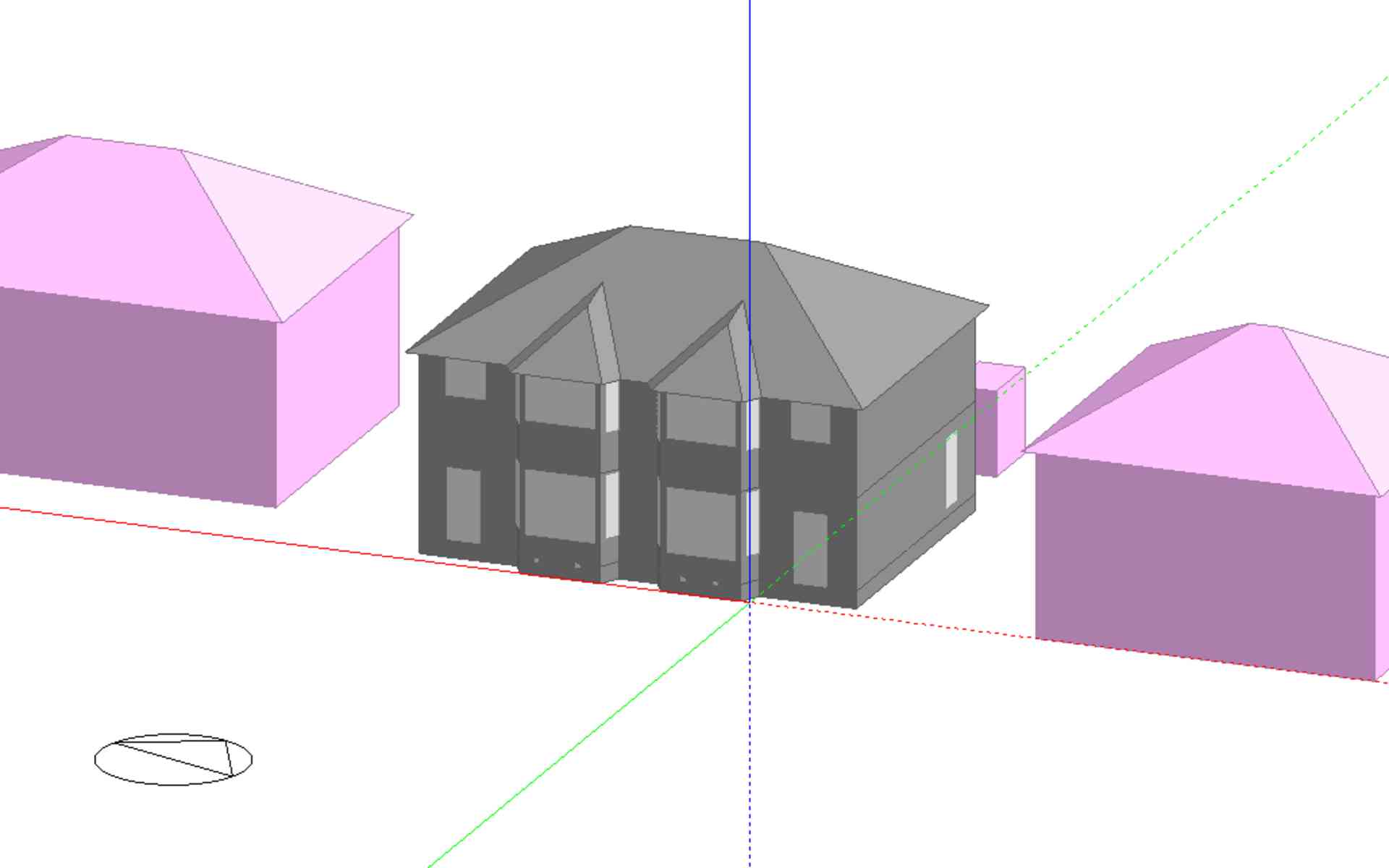
Having established her calibrated baseline models, Marlena is now exploring how much the models can be simplified without losing the ability to draw useful conclusions.
One area is ventilation modelling. The TM59-recommended approach is complex and computationally intensive. A simpler alternative treats infiltration and ventilation as a single constant value throughout a simulation. Marlena is testing whether this simpler approach affects the accuracy of overheating predictions, or whether it changes the conclusions enough to matter.
The other major area is zoning. A full dynamic thermal model divides a building into many zones, each with its own thermal behaviour. A model aligned with RdSAP²-style assessment would use only two zones. The question Marlena is exploring is whether a two-zone model leads to the same conclusions about whether a building is likely to overheat, even if it is less precise about the exact temperatures involved.
Crucially, she is also asking whether simplified models can still identify which mitigation measures are most effective. For existing buildings, the practical question is rarely just whether overheating will occur; it is what to do about it. If a simplified model can reliably point towards the right interventions, it may be fit for purpose even if it cannot match the precision of a full TM59 assessment.
"You can actually measure whether a building overheats," Marlena points out. "So for existing buildings, it's really about whether a simple model can realistically assess what we can do about it."
Questions for housing providers to reflect on
Your organisation may have commissioned dynamic thermal modelling for overheating assessments. Do you know what assumptions and defaults those models used, and whether different modelling choices could have produced materially different conclusions?
As you think about overheating risk across your existing stock, are you relying on EPC data as a proxy for thermal performance? What would it mean if the relationship between EPC ratings and overheating risk is less reliable than assumed?
When retrofit measures are specified to reduce overheating, how confident are you that the evidence base for those measures accounts for the way your residents actually live in their homes, rather than a modelled average occupancy?
Key takeaways
Existing overheating models are less reliable than most people assume. Temperature predictions from experienced modellers on the same building can differ by five to seven degrees. For housing providers using modelling outputs to make investment decisions, understanding the uncertainty behind those numbers matters.
Standardisation gaps create inconsistency. Many settings in dynamic thermal modelling software are not standardised by industry guidance, meaning two assessors can reach different conclusions on the same building. This is an area where Marlena's research may prompt improvements to both guidance and software defaults.
A simpler approach may still answer the right question. The goal for existing housing is not perfection; it is identifying which homes are at risk and what can be done. If EPC-level data can support that, it could transform how social landlords screen and prioritise their stock for overheating intervention.
Notes
¹ TM59 is the CIBSE methodology for assessing overheating risk in naturally ventilated residential buildings, published in 2017. It sets thresholds for acceptable temperatures in living areas and bedrooms, uses a standardised occupancy profile, and is the basis for Part O compliance in new homes. Full TM59 assessments require detailed building data that is rarely available for existing properties. See Healthy Homes Hub’s article on Niloo Todeh Kharman's research for more detail on TM59 thresholds and their application.
² RdSAP (Reduced Data Standard Assessment Procedure) is the version of the Standard Assessment Procedure used for existing dwellings, where full design data is not available. It underpins EPC ratings for the existing housing stock and models a building in two zones using standardised occupancy and heating assumptions. Because it is designed to assess energy efficiency rather than overheating, it does not capture the dynamic hourly temperature behaviour needed for overheating assessment, which is why Marlena's research into whether RdSAP-level data can still support useful overheating conclusions is significant. SAP, the full version, is used for new builds where complete design information is available.
This article draws on a recorded conversation between Healthy Homes Hub Founder and CEO Jenny Danson and PhD researcher Marlena Swan, conducted in July 2026. Marlena is in her final year of the EPSRC Centre for Doctoral Training in Energy Resilience and Built Environment (ERBE CDT) programme at Loughborough University. Her doctorate is co-sponsored by the Department for Energy Security and Net Zero. Findings are from ongoing research; the simplified modelling analysis is currently in progress.
Image credit: Marlena Swan
Unlock all content
This is the 1 of 3 articles you can access for free. Become a member to unlock unlimited access to our full content library.