
Compliance Must Evolve: From Process to Purpose
5th March 2026
By Ryan Dempsey, Chief Executive Officer, TCW
For years, compliance has been viewed as a process, something we do to meet legal obligations, pass audits, and reduce risk.
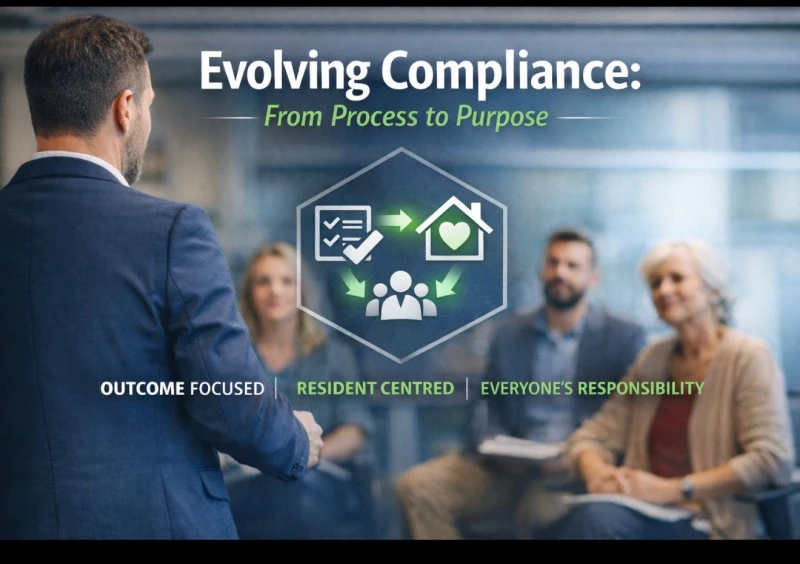
But in 2025/26, I personally believe we are standing at a pivotal moment. The sector is beginning to shift, or at least trying to, from a process-driven mindset toward something far more meaningful: an outcomes-focused, resident-centred approach to compliance.
This shift is really important, because compliance was never meant to be about paperwork. It exists to keep people safe.
Traditional compliance models focus heavily on evidence of activity, things like inspections being complete completed, forms signed, reports filed. Yet residents don’t experience compliance as a spreadsheet. They experience it through safe homes, functioning systems like hot water and heating and trust in those responsible for managing risk.
An outcomes-focused approach changes the narrative. It doesn’t ask “Did we complete the process?”, instead it demands that we ask “Did we genuinely improve safety and wellbeing?”. That subtle change in thinking fundamentally alters how organisations behave.
So, how do we enable that shift?
Moving toward outcomes requires more than new systems or policies. It requires a change in behaviour and leadership culture. I'm very grateful for the position I hold in TCW as it gives me the ability to interact with organisations making real progress, interestingly though, they all demonstrate several similar characteristics:
Curiosity over complacency, continuously asking “what could go wrong?” rather than assuming compliance equals safety.
Transparency over defensiveness, seeing gaps as opportunities to improve, not failures to hide.
Accountability with empathy, recognising that compliance is delivered by people, not processes.
Data-informed judgement, using information to support decisions, not replace professional responsibility.
Technology can support this journey, but it cannot replace competence, judgement, or ownership.
Beyond minimum legal adherence
The legal baseline for compliance should be viewed as the floor, not the finish line. When compliance becomes a checklist exercise, organisations risk doing the minimum required rather than what is genuinely needed. That mindset creates fragility, because risk doesn’t sit neatly inside regulations.
The real opportunity is to turn compliance into continuous improvement,
Learning from incidents, near misses, and patterns.
Embedding risk awareness into everyday decision-making.
Treating compliance as a living operational discipline rather than an weekly, monthly or annual event.
When done well, compliance stops being a burden and becomes a source of confidence, both internally and externally.
We have to really understand that compliance is everyone’s responsibility. One of the biggest barriers to progress is the belief that compliance belongs to a specific team. It doesn’t. Compliance is delivered by….
The operative who notices something isn’t right.
The manager who prioritises remediation over convenience.
The leadership team that sets expectations and culture.
The board that asks better questions.
And, the resident who feels confident enough to speak up.
For housing leaders, the responsibility is clear, create the environment where safe decisions are the easiest decisions to make. That means clarity of accountability, visibility of risk, and a culture where raising issues is encouraged, not feared.
Transparency
Transparency is still an uncomfortable subject across the sector. Many organisations are improving their internal reporting, but true transparency goes further, it means being honest about challenges, progress, and lessons learned. Trust grows when stakeholders can see not only what is working, but how issues are identified and addressed. Compliance should not be invisible. It should be visible proof of care.
Ok so, where does the resident fit in to the process?
If compliance is about safety, then the resident must sit at the centre. Residents often see risks long before systems do. Their experiences provide context that data alone can’t capture. The challenge for the sector is not just hearing the resident voice, it’s finding a way to act on it.
This means creating clear routes for residents to raise concerns. Demonstrating how feedback leads to action and communicating openly about decisions and outcomes. When residents see change happen, trust follows.
A recent example in Wales, which is being pushed throughout the rest of the UK is a great example of process over engineering. In Housing we are instructed to send very technical compliance electrical documents to residents within 14 days yet common sense would say the HA’s should communicate information correctly to residents. Sending a document that is compiled with science and principles with a few negative words like Unsatisfactory, Potentially Dangerous simply leads to increase disrepair and complaints and a break down of trust.
The future of compliance
The future isn’t about more checklists or more dashboards. It’s about maturity and transparency, moving from proving we have done something to proving it made a difference. Compliance done well is not a department or a part of someone’s job, it is a culture. And culture is shaped by leadership, ownership, and a shared understanding that safety is everyone’s role, because ultimately, compliance is not about avoiding failure, it is about actively creating safer environments through continuous learning and action, every single day.
Unlock all content
This is the 1 of 3 articles you can access for free. Become a member to unlock unlimited access to our full content library.
Author