Smart Controls For Storage Heating: What 400 Homes Taught Trust Housing Association
2nd November 2026
Jenny Danson
Retrofit conversations often focus on the fabric of a building or the replacement of a heating system. At a recent Healthy Homes Hub session at the Housing Scotland Conference, Ian Davie, Director of Assets and Sustainability at Trust Housing Association, shared a different and refreshingly practical story: what happens when you keep the heaters you have, add intelligence to the controls, and put the resident experience at the centre of the project.
Ian's presentation covered a project to install smart controls in 400 homes with electric storage heating. It was delivered with Connected Response, and it also attracted grant funding from the Scottish Government. The results offer useful evidence for any landlord thinking about thermal comfort, energy costs and the future of older electric heating.
A landlord that also manages the heat
Trust Housing Association is a national registered social landlord with 4,000 properties and a presence in 23 of Scotland's 32 local authority areas. What makes its position distinctive is that it does not simply own the homes. For around 2,000 customers, it procures and manages their heat and hot water through a Heat with Trust service, developed in consultation with residents.
The model is straightforward. The landlord holds large energy contracts with electricity and gas providers, procured through public sector frameworks. In homes with electric storage heating there are two separate meters: one covering heat and hot water, and the customer's own domestic meter for lighting and power. Customers pay an annual amount for heat and hot water based on household size, set using energy price forecasts and the previous year's consumption. The landlord does not make a profit from the service.
Consultation with residents showed just how much they value the service. Knowing their home will stay warm provides peace of mind, while removing the need to navigate complex energy tariffs or worry about bills fluctuating throughout the year. A dedicated energy team is also available to answer any questions and provide support when needed.
Why change was needed
Before 2022, the charges for the service had remained static at around £40 a month. The energy crisis of 2022 and 2023 made that position impossible to sustain, and increases were unavoidable. They arrived at a time when Scottish housing associations were also absorbing wider inflation, rising interest costs, investment pressures and continued uncertainty about the cost of decarbonisation.
At the same time, the team was receiving concerning feedback from residents about inconsistent temperatures in their homes. Some customers described being uncomfortably warm during the day but cold in the evening, while others reported temperatures reaching almost 30 degrees at times. The housing portfolio in question includes a mix of traditional and high heat retention heaters, with older models relying on fixed charging periods.
Many residents struggled to understand the controls and relied heavily on the boost function to manage their heating. As Ian explained, the heaters themselves were not failing, they simply weren’t meeting the needs of the people using them.
The challenge was to address these issues without replacing entire heating systems. The team wanted to retain existing heaters wherever possible, introduce smarter controls that could be managed and monitored by the landlord, and minimise disruption for residents.
How the technology works
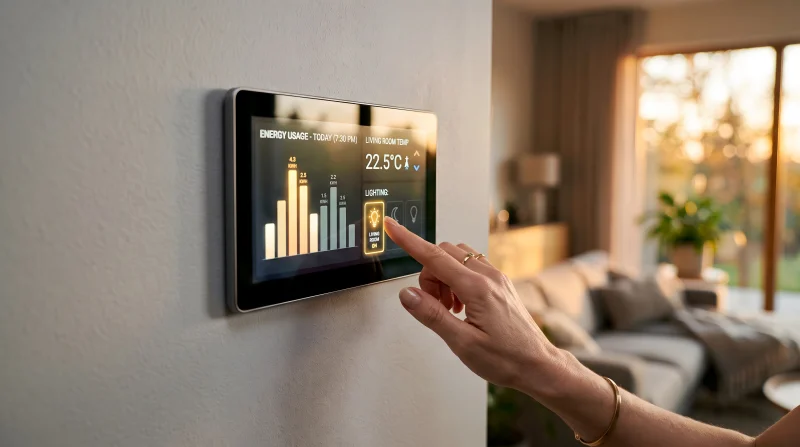
The Connected Response solution is a retrofit that is light on equipment. A temperature sensor sits in the living room, and a smart load switch is fitted in the old meter cover. The system monitors the indoor temperature and the local weather forecast, then automatically adjusts the charging period of the heaters to achieve the desired temperature. In milder weather, the charge period shortens, and in colder weather it extends.
For the first time, the landlord now has access to a data platform, meaning it can monitor temperatures against the 18°C benchmark and intervene where a home is not adequately heated. It also gives the team a valuable tool for managing and mitigating the risk of damp and mould.
Putting residents first
The installation was only part of the picture. Connected Response also delivered tenant engagement sessions to explain how the smart controls work and why they are beneficial. This proved valuable for residents and their families, and for frontline staff, who are often the first to be asked about comfort in the home.
The project also enabled the landlord to prepare for the national phase-out of Radio Teleswitch Service (RTS) meters. By co-ordinating upgrades across all 400 homes, the team was able to manage the transition proactively, reducing the risk of unexpected disruption and emergency callouts for residents.
What the data shows
The performance data shared during the session was encouraging. On colder days, when outside temperatures dropped below 12°C, homes maintained an average indoor temperature of around 23°C over a 24-hour period, without the significant fluctuations that residents had previously experienced. More than two years after installation, average indoor temperatures have remained consistently between 23 to 24°C. The data also showed a substantial reduction in charging hours during the summer months, reflecting lower energy demand and demonstrating that the system was responding as intended.
The comparison between heater types was particularly reassuring. Homes with high heat retention heaters and homes with older storage heaters track very closely on both indoor temperature and energy consumption. That validates the decision to invest in smart technology for the older units.
Further data compared homes across five registered providers using the same heating system in general needs properties, where residents pay their own energy bills, with those covered by the heat service. The comparison looked at the proportion of homes with average indoor temperatures below 18°C. In Trust's heat service homes, just 6%fell below this threshold, compared with significantly higher proportions among the other providers. Ian was candid that the 6% figure included some long-term vacant properties, so it is slightly overstated. Even so, the contrast raises an important question for the sector: how can landlords better support residents to maintain comfortable temperatures when they are responsible for their own energy bills?
From retrofit to intelligent asset management
The team was honest about the difficulties too, with most of the installation challenges coming from interactions with energy companies. Their conclusion, though, was that installation is only the start of the journey. The landlord is now managing energy performance with real data, and the project has moved from retrofit to intelligent asset management. It has gained controllable electrical demand, better operational data and a solution that was delivered without compromising customer comfort. The smart controls have also extended the life of many older storage heaters, and the strong partnership with the Scottish Government has led to further funding connected to the project.
Why it matters for the sector
This project shows that thermal comfort, energy efficiency and resident trust can improve together without ripping out what is already in the home. For landlords with electric storage heating, and for those exploring guaranteed minimum temperatures, the combination of simple controls, live data and genuine resident engagement is definitely worth a closer look.
Image credit: Adobe Stock
Unlock all content
This is the 1 of 3 articles you can access for free. Become a member to unlock unlimited access to our full content library.