
A Showcase on Data, Responsibility and Readiness
24th June 2026
Jenny Danson
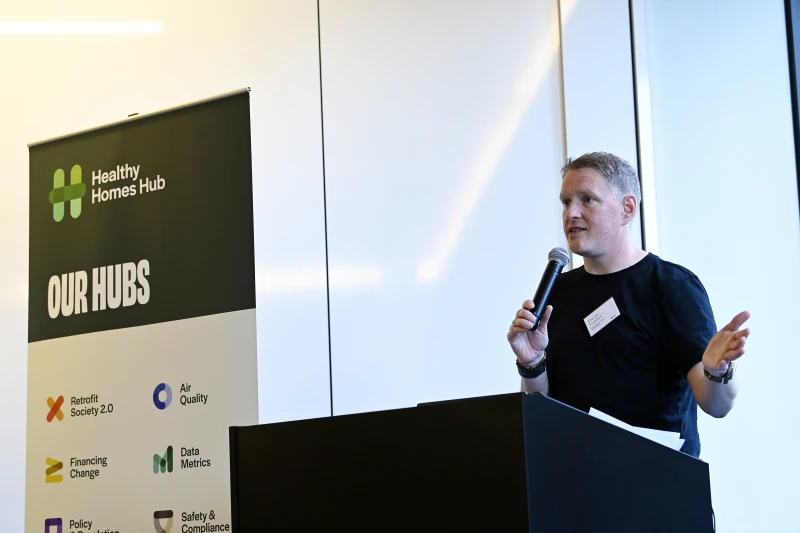
This workshop explored how housing providers can use data more intelligently, responsibly and practically to improve resident outcomes, reduce avoidable cost and support more effective asset investment. The discussion focused on moving from fragmented, component-led approaches to joined-up, place-based and outcome-led decision-making.
The central argument was that housing organisations should use data to understand the relationship between homes, residents and places, rather than treating asset performance and customer experience as separate issues. Data should inform decisions, but not replace human judgement, because housing decisions affect people’s lives, health, finances and communities.
Main points
Housing providers often hold significant data, but it is commonly fragmented across housing, asset, repairs, procurement and customer systems.
Asset data and customer data are usually managed separately, which limits the sector’s ability to understand why homes perform well or poorly for different households.
Traditional investment planning is often based on component replacement cycles, regulatory minimums and theoretical average households.
Resident needs change over time, while the physical asset remains largely fixed; investment models need to reflect changing household size, health, vulnerability, income, lifestyle and local connection.
Outcome-led planning should focus on comfort, health, affordability, wellbeing, satisfaction and fairness, not just whether kitchens, roofs, boilers or bathrooms have been replaced.
Place-based working can help tailor services and investment to the needs of specific communities, supported by stronger links with health, education, policing, local authorities and other partners.
Predictive analytics can help identify risks earlier, such as poor service, damp and mould, under-occupation, over-occupation, complaints and unsuitable homes.
IoT has a role, but only where organisations have the operational infrastructure, governance and capacity to act on the alerts and data it produces.
Context and speakers
The session was introduced by Mark Wood, National Specification Manager for AICO. The key speakers were Mike Craggs, Development & Asset Management Innovation Lead MCIH, and Kieran Bowden, Director of Data and Analytics, Bromford Flagship. The discussion drew on the experience of Bromford Flagship LiveWest, a large housing association formed through merger and working across a broad geography including the South West and East Anglia.
Organisational context
Bromford Flagship LiveWest was described as managing around 125,000 homes and working through the challenges of aligning three organisations, legacy systems and different ways of working. The organisation is integrating asset management into Microsoft Dynamics 365 and developing a future operating model based around approximately 120 local places. Its stated purpose is to ensure that everyone has a safe, affordable home to live in.
Key challenges identified
Fragmented systems: Housing, asset, procurement and customer systems do not always align, making it difficult to build a complete picture.
Legacy models: Established asset systems and long-standing processes can make organisations reluctant or unable to change.
Component-led investment: Planned works often focus on replacing assets rather than improving resident outcomes.
Static assumptions: Investment decisions are often based on a household profile at one point in time, even though residents’ circumstances change over the life of the tenancy.
Limited resident insight: Complaints, repairs history, anti-social behaviour, lettings history, affordability, wellbeing and vulnerabilities are not always used to inform investment decisions.
Governance and consent: Responsible data use requires clear ethics, customer engagement, data protection oversight and evidence of positive intent.
Operational readiness: New technology is only useful if teams have the capacity, processes and accountability to act on the information it provides.
Resident journey and asset fit
A major theme was the mismatch between fixed assets and changing residents. A household may enter social housing with one set of needs, but over 20 years the household can grow, become overcrowded, reduce in size, become under-occupied, experience health changes or require adaptations. The home often remains unchanged, which can affect comfort, health, affordability and suitability.
The speakers argued for an “asset fit” approach, using data to understand whether the home remains suitable for the resident and whether different investment, adaptations, support or relocation options should be considered. This should be handled sensitively, recognising that residents may have emotional, family or local reasons for wanting to stay in their home or community.
Place-based working
The organisation is moving towards a place-based model, dividing its homes into local areas designed around the needs of residents in those places. The model aims to avoid a one-size-fits-all approach and give local teams clearer accountability, better knowledge of residents and assets, and the ability to prioritise the most important issues in each place.
This approach was linked to the role of housing providers as anchor institutions. Stronger partnerships with health, education, policing, local authorities and community organisations were seen as essential to addressing wider issues such as health inequality, employment, adult social care demand and local housing need.
Data-informed decision-making
Kieran Bowden emphasised the difference between data-driven and data-informed decision-making. The aim is not to reduce residents to metrics, but to use data to support better judgement, earlier intervention and more effective services. Data only has value when it is interpreted, connected to real problems and used to create measurable outcomes.
The data strategy described in the workshop involves taking raw data, adding context, connecting it across customers, homes and places, and producing outputs that help colleagues and residents. The speakers stressed that technology capability and colleague/customer needs must meet in the middle; simply building tools is not enough if users do not understand, trust or act on them.
Examples discussed
Retrofit and resident outcomes: A retrofit project showed that spending significant sums on homes did not always lead to expected comfort outcomes. In some cases, the issue appeared to relate to resident circumstances or household use rather than the asset alone.
Predictive service model: A model using around 260 connected data attributes was tested against historic data and reportedly achieved around an 80% hit rate in identifying customers at risk of poor service outcomes.
Damp and mould prediction: A separate predictive model was used to identify properties at risk of damp and mould, with the speakers reporting a hit rate of around 70%.
Employment and education support: Customer data was used to identify residents interested in work or education opportunities, enabling targeted support such as CV help, interviews, training and access to equipment.
Customer 360: The organisation is developing a consolidated view of key customer, asset and place information so teams can access the most important context in one place.
Planning and housing need: Data on under-occupation, local connection and resident needs can help make a stronger case to local authorities for different types of homes, such as adaptable bungalows, rather than relying only on waiting-list demand.
Responsible data use
The speakers stressed that data use must be ethical, governed and clearly linked to positive outcomes. They described involving data protection officers and customer panels before developing new products or interventions. The principle was that data should be used to help customers and improve services, not to penalise or negatively target residents.
IoT and predictive analytics
The workshop positioned IoT as useful but not sufficient on its own. The speakers argued that sensors and alerts can create large volumes of data, but without embedded processes, teams and accountability, organisations may struggle to respond. Their preferred approach was to use predictive analytics to identify likely issues, intervene earlier, and then use IoT where appropriate to monitor whether interventions are working.
Discussion and questions
The discussion covered whether better data reduces cost, how to build a business case for predictive work, the importance of local connection when encouraging residents to move, and the need to influence local authorities with evidence about actual housing need. The speakers argued that early intervention could reduce compensation, maladministration, repeat repairs and poor customer experience, while also improving health and community outcomes.
Follow-up actions
Map where key asset, customer, repairs, complaints, affordability and place-based data currently sits.
Identify priority use cases where connecting asset and customer data would improve outcomes or reduce avoidable cost.
Develop clear governance principles for responsible data use, including customer consent, data protection review and customer panel input.
Build small predictive pilots in high-value areas such as damp and mould, repeat complaints, poor service outcomes or unsuitable homes.
Use pilot results to create a business case for earlier intervention, comparing prevention costs with compensation, repeat visits, maladministration and resident harm.
Create a clearer “customer, home and place” view for operational teams, so they can act on the most important information quickly.
Use place-based evidence to influence local authority planning, development priorities and partnership working with health and social care.
Define where IoT adds value, particularly as a monitoring and assurance tool after interventions have been made.
Unlock all content
This is the 1 of 3 articles you can access for free. Become a member to unlock unlimited access to our full content library.