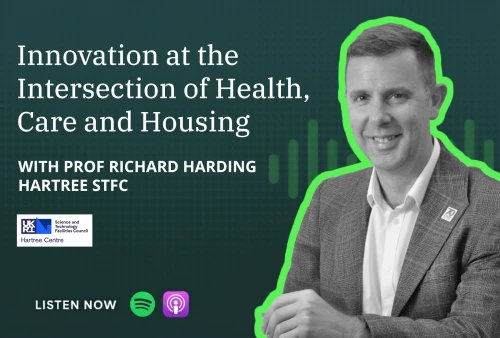

From Data to Digital Twins: Richard Harding on Housing’s Tech Future
29th October 2025
Matt Chenery

In part one of our conversation with Professor Richard Harding, the message was clear: service redesign must come before digital roll-out. Without people and process in place, even the smartest sensors fail.
In this second part, Harding – Business Development Manager at the Hartree Centre and Visiting Professor at UCLan – turns his attention to what is coming next: trusted data environments, artificial intelligence, digital twins and even quantum computing. His enthusiasm is balanced by caution. Each technology, he stresses, will only matter if housing has the skills, standards and partnerships to make use of it.
“It’s not about technology,” he says. “It’s about people and process.”
Trusted data, shared responsibly
Harding begins with data. In healthcare, secure data environments (SDEs) and trusted research environments (TREs) are already changing how sensitive information can be accessed. What excites him is the potential for housing to be part of that infrastructure.
“The insights you can get from sharing the right data at the right level, to the right people at the right time – that’s where I think it gets exciting,” he explains. “If John the repairman is fixing a boiler and the tenant hasn’t been seen for a few days, he doesn’t need to know their diagnosis, but he does need to know their health might be at risk if the boiler isn’t working.”
The challenge is to move beyond demonstrations. TREs often remain the preserve of researchers rather than frontline staff. Housing needs standards, skills and governance models that allow secure, role-based access. Harding points to childhood asthma in Liverpool as a clear example of where integrated datasets could drive better outcomes.
Regional collaboration, not postcode lottery
Capacity remains a concern. “Social landlords don’t have the bandwidth to engage with all of this one by one,” Harding acknowledges. With over 1,500 registered providers, duplication is inevitable. His solution is regional collaboration, aligned with existing NHS geographies and mayoral devolution.
“In Cheshire Merseyside alone, there were 27 NHS organisations when I led maternity work. Good luck getting them all to share data,” he says. “But if you can start with six or seven housing associations in the same patch, agree an information governance model, and build from there – that’s how you get traction.”
The alternative, he warns, is a postcode lottery in which residents’ access to integrated health and housing support depends on local happenstance. National standards and regulatory alignment are needed to ensure scalability.
Digital twins: more than a buzzword
Harding is wary of hype, but digital twins capture his imagination. At their simplest, they are digital replicas of homes or estates, fed by live and historic data, allowing providers to model the impact of changes before making them on the ground.
“If BMW can model a whole factory before putting a spade in the ground, why can’t housing do the same?” he asks. “Imagine zooming from a regional map into a single property, seeing boiler data, air quality readings and net zero performance, then testing scenarios: what happens if we retrofit here, demolish there, or change our ventilation strategy?”
He contrasts this with current practice, where investment planning often relies on partial datasets, inconsistent standards and reactive repairs. Digital twins could allow boards to make decisions based on evidence and simulation, not estimates.
AI: promise with caveats
Artificial intelligence, Harding concedes, is the buzzword on every CEO’s lips. But he urges caution.
“There are lots of caveats around trustworthy, transparent and ethical AI,” he says. “You need guardrails so models aren’t biased, and you can explain how they work. And you need to be clear: are we using AI to give people more time for preventative work, or just to increase caseloads?”
Examples like voice-to-text tools for housing officers show both sides. They can free staff from admin, but could also be used to drive efficiency at the expense of resident relationships.
For Harding, AI is best seen as a “digital front door” – a tool to widen access and reduce barriers. But without ethical frameworks, clear due diligence and transparency for both staff and tenants, trust will quickly erode.
Quantum: watch, but don’t rush
Few in housing will be thinking seriously about quantum computing. Harding believes they should at least be curious.
“My guesstimate would be in five to seven years, you’ll see architectures that can deliver sizeable projects with meaningful outcomes,” he says. “The question is, do we want to repeat what happened with AI – chasing the hype and retrofitting safeguards afterwards?”
For now, quantum remains largely academic. But Harding identifies optimisation as a future use case with direct relevance to housing. “If you’ve got 8,000 homes, dozens of repair teams, community staff and thousands of jobs to schedule – matching all that demand and supply is a mathematically hard problem. Quantum might get us closer to an answer than AI alone.”
Unlock all content
This is the 1 of 3 articles you can access for free. Become a member to unlock unlimited access to our full content library.