
From Ancient Wisdom to Modern Homes: How Our Understanding of Ventilation Has Evolved
9th March 2026
Jenny Danson
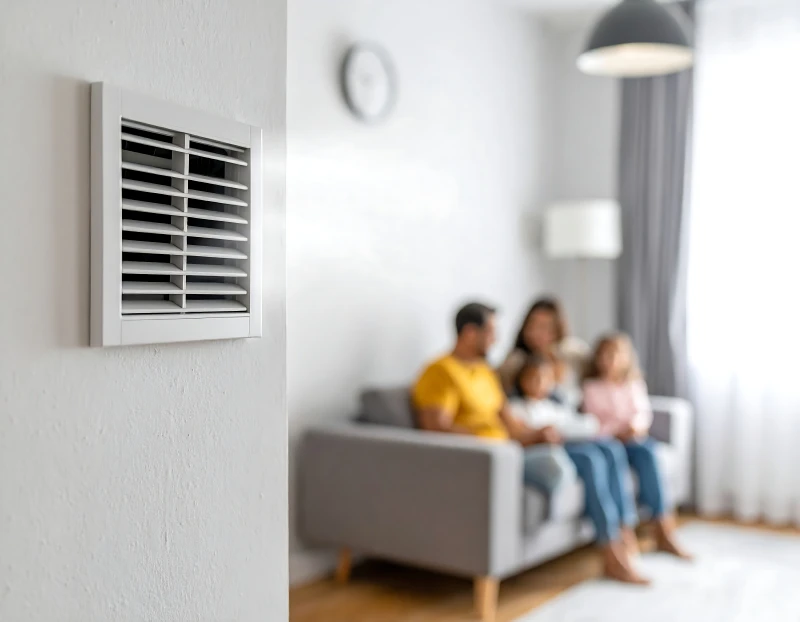
When we talk about healthy homes today, ventilation often feels like a technical detail – trickle vents, extract fans, MVHR systems and air quality monitors. But ventilation, at its core, is about something far more fundamental: breath, health and life itself.
In their 2023 paper, Rebecca F D’Cruz and Nicholas Hart explore the history of mechanical ventilation through a clinical lens, tracing how our understanding of breathing support has evolved over centuries. Their work offers valuable lessons not just for healthcare, but for how we think about ventilation in the home today.
Breath as Life: Early Understandings of Ventilation
Long before modern medicine or building regulations, early civilisations recognised the importance of air and breath. Ancient Hindu, Egyptian and Greek writings all acknowledged breathing as essential to vitality and survival.
By the second century AD, Galen had begun to describe the mechanics of breathing, identifying the role of the lungs and diaphragm in sustaining life. These early insights laid the foundations for understanding respiration as a physical, mechanical process rather than a purely spiritual one.
The Renaissance marked a turning point. Anatomists such as Andreas Vesalius described direct access to the airway, while scientists like Robert Hooke experimented with bellows to keep animals alive. These experiments demonstrated that it was airflow, not chest movement alone, that sustained life, a principle that underpins both modern mechanical ventilation and effective ventilation in buildings.
Crisis, Innovation and the Rise of Mechanical Ventilation
As D’Cruz and Hart describe, major leaps in ventilation have often followed moments of crisis. The poliomyelitis epidemics of the mid-20th century forced rapid innovation, leading to the widespread use of negative pressure ventilation in the form of iron lungs.
Soon after, clinicians such as Bjørn Ibsen demonstrated that positive pressure ventilation could dramatically improve survival. This shift transformed respiratory care and laid the groundwork for intensive care medicine as we know it today.
Over time, ventilation moved beyond short-term life-saving intervention towards long-term support, culminating in the development of home mechanical ventilation for people with chronic respiratory and neuromuscular conditions. The focus shifted from survival alone to comfort, dignity and quality of life.
That shift is highly relevant when we consider how ventilation has evolved in our homes.
How Ventilation in the Home Has Changed Over the Last 40 Years
While clinical ventilation was becoming more sophisticated, the way our homes breathe was also changing – though not always deliberately or safely.
1980s: Leaky Homes and Unintended Ventilation
Forty years ago, most homes in the UK were far from airtight. Single glazing, open chimneys and minimal insulation meant air moved freely through buildings. This accidental ventilation diluted moisture and pollutants, even if it came at the cost of cold homes and high energy use.
Ventilation wasn’t designed, measured or discussed, but it happened.
1990s: Energy Efficiency Takes Priority
As insulation standards improved and draught-proofing became common, homes began to retain heat more effectively. However, ventilation strategies didn’t evolve at the same pace.
Extract fans were often weak or poorly installed, and trickle vents were frequently closed by occupants trying to stay warm. Homes were warmer, but moisture and indoor air quality issues began to increase.
2000s: Airtightness Without a Ventilation Strategy
Building regulations increasingly favoured airtight construction, particularly in new homes. Ventilation was largely reliant on occupant behaviour - opening windows, using fans, rather than on well-designed systems.
This period saw rising concerns around condensation, mould and respiratory health, particularly in social housing and among vulnerable residents.
2010s: Mechanical Ventilation Enters the Mainstream
As airtightness improved, mechanical ventilation systems such as MEV and MVHR became more common. When properly designed and maintained, these systems provided consistent airflow while retaining warmth.
However, as with early clinical ventilation, success depended on good design, commissioning and user understanding. Where those were missing, systems often failed to deliver the intended health benefits.
2020s: Ventilation as a Health Intervention
Today, ventilation is increasingly recognised as a determinant of health, not just a building service. The use of sensors, better data and closer collaboration between housing and health professionals mirrors the journey described by D’Cruz and Hart in clinical settings.
The focus is finally shifting towards long-term outcomes, lived experience and prevention.
What History Teaches Us About Healthy Homes
The parallels between clinical ventilation and domestic ventilation are striking.
As D’Cruz and Hart show, mechanical ventilation only truly succeeded when it became:
Person-centred
Comfortable and usable
Designed for long-term living, not short-term fixes
The same principles apply to our homes.
Ventilation cannot be an afterthought bolted onto energy efficiency measures. Nor can it rely solely on resident behaviour. Healthy homes require intentional, well-designed ventilation that works quietly in the background, supporting health every day.
Breathing Life Back Into Housing
The history of ventilation reminds us that air is not neutral. It carries moisture, pollutants and pathogens, but also warmth, comfort and wellbeing when managed properly.
From ancient philosophy to modern mechanical systems, the story of ventilation is one of learning, adaptation and progress. As we continue to improve the quality of our housing stock, we would do well to remember that a healthy home, like a healthy body, depends on the simple act of breathing well.
And that is a lesson centuries in the making.
Unlock all content
This is the 1 of 3 articles you can access for free. Become a member to unlock unlimited access to our full content library.