
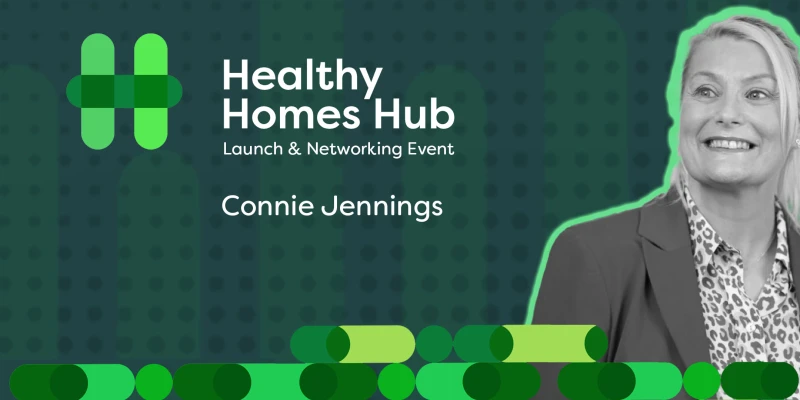
Healthy Homes Hub Launch: Connie Jennings
5th December 2024
Connie Jennings: Transforming Communities Through Passion and Lived Experience
Hi, I’m Connie Jennings. My journey into housing and community work wasn’t a straight path—it’s something I stumbled into, as many of us do.
But I passionately believe we need to change the narrative. Housing isn’t just a job; it’s a calling, and we need passionate, driven people to help shape its future.
I’ve never repaired, rented, or allocated a home, but my role is all about the people who live in them. To me, they are the most important part of the work we do. I grew up in social housing and am incredibly proud of that—it shaped who I am today. Someone once saw potential in me and encouraged me to go to university. That intervention changed my life, and now I use my lived experience as a superpower to inspire others.
Empowering Communities Through Champions
One of my proudest achievements is the Community Champion model at WHG. This initiative brings people with lived experience into roles where they can lead, inspire, and support their communities. These champions often come from challenging circumstances—they may have faced adversity, grown up in poverty, or overcome significant barriers.
We recruit them not for their qualifications but for their resilience and passion. Through training, support, and mentorship, we ensure they develop professionally, requiring at least a Level 2 qualification to break the cycle of low-skilled, low-paid work. Many of these champions go on to full-time professional roles, with around 200 champions trained so far—only five have not achieved their potential.
The ripple effect is profound. One champion recently told me her daughter was inspired by her journey and is now attending university. It’s a generational shift that starts with empowering one person.
Health and Housing: The Asthma Programme
One of our most impactful initiatives has been creating healthier homes for children with asthma. This work is deeply personal to me. Growing up, my father smoked 60 cigarettes a day, and my brother suffered from severe asthma. At the time, I didn’t connect our cold, damp home and the constant smoke to his health problems, but now I see the link clearly.
We’ve partnered with clinicians, such as Viv Marsh, and organisations like Walsall Healthcare NHS Trust and the George Coller Memorial Fund to tackle these issues. Together, we’re improving living conditions for children with asthma by addressing damp, mould, and air quality in homes. This work is backed by data and evidence, but at its heart, it’s about preventing avoidable tragedies and giving children a healthier start in life.
Measuring Impact and Speaking Their Language
In today’s world, everything must be measured to prove its value, and we’ve become experts at speaking the language of policymakers and funders. For example, we use clinical and social value frameworks like the Warwick-Edinburgh Mental Wellbeing Scale or diabetes-focused metrics when needed. Our goal is to show how initiatives like the asthma programme don’t just improve lives—they reduce hospital admissions, ease pressure on healthcare systems, and save money.
It’s a challenge to secure funding, but our results speak for themselves. For instance, the asthma programme demonstrates that addressing poor housing conditions reduces the need for emergency paediatric care. We don’t just tell these stories; we prove them.
Scaling the Champion Model
The Community Champion model is completely transferable. We’ve already adapted it for diabetes awareness in South Asian communities and loneliness and isolation among young people. It works because champions are embedded in their communities—they understand the challenges, and they have the trust of those they’re helping.
It’s not always smooth sailing. The model doesn’t work if you parachute people in who have no connection to the community. That’s when engagement fails, and people get labelled as “hard to reach.” The truth is, they’re not hard to reach if you know where to look. Whether it’s on playgrounds, buses, or supermarket foyers, real engagement comes from building relationships and meeting people where they are.
Breaking the Cycle of Poverty and Over-Medicalisation
A big part of my work is addressing the root causes of health and social issues. Too often, we medicalise natural responses to difficult circumstances. A single mum in a cold house, worried about feeding her children, doesn’t need antidepressants—she needs practical support and a network to lean on.
By focusing on housing conditions and creating opportunities like the Champion programme, we’re breaking this cycle. Our champions don’t just help others; they change perceptions of what’s possible for themselves and their families.
What Drives Me
I’ve been there—feeling the shame of poverty as a child. But I use that experience as fuel to make sure others don’t feel the same. Seeing champions move on to successful careers, hearing about their children reaching new milestones, and knowing we’ve turned cold houses into healthy homes—these are the moments that make it all worthwhile.
Housing isn’t just about structures; it’s about changing lives. And when you see the ripple effect of a healthier home or an empowered champion, you realise just how powerful this work can be.
Unlock all content
This is the 1 of 3 articles you can access for free. Become a member to unlock unlimited access to our full content library.