
Sustainable Buildings and Operations on AWS
5th June 2025
Jenny Danson
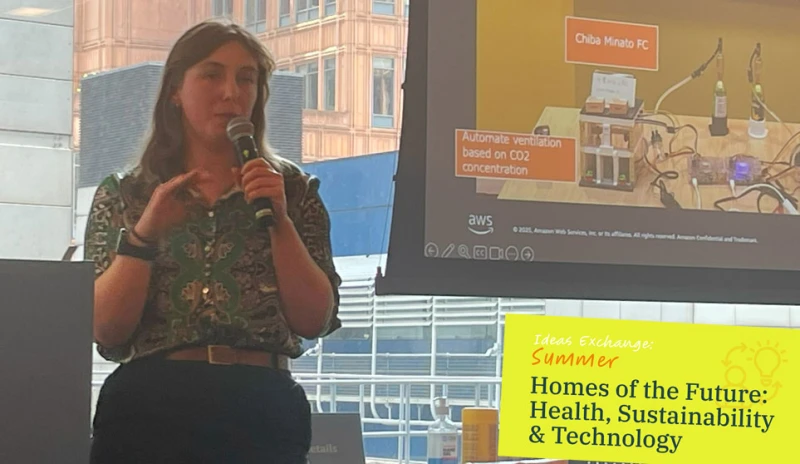
In a world increasingly focused on climate goals, the buildings we live and work in matter more than ever. Yet across industries, making buildings smarter and more sustainable remains a huge challenge. At the Summer Ideas Exchange, Tamara Herbert from AWS explored how data, technology, and the right tools can help us unlock building performance—and, crucially, reduce emissions at scale.
Her session broke down complex topics into accessible ideas, making it clear that smarter buildings aren't just for tech giants. They're a goal every organisation, including housing providers, can work toward.
Why Building Emissions Are So Hard to Tackle
Tamara opened by acknowledging a problem many of us face: the data we need to make buildings more efficient is often locked away in different systems, formats, and spreadsheets. “Water, electricity, heating—these are often tracked in separate places, using incompatible systems,” she said.
This “data sprawl” makes it hard for building operators, housing associations, or estates teams to make meaningful decisions. And when it comes to sustainability, that lack of clarity leads to wasted energy, missed savings, and avoidable emissions.
Buildings Are Evolving—Slowly
The idea of “smart buildings” has been around for decades. Tamara took us through the history—from early systems that could dim lights or open blinds based on daylight, through to today’s Internet of Things (IoT) devices and AI-powered platforms.
As the number of connected devices in buildings has exploded—especially since 2016—so too has the opportunity to gather real-time information about energy use, occupancy, temperature, and air quality. But while the technology exists, many organisations are still struggling to apply it in ways that make buildings truly efficient.
What Is a Smart Building?
Tamara defined a smart building simply: it’s a space where software, hardware, and sensors work together to monitor and control how the building functions.
That might include:
Tracking how much energy different parts of a building use
Monitoring indoor air quality or temperature
Automatically adjusting heating or ventilation based on how many people are in a room
Importantly, smart buildings aren’t just about energy savings—they’re also about people. “It’s not just reducing emissions,” Tamara explained. “It’s about keeping the people in the building comfortable, safe, and able to work or live well.”
Scope 1, 2, and 3 Emissions—What Do They Mean?
For housing professionals beginning their sustainability journey, Tamara broke down carbon emissions into three categories:
Scope 1: Direct emissions from things like boilers, on-site fuel use, or company vehicles
Scope 2: Indirect emissions from purchased energy (like electricity or heat from a district heating system)
Scope 3: Everything else—like supply chains, tenant behaviour, or waste
Most smart building projects start with Scopes 1 and 2, because they’re easiest to measure and directly influence. “You can’t manage what you don’t measure,” Tamara said. “And buildings are a great place to start.”
A Real-World Example: Water Monitoring in Glasgow
One standout story Tamara shared involved a logistics facility in Glasgow. AWS had rolled out water meters across its estate and spotted unusually high usage in one building. Thanks to their data monitoring system, they alerted engineers and discovered an underground leak that had gone unnoticed.
The fix? An estimated 9 million gallons of water saved per year. And all from connecting a basic utility meter to a smart dashboard.
AI Can Help—But You Need the Basics First
Tamara acknowledged that while artificial intelligence and machine learning can play a big role, the most important step is getting good data in the first place. “You don’t need to be a data scientist,” she reassured the audience. “There are now off-the-shelf tools that can help bring your utility bills, sensors, and maintenance logs into one dashboard.”
One such tool, available as an open-source starter kit from AWS, helps organisations:
Import utility bills from multiple providers
Normalise the data into a consistent format
Identify hotspots (e.g., a building using far more energy than others)
This kind of “single pane of glass” view helps teams move from reactive maintenance to proactive optimisation.
A Building That Opens Its Doors Only When Needed
Tamara described a demo from Japan where two buildings were compared. One kept its ventilation system running constantly, while the other only opened windows and doors when air quality sensors detected high CO2 levels. The result? The smarter building stayed cooler, used less electricity, and maintained better air quality—all automatically.
This example may seem high-tech, but Tamara emphasised the simplicity behind it: “This was just a few sensors, some logic, and a dashboard. It’s not science fiction—it’s available now.”
What Can Social Housing Learn From This?
While much of the AWS work has focused on logistics centres, Tamara’s insights are hugely relevant to housing providers:
Many buildings already have some kind of sensors or smart meters—what’s missing is integration
Retrofit and new-build programmes are ideal moments to embed smart building principles
Tenant comfort, energy efficiency, and regulatory compliance can be improved together, not separately
In particular, Tamara urged organisations to consider the link between operational efficiency and resident wellbeing. “Too often, energy optimisation is seen as just cost-cutting,” she said. “But it’s also about air quality, comfort, and creating healthier places to live.”
Getting Started Doesn’t Mean Going Big
One key takeaway? You don’t have to be Amazon to benefit. Start small. Connect your utility data. Install a few environmental sensors. Choose one pilot building. Build a case for wider rollout using real data and resident feedback.
As Tamara put it: “The most powerful thing you can do is bring your data together. Once you can see what’s going on, the right actions become obvious.”
About the Summer Ideas Exchange
The Summer Ideas Exchange, hosted by Healthy Homes Hub and supported by AWS, brings together housing leaders, technologists, and innovators to explore the future of healthy, sustainable homes. This session made it clear that smarter buildings aren’t about flashy tech—they’re about people, partnerships, and making the invisible visible.
Unlock all content
This is the 1 of 3 articles you can access for free. Become a member to unlock unlimited access to our full content library.