
Powering the Future: Why Every Housing Provider Needs an Energy Strategy
5th June 2025
Lee Reevell
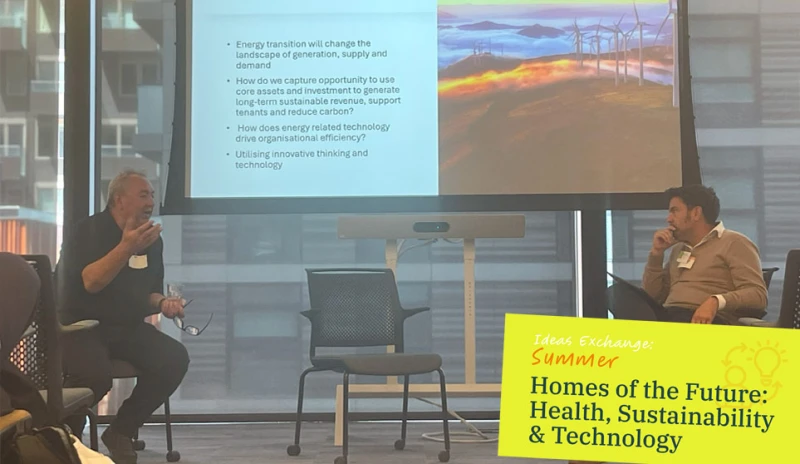
What does it take to turn a housing provider into a clean energy leader? According to Patrick Berry, it starts with a bold mindset—and a clear energy strategy.
In his candid and insightful session at the Summer Ideas Exchange, Patrick Berry shared how Together Housing’s journey into energy and retrofit wasn’t born from idealism, but necessity. With public funding shrinking, the team had to get creative. That’s when energy—and its untapped potential—entered the frame.
A Journey Sparked by Solar
Patrick’s involvement began around 2010, when funding dried up across the public sector. “There was no more public money,” he said, “so we had to find something else to do.”
That “something” turned out to be solar. Through the Feed-in Tariff scheme, Patrick helped secure investment in rooftop solar across Together Housing’s estate—eventually installing around 5 megawatts’ worth. The decision wasn’t easy, he admitted: “A lot of people were cautious. But now that portfolio brings in around £2 million a year. It’s paid back many times over.”
This early win gave Together Housing the confidence to think bigger. What if energy wasn’t just a side project—but a core part of its strategy?
From Side Project to Strategic Priority
The organisation soon realised that energy touches everything—fuel poverty, compliance, tenant health, financial sustainability, and environmental impact.
With 38,000 homes under management, Together Housing knew it had scale. But scale without a plan is just noise. Patrick made it clear: “You need an energy strategy that is intentional. Something that says: we will reduce emissions, lower costs, and support residents—at the same time.”
Their strategy has since grown into a portfolio of projects including solar PV, battery storage, ground source heat pumps, and energy efficiency upgrades. Some of this is grant-funded, but much is driven by commercial viability. “We have to act like a business, with a social conscience,” Patrick said.
Making the Business Case
One key point in Patrick’s talk was that energy isn’t just about net zero—it’s about value. The business case for retrofit and energy investment is now stronger than ever:
Rising energy prices make efficiency savings more impactful
Funding routes like SHDF and ECO4 provide upfront support
Long-term gains in health and maintenance costs offset the upfront spend
“You don’t have to do everything at once,” he said. “But you do have to start.”
Patrick also stressed the importance of embedding energy within the corporate strategy—not siloing it in a single team. “The sustainability team can’t do this alone. You need your finance people, asset managers, and exec board all pointing in the same direction.”
Energy as an Enabler of Healthy Homes
The link between housing and health came through strongly. Patrick noted that many of Together Housing’s retrofit projects have improved indoor air quality, reduced damp and mould, and created more stable thermal environments.
“These aren’t abstract carbon numbers,” he said. “They’re people living in homes that are easier to heat and safer to breathe in.”
This alignment of environmental and health outcomes was a major takeaway. It supports the Healthy Homes Hub vision that energy efficiency is a public health intervention as much as a climate one.
Practical Tips for Housing Providers
For organisations just starting their journey, Patrick offered some clear advice:
Understand your stock – Know your property types, EPCs, and where your worst-performing homes are.
Secure leadership buy-in – Without support from the top, progress will stall.
Find your early wins – Start with projects that are financially viable and build momentum.
Embed energy in your asset management strategy – Don’t bolt it on—bake it in.
Talk to tenants early – Retrofit is relational, and success depends on trust.
He also highlighted the importance of partnerships—working with local authorities, energy firms, and other housing associations to build capacity and share learning.
Looking Ahead: The Electrification of Everything
Patrick believes the sector is at a turning point. Gas boilers are on their way out. The electricity grid is decarbonising. And residents are more aware than ever of the cost and comfort of their homes.
But this transition needs infrastructure, planning, and resilience. “If every home is going to have a heat pump and an EV charger,” he asked, “how are you upgrading your substations? Your cables? Your asset registers?”
This long-term thinking is what separates a retrofit plan from a full energy strategy. It’s about planning for the homes—and lives—of the future.
A Call to Action
Patrick closed his session with a challenge to the sector. “We know what to do. The question is: are we brave enough to do it?”
For him, the answer lies in getting started. Building an energy strategy doesn’t mean having all the answers—it means committing to the journey, setting clear goals, and learning along the way.
About the Summer Ideas Exchange
The Summer Ideas Exchange, hosted by Healthy Homes Hub and supported by AWS, brings together housing professionals, technologists, and policy thinkers to explore how we can create healthier, more sustainable homes. Patrick Berry’s session was a reminder that energy isn’t just an operational issue—it’s a leadership opportunity.
Unlock all content
This is the 1 of 3 articles you can access for free. Become a member to unlock unlimited access to our full content library.