
Low Regret Asset Decisions - Why Asset Choices Must Perform For Their Full Life, Not Just At Handover
10th March 2026
Jenny Danson

An ambition rooted in the customer experience
For Yorkshire Housing, asset strategy starts with a clear ambition: to be a customer obsessed organisation. That ambition goes beyond service responsiveness or satisfaction measures. It is about designing homes and investment decisions so that customers experience fewer interventions, more stable living conditions and homes that work properly over time.
This lens changes how asset decisions are framed. Success is not defined by how quickly work is delivered or how closely programmes align to annual budgets, but by whether homes continue to perform long after work is completed. Reducing repeat disruption, avoiding unnecessary return visits and preventing problems before they occur are treated as core outcomes, not secondary benefits.
It is from this position that low regret asset decisions are made, with customer experience, asset performance and long-term value considered together rather than in isolation.
A familiar set of pressures
Asset strategies across social housing are being tested from multiple directions. Repair demand continues to rise, funding is constrained and expectations around safety, energy performance and resident outcomes are increasing. At the same time, regulatory requirements are becoming more stringent and less forgiving of short term thinking.
In this context, many programmes still prioritise immediate compliance or annual budget alignment. While this provides short term certainty, it often results in components that meet today’s standard but fall short of what will be required well within their expected life.
Yorkshire Housing has taken a different route, focusing on decisions that remain valid over time. The emphasis is not on introducing new programmes, but on adjusting how existing investment is specified, timed and sequenced.
Shifting the basis of decision making
Traditional asset planning has relied heavily on component age and Decent Homes cycles. That approach remains useful, but on its own it does not account for changing performance expectations or the cumulative cost of repeat intervention.
By combining stock condition data with energy performance, repairs history, damp and mould indicators and local intelligence, investment decisions are tested against future performance as well as present condition. This allows prioritisation to be based on likely outcomes rather than single metrics.
The result is not a departure from planned maintenance, but a refinement of it. Components that are already due for replacement are specified to reduce the risk of further work being required later in their life.
Avoiding work that will need undoing
A core principle in this approach is that replacing the same component twice within its expected life represents poor value, even if the initial capital cost appears lower.
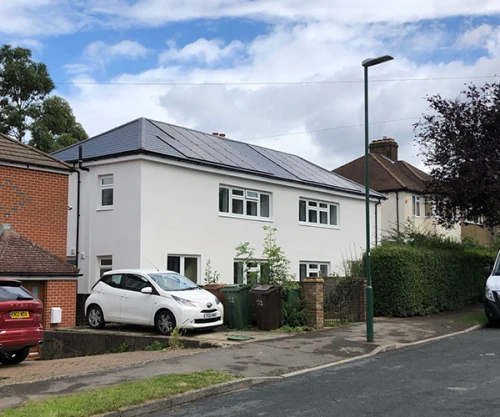
Roof replacements now routinely include integrated solar PV. Access costs are already incurred, and integrating systems at this point avoids the need for future scaffolding, fixings and disruption. Installing PV later would duplicate cost and undermine the value of the original investment.
Window replacements follow similar logic. Where windows reach end of life, higher performance units are installed as standard. The installation process is unchanged, but the asset is better aligned with future energy performance requirements. This avoids premature replacement driven by regulatory change rather than physical failure.
Bathroom renewals are used as a trigger for introducing wastewater heat recovery. The timing is deliberate, aligning specification changes with contract reprocurement to secure value and avoid in-contract variation.
In each case, the decision is based on the likelihood of future intervention and the cost of deferring performance improvements.
Aligning standards with long term cost planning
Specification changes of this nature require confidence in long term cost modelling. Yorkshire Housing has revisited component life cycles and average costs within its asset management system to reflect how homes will be maintained over time, not just how they are renewed.
This provides greater certainty when planning investment over 30 years. While some measures increase initial capital cost, they reduce exposure to repeat programmes, aborted assets and inefficient sequencing.
Retrofit is therefore treated as a core part of asset planning rather than a separate activity. External funding is used where available, but it does not dictate the delivery model. This reduces reliance on short funding windows and allows work to be planned coherently.
Reducing inefficiency through sequencing
Poor sequencing remains a significant source of waste in asset programmes. Multiple visits, repeated preliminaries and fragmented delivery increase cost and erode resident confidence.
By aligning energy efficiency measures with planned maintenance, work is delivered once and to a higher standard. Scaffolding is erected once, components are renewed together and homes are left in a more stable condition.
This reduces disruption, limits abortive cost and lowers the likelihood of future reactive intervention. It also creates clearer accountability for performance, rather than dispersing responsibility across multiple programmes.
Using data to refine investment decisions
Risk based stock condition surveys now focus inspection effort where it is most needed. Homes showing higher levels of risk are reviewed more frequently, ensuring decisions are informed by current data.
The introduction of in-home sensors provides additional insight into temperature, humidity and ventilation performance. This information supports more targeted specification and helps move away from uniform solutions that do not reflect how homes actually perform.
Over time, this data will allow further refinement of standards, reducing the risk of installing systems that are either insufficient or unnecessarily complex.
Implications for asset health and resident outcomes
Homes that maintain stable temperatures, manage moisture effectively and require fewer interventions are easier to manage and healthier to live in. These outcomes are a direct result of decisions made at the point of renewal.
Low regret asset decisions link capital investment to long term performance. They reduce exposure to future regulatory risk and support healthier living environments without relying on continuous retrofit cycles.
Practical steps for housing providers
Review asset specifications against full component life, not just current compliance.
Align energy efficiency improvements with planned maintenance to avoid duplication.
Use stock, repairs and performance data together to inform prioritisation.
Update specifications through contract reprocurement, not mid-contract change.
Treat retrofit as part of core asset planning, not a separate programme.
Low regret decisions are rarely visible at the point of delivery. Their value becomes clear years later, when there is no need to return and correct what should have been done first time.
If all of this feels overwhelming, you’re not alone. With the competing pressures, shifting standards, data gaps, funding uncertainty and the sheer weight of decisions sitting with asset and housing teams right now, the risk isn’t lack of ambition, it’s decision fatigue.
What Yorkshire Housing shows is that progress doesn’t come from doing more, it comes from making clearer, better-timed decisions and sticking to them. That’s where tools like HousingAI can quietly help. Not by replacing professional judgement, but by pulling together guidance, standards, evidence and best practice in one place, so teams can sense-check choices, spot low-regret options and move forward with confidence.
Used well, it becomes a thinking partner rather than another system to manage, helping organisations focus on good sense decisions that stand up over the life of the asset.
Unlock all content
This is the 1 of 3 articles you can access for free. Become a member to unlock unlimited access to our full content library.