

Grant Funding Isn’t Broken...But It Was Never Designed to Carry the Whole Solution
14th May 2026
Jenny Danson

Grant funding has played a vital role in improving homes. It has enabled innovation, unlocked early action and supported some of the most important retrofit and energy efficiency programmes we’ve seen across social housing.
But we are now asking grants to do a job they were never designed to do.
We are expecting short-term, competitive funding rounds to resolve long-term, systemic challenges: damp and mould, rising repair demand, decarbonisation, energy affordability, asset risk and widening health inequalities.
That gap between expectation and reality is becoming increasingly visible, particularly to CEOs, CFOs and boards trying to plan beyond the next spending round.
The scale of the challenge has outgrown the grant model
The pressures facing housing providers today are not isolated problems. They are deeply interconnected:
Poor housing conditions driving avoidable health costs
Reactive repairs absorbing revenue budgets
Carbon reduction targets colliding with ageing stock
Residents living with ongoing uncertainty as programmes start and stop
Grant funding, by design, is episodic. It comes in waves, with eligibility criteria, fixed scopes and tight delivery windows.
Healthy homes require something very different: continuity, predictability and long-term intent.
This mismatch is one of the main reasons the sector struggles to move from pilots to scale.
Why relying on grants alone creates organisational risk
From a CEO or CFO perspective, over-reliance on grants introduces real and measurable risk:
Uncertainty around timing, eligibility and future availability
Stop–start delivery, increasing mobilisation and demobilisation costs
Procurement churn, driving inefficiency and supplier fatigue
Fragmented outcomes, where funding rules shape decisions more than asset or health need
This is not a criticism of grant funding. It is an acknowledgement that grants are a tool, not a strategy.
Making funding go further means changing the model
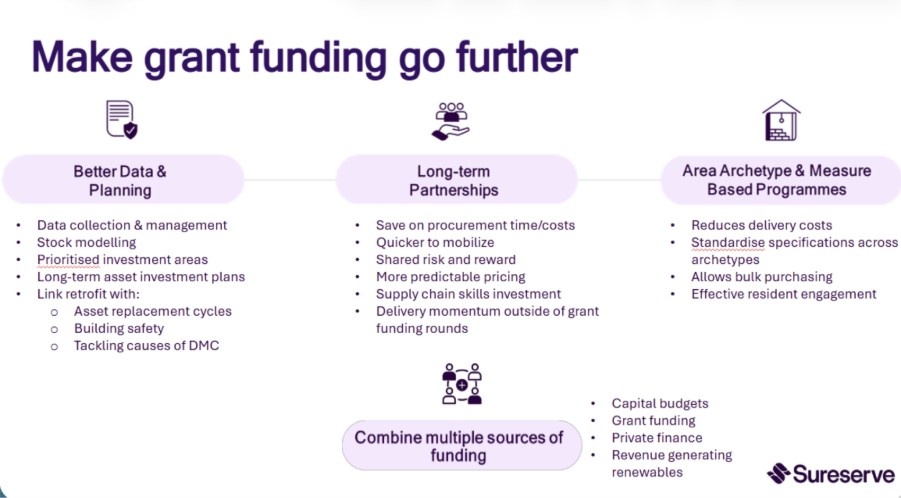
What’s needed now is a more mature approach, one that treats grant funding as an accelerator, not the entire engine.
Across the sector, a clearer picture is emerging of what works better in practice:
1. Long-term planning grounded in data
Using robust stock data and asset modelling allows investment, grant or otherwise, to be targeted where it delivers lasting benefit.
This means aligning retrofit and healthy homes work with:
Asset replacement cycles
Building safety and compliance programmes
The underlying causes of damp and mould, not just symptoms
2. Strategic partnerships rather than one-off projects
Longer-term delivery models reduce procurement churn, improve cost certainty and allow supply chains to invest in skills and capacity. Making long-term delivery models a success requires early collaboration with supply chain partners and strong contract management skills.
This supports better outcomes and greater organisational confidence.
3. Area and archetype-based delivery
Moving away from individual property interventions towards area-based and archetype-led programmes enables:
Standardised solutions
Bulk purchasing
Lower delivery costs
More effective resident engagement
This is where scale starts to work in the organisation’s favour.
4. Blended funding rather than single funding streams
The most resilient approaches combine:
Grant funding
Capital investment
Private finance
Revenue-generating renewables
This reduces exposure to the volatility of any one funding source and creates more control over delivery.
Where private finance and off-balance-sheet solutions fit
If grants accelerate progress, private finance stabilises it.
Not because housing providers want to behave like commercial developers, but because the scale, pace and certainty now required cannot be delivered through episodic public funding alone.
Crucially, this is not simply about taking on more debt.
Many emerging models are designed to:
Sit alongside core borrowing, not replace it
Match payment to performance or service delivery
Transfer delivery and performance risk away from the landlord
Accelerate delivery without undermining balance sheet resilience
This is where off-balance-sheet approaches can play a valuable role.
What off-balance-sheet approaches actually enable
Used well, these models allow organisations to:
Avoid large upfront capital outlay
Pay over time for energy, performance or outcomes
Share risk with delivery and finance partners
Protect borrowing capacity for other strategic priorities
They are not about hiding liabilities. They are about aligning cost, benefit and risk more intelligently.
Common applications include energy-as-a-service models, long-term service or concession agreements, special purpose vehicles and private finance linked to revenue-generating assets such as renewables.
What matters is not the structure, but whether it:
Delivers healthier homes faster
Improves cost predictability
Reduces long-term revenue pressure
Supports organisational resilience
What this means for leadership teams
For CEOs and CFOs, this is ultimately about optionality and control.
Blended funding models allow organisations to:
Move at pace when opportunities arise
Avoid bottlenecks created by funding cycles
Commit to multi-year delivery with confidence
Align asset strategy, finance and health outcomes
Avoiding private finance entirely does not remove risk, it simply pushes risk back into reactive spend, service pressure and deteriorating assets.
CEO / CFO summary
Grant funding remains important, but it cannot be the primary mechanism for delivering healthy homes at scale.
Over-reliance on grants creates uncertainty, inefficiency and stop–start delivery, increasing long-term cost and risk.
The organisations best positioned for the future are those that:
Treat healthy homes as a long-term investment decision
Use grants strategically, not dependently
Combine capital, grants and private finance intelligently
Shift from project-led thinking to programme-led delivery
This is not about spending more. It is about spending once, properly, and avoiding repeat failure.
Questions boards should be asking
To understand whether their organisation is genuinely set up to deliver healthier homes, boards should be asking:
What proportion of our investment strategy depends on future grant funding, and what risk does that create?
How often are we investing in the same homes more than once, and why?
Are our programmes aligned to asset life cycles and health outcomes, or funding windows?
Which elements of delivery genuinely need to sit on our balance sheet, and which do not?
Where could performance-based or service-based models reduce long-term cost and risk?
Are we optimising for short-term compliance, or long-term home performance?
How confident are we that our current approach supports pace and scale?
Do we have a long-term costed strategy to upgrade all of our homes to make them warm, comfortable, healthy and affordable?
These are not technical questions, they are leadership questions.
Healthy homes should not be something organisations wait to apply for. They should be something planned, financed and delivered as part of a long-term operating model.
Grants help.
Private finance builds momentum.
Good governance keeps control.
And leadership is what brings all three together.
If we want healthier homes to become the norm rather than the exception, we need to stop asking grant funding to do a job it was never meant to do, and start building models that are fit for the future.
Unlock all content
This is the 1 of 3 articles you can access for free. Become a member to unlock unlimited access to our full content library.