

What the Connected Home Now Tells Us About What’s Still Missing
8th April 2026
Chris Jones,
Aico
By Chris Jones, Product Director, Aico
Across the social housing sector, the connected home has crossed a threshold. What began as pilot schemes and early adoption is now being deployed at scale, with a growing number of landlords rolling out across their entire stock, not just selected properties.
The question has shifted as a result. It is no longer primarily about whether to adopt connected monitoring, but about what landlords learn when they do, and whether their organisations are structured to act on it.
That shift matters because it changes what landlords are accountable for. Where connected systems were once positioned as an enhancement to compliance, they are now increasingly treated as part of the control environment itself, a mechanism for identifying gaps that would otherwise remain invisible until harm occurs.
The connected home doesn’t just improve visibility, it changes the standard of accountability.
At a glance
Compliance at installation is not the same as compliance over time and connected monitoring is now proving it at scale
The shift from reactive to proactive management depends on operational capacity to act on insight, not just collect it
The measure of an effective connected home is not system presence, but system performance over time
Visibility creates accountability and accountability requires capacity
Connected fire and carbon monoxide monitoring has reached sufficient scale to demonstrate a consistent pattern: compliance at installation does not reliably translate into compliance over time. Like all fire safety equipment, alarms have a defined lifespan before they need to be replaced. Managing a large portfolio with thousands of replacement dates is complex, but connected monitoring ensures these replacement cycles are maintained and addressed proactively.
Alarms are sometimes removed or repositioned by residents. Interconnection can be lost. These are not isolated cases; they are operational realities that connected monitoring makes visible in ways that annual testing schedules cannot.
For example, a property may be fully compliant at installation, yet months later a disconnected alarm or depleted battery may affect coverage. Without connected monitoring, that gap in coverage remains invisible until the next inspection.
The value of that visibility depends entirely on whether organisations have the operational capacity to act on what the data reveals, and whether governance structures assign clear accountability for response.
Building that capacity is what converts visibility into genuine, ongoing control.
Visibility is only as valuable as the response it enables
Connected monitoring gives organisations something traditional compliance models could not: a real-time picture of how their safety systems are actually performing. Where periodic verification could only confirm what was true at a point in time, continuous monitoring reflects what is true now – enabling earlier, more consistent action.
The organisations that get the most from connected monitoring are those that pair it with the operational capacity to act, converting real-time insight into consistent, evidenced response.
Defining thresholds, escalation processes, and named accountability for response is what ensures monitoring delivers its full value: turning data into a reliable, repeatable mechanism for addressing issues.
The organisations that do this well build clear operational structures around their monitoring, so that when data surfaces an issue, there is a defined path from detection to resolution, and a consistent record of proactive action to evidence it.
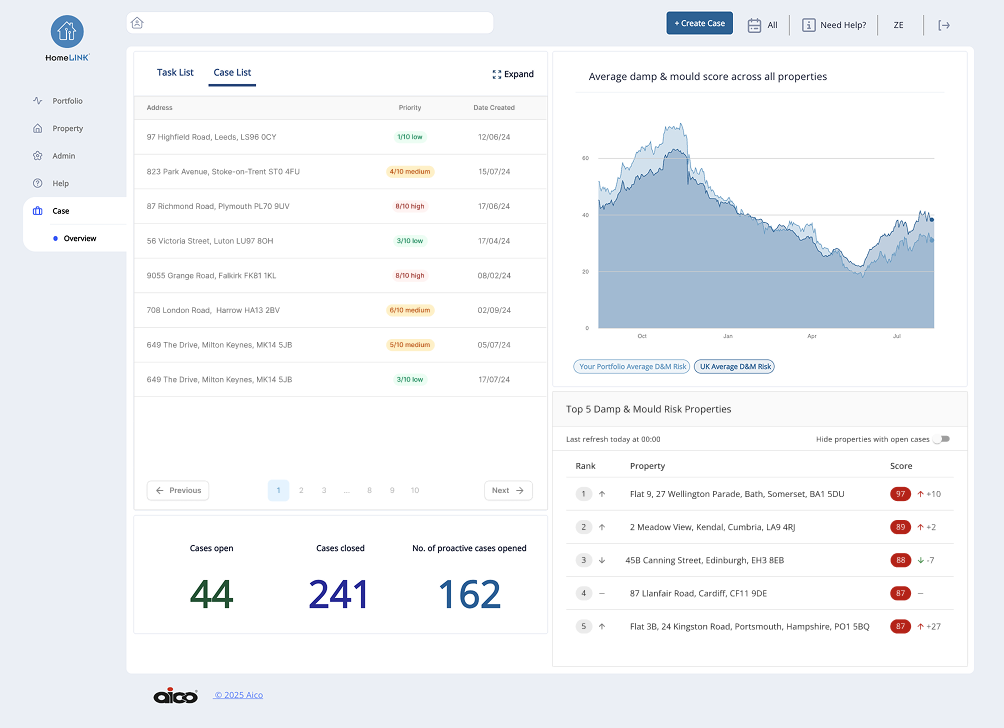
Correcting a misconception: the connected home is not about technology adoption
There is a persistent assumption that the connected home is primarily a technology question, a matter of selecting the right products, ensuring compatibility, and managing installation at scale. That framing misses the point.
The connected home is actually a governance question. It is about whether an organisation has structured its operations to act on the insight that connectivity provides. That means defining what constitutes an actionable alert, who is responsible for escalation, what the response timescales are, and how compliance is evidenced not just at installation but continuously.
This reflects a deeper reality: the operational model for managing fire and CO safety was designed for periodic verification, not continuous monitoring. Adapting that model requires investment in capability, process design, and governance, not just procurement.
What the data now reveals: the gaps that remain
With sufficient scale, connected monitoring now provides a clearer picture of where compliance breaks down in practice. Three patterns emerge consistently.
Installation vs. performance over time
Systems that meet standards at handover can be affected by battery usage, tampering, or environmental factors over time. Without continuous monitoring, these gaps in coverage may go undetected between inspections.
Presence vs. effectiveness
Alarms may be present and functional, but effectiveness depends on correct siting, interconnection, and suitability for the property layout and resident profile. Connected monitoring can help identify issues such as delayed activation or insufficient audibility that would not be captured by a simple presence check.
Data vs. action
Connected monitoring surfaces the information needed to act. Converting that into consistent improvement requires clear thresholds, defined accountability, and the operational resource to close the loop between detection and resolution. The best-performing organisations build all three.
What good looks like: proactive management supported by usable insight
Organisations that use connected monitoring effectively tend to share three operational characteristics.
First, clear thresholds and escalation processes. Organisations must define what constitutes an actionable alert, who is responsible for the response, and what the expected timescales are. Without this, monitoring generates noise rather than control.
Second, named accountability across the lifecycle. Specification, installation, and ongoing maintenance must each have clear ownership, with governance structures that ensure continuity rather than fragmentation. Connected monitoring strengthens accountability by giving organisations the evidence to act, and the record to demonstrate that they have.
Third, preventative maintenance supported by insight. The value of connected systems is not just in identifying issues after they arise, but in recognising patterns that allow intervention before risk becomes harm. That requires operational capacity to act on trends, not just respond to alerts.
Why this matters now: demonstrating impact under scrutiny
Social housing providers operate under increasing regulatory and public scrutiny on resident safety and demonstrable system effectiveness. The expectation is no longer simply that systems are present, but that they are effective, maintained, and that landlords can evidence both.
Connected monitoring provides the mechanism to demonstrate that impact, but only if the operational model is designed to support it. The shift from reactive to proactive management is not a technology upgrade. It is a governance shift that requires investment in capability, process, and accountability.
The connected home is now established practice. The question is no longer whether to adopt it, but whether landlords are structured to act on what it reveals.
That is the opportunity connected monitoring creates. Not just to know more, but to act earlier, more consistently, and with the evidence to show it.
Unlock all content
This is the 1 of 3 articles you can access for free. Become a member to unlock unlimited access to our full content library.
Author