
Breathing Easier: Housing and Health Working Together to Tackle Asthma
5th June 2025
Lee Reevell
Poor housing can worsen—or even cause—health conditions. Nowhere is this more evident than in the case of asthma, a condition affecting one in eleven children in the UK. But what happens when housing providers and the NHS join forces to change that?
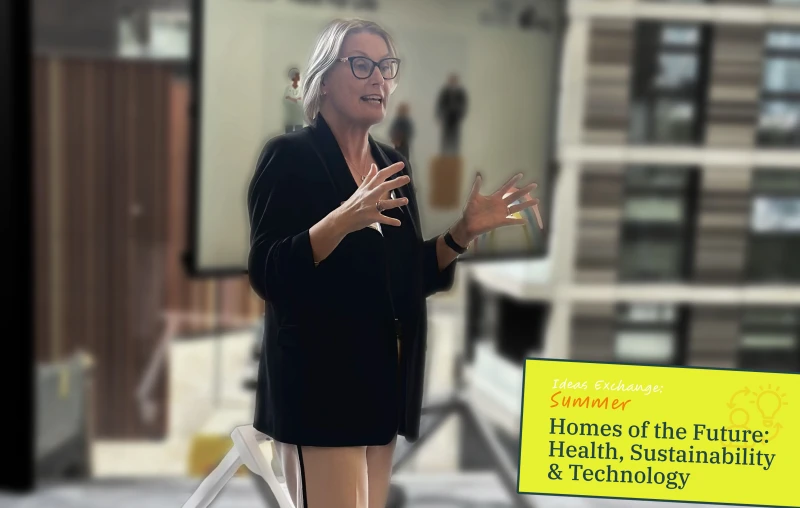
At the Summer Ideas Exchange, Connie Jennings from WDH and Viv Marsh from the NHS shared how they’ve built a pioneering partnership to tackle indoor air quality and reduce asthma triggers in social homes. Their story is one of compassion, collaboration, and quiet revolution.
Meeting at the Intersection of Housing and Health
Connie opened the session by setting out the challenge: “If you live in social housing, you’re more likely to die younger than the national average. That’s not right, and it’s not inevitable.”
WDH, a large housing provider, has long recognised the role of housing in health outcomes. But it wasn’t until Connie began working closely with Viv—an experienced asthma nurse and clinical lead in the Black Country Integrated Care Board—that the potential for deep, systemic change began to take shape.
Viv added, “When we look at asthma admissions in children, poor housing conditions come up again and again. Damp, mould, dust mites, cold homes—these are all major triggers.”
From Observation to Action
The collaboration began by reviewing hospital data. Patterns emerged: repeated admissions of children from the same homes, the same postcodes. Many of these children were under the care of GPs and were being prescribed the right medications—but their environments were working against them.
“We had to ask ourselves,” Viv said, “why are we constantly treating the symptoms without addressing the cause?”
This led to the development of a new, proactive model. Instead of waiting for children to end up in A&E, WDH and the NHS began to intervene earlier—looking at the home environment as part of asthma care.
A Toolkit for Change
Together, Connie and Viv helped create a structured toolkit focused on indoor environmental quality. It includes:
Home assessments that identify asthma triggers, such as damp, mould, poor ventilation, and cold
Air quality monitoring, using small sensors to capture real-time data on temperature, humidity, and pollutants
Targeted interventions, including repairs, upgrades to ventilation systems, and tenant education
Importantly, the toolkit also involves clinical input. Housing officers don’t make health decisions—but they are trained to spot risks and know when to escalate concerns. Likewise, health professionals are equipped to understand housing hazards and can refer families for housing interventions.
Joining the Dots Across Systems
One of the major breakthroughs has been improved communication between agencies. Connie explained: “Previously, housing and health worked in silos. Now, we’re speaking the same language.”
WDH now works closely with paediatric asthma services, ensuring families identified as high-risk through the NHS are also flagged for housing support. This multi-agency approach is part of a broader transformation within the Black Country Integrated Care System.
Viv noted that children with poorly managed asthma often live in homes where multiple issues—like damp, cold, or overcrowding—exist. “By addressing these issues head-on, we’re not just improving asthma management—we’re reducing hospital admissions, improving school attendance, and supporting families holistically.”
Real People, Real Results
The session was grounded in real-life stories—families who had suffered for years without knowing that their home was exacerbating their child’s condition. In one case, a child under frequent hospital care was found to be living in a home with invisible damp behind plasterboard walls. Once the problem was identified and fixed, their health improved dramatically.
“There is nothing more powerful,” Connie said, “than walking into a home with a sensor and showing a parent what’s happening in the air their child breathes.”
But it’s not just about data. It’s about relationships. Both Connie and Viv stressed the importance of building trust with families—ensuring they don’t feel judged or blamed, but supported.
Barriers and Breakthroughs
Of course, change hasn’t come easy. Early on, there were sceptics on both sides—clinicians unsure of housing’s role, and housing staff wary of taking on ‘healthcare’ responsibilities.
“There’s a fear that if you step into health, it’s outside your remit,” said Connie. “But it’s not about doing each other’s jobs—it’s about seeing the whole picture.”
Training has been crucial. Housing staff have been given basic education in asthma awareness. Health teams have been introduced to building performance data. And both now have referral pathways that are faster, simpler, and more effective.
Viv summed it up: “We’ve moved from reacting to crises to preventing them.”
Scaling the Impact
This partnership is already delivering measurable outcomes—and now the focus is on scaling. WDH and NHS teams are exploring how to embed this model across other housing associations and regions.
One key learning has been the importance of data sharing—done safely, ethically, and with consent. Another is the need for leadership buy-in. “If you don’t have execs who believe in this, it’s hard to get traction,” Connie admitted. “But once they see the results, it becomes a no-brainer.”
A Shared Purpose
What united Connie and Viv throughout the session was a shared sense of purpose. Both came into their roles to help people—and both believe that partnership, not isolation, is how we drive lasting change.
“We’re not trying to do anything radical,” Viv said. “We’re just saying: if we work together, we can stop kids getting sick in the first place.”
About the Summer Ideas Exchange
Hosted by Healthy Homes Hub and supported by AWS, the Summer Ideas Exchange is a cross-sector gathering for people working at the intersection of housing, health, and innovation. This session showed how practical collaboration—based on trust, data, and shared goals—can transform homes into healthier spaces for children and families.
Unlock all content
This is the 1 of 3 articles you can access for free. Become a member to unlock unlimited access to our full content library.