
Best Practice: Why Riverside Created Healthy and Modern Homes
5th June 2025
Trina Chakravarti
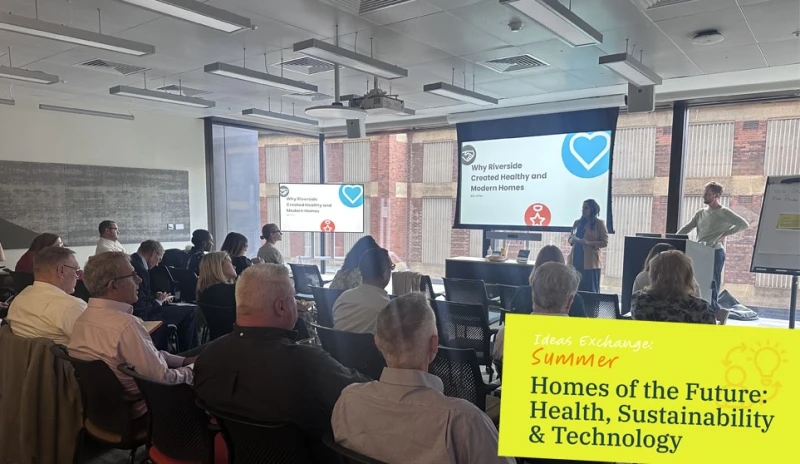
Riverside has been on a mission to rethink how homes support health, wellbeing, and modern living. At the Summer Ideas Exchange, Billy Cliffen shared the story behind the organisation’s Healthy and Modern Homes strategy—a practical, people-first approach to improving the lived experience for residents.
In a session rich with insight, Billy unpacked the thinking behind the strategy, the progress made so far, and the lessons learned along the way.
Speaker: Billy Cliffen, Healthy and Modern Homes Manager, Riverside
Where the Journey Began
For Riverside, the journey toward healthier homes started with a recognition that the homes themselves—especially those built decades ago—weren’t always designed with wellbeing in mind.
Billy explained: “We know that housing is one of the key social determinants of health. And yet, for a long time, we were focused mostly on bricks and mortar. Our new strategy is about thinking holistically—how the design, upkeep, and use of a home impacts the health of the people living in it.”
This meant looking not just at damp and mould, or energy efficiency, but also at daylight, ventilation, space, and even the aesthetics of the home. “It’s about dignity, comfort, and pride,” Billy said.
Defining What ‘Healthy and Modern’ Really Means
Rather than jumping straight into retrofit works or technology trials, Riverside began by developing a clear set of principles for what a healthy and modern home should offer. These included:
Good air quality and ventilation
Warmth and energy efficiency
Low noise levels
Accessibility and adaptability
Digital connectivity
Natural light and outlook
Ease of maintenance
These criteria became the foundation for a self-assessment framework that Riverside now uses to evaluate its stock and inform future works.
Listening to Tenants and Learning from Practice
A standout aspect of the Riverside approach is how central tenant voice has been to shaping the programme. “We went out and asked people: what does a healthy home mean to you?” Billy said. “It wasn’t about imposing our ideas—it was about co-design.”
Residents pointed to things that might seem small but are deeply meaningful—like having space for children to do homework, or not having to choose between heating and eating.
These insights helped Riverside refine its priorities. For instance, the strategy now includes plans to ensure all homes have at least one warm, dry, and comfortable space to relax—a simple but powerful ambition.
Not Just Retrofit—But Mindset Shift
While energy efficiency plays a big role, Billy was clear that Riverside’s strategy goes beyond technical upgrades. “Retrofit is part of the puzzle,” he said. “But we also needed to change how we think across the organisation.”
This includes:
Training teams across the business to recognise the signs of unhealthy homes
Linking data on repairs, complaints, and voids to understand root causes
Building shared ownership between asset, housing, and customer service teams
One example Billy gave was the alignment between voids teams and the Healthy Homes strategy. “We’ve started thinking differently about the works we do when a home becomes empty. Could we take that opportunity to fix long-standing issues—maybe poor ventilation or lack of daylight—rather than just refreshing paint?”
Practical Progress
So far, Riverside has piloted the strategy in several locations. These pilots have helped identify both quick wins and longer-term interventions. For instance:
Installing mechanical ventilation systems in homes prone to condensation
Swapping carpets for hypoallergenic flooring in homes with respiratory risks
Introducing low-level, low-cost changes that increase comfort—like changing internal door widths or providing mobile connectivity solutions
Crucially, the strategy is now embedded in Riverside’s stock condition surveys and planned maintenance processes. “It’s not a bolt-on,” Billy explained. “It’s part of our core business.”
A Cross-Team Effort
Throughout the session, Billy returned to the importance of cross-functional working. “If this strategy sat only in the asset team, it would fail,” he said. “We needed everyone—from housing officers to customer service teams—to see themselves as part of delivering healthier homes.”
To support this, Riverside created internal champions across different departments. These individuals act as the link between the strategic vision and day-to-day operations.
Outcomes So Far
While it’s early days, the benefits of the strategy are already becoming visible:
Fewer repeat repairs linked to condensation and damp
Better resident satisfaction scores in pilot areas
Improved staff confidence in identifying and responding to health-related housing issues
Billy was cautious not to overclaim. “We’re still learning,” he said. “But the direction is clear—and the momentum is real.”
Sharing the Learning
Riverside sees its Healthy and Modern Homes strategy as something the whole sector can benefit from. Billy ended his session by encouraging others to take the principles and adapt them to their context.
“This isn’t proprietary,” he said. “If you think it can help your organisation or your residents, use it. Tweak it. Share it. That’s how we move forward together.”
About the Summer Ideas Exchange
The Summer Ideas Exchange, hosted by Healthy Homes Hub and supported by AWS, brings together housing leaders, researchers, and practitioners to explore bold ideas for improving homes and lives. Riverside’s contribution to the day was a reminder that creating healthier homes is not about complexity—it’s about empathy, clarity, and commitment.
Unlock all content
This is the 1 of 3 articles you can access for free. Become a member to unlock unlimited access to our full content library.