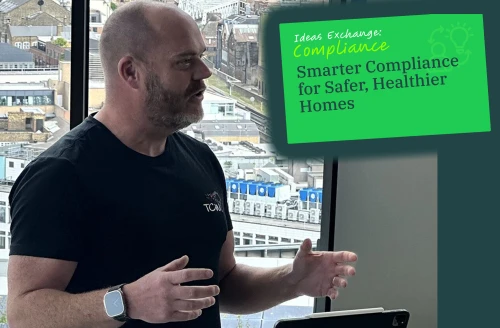

AI in Compliance: Supporting Better Decisions, Not Replacing Them
18th June 2026

By Ryan Dempsey, CEO, The Compliance Workbook Ltd
At a glance:
AI can structure and interrogate compliance data, but cannot replace human oversight of safety decisions
The technology is most effective when applied to evidence validation, pattern recognition and action tracking
Compliance remains people-centric: AI supports the process; residents remain the focus
The question facing housing providers is not whether AI will transform compliance, but whether it can be deployed in ways that strengthen or undermine assurance.
AI offers genuine capability in areas where compliance has historically struggled: structuring fragmented data, identifying gaps in documentation and tracking remedial actions across dispersed systems. These are not trivial gains. When compliance information is incomplete or inaccessible, safety decisions will be made without full visibility. AI can help to reduce that risk.
But the technology also invites a dangerous assumption: that compliance can be automated. It cannot. Compliance depends on human judgement, clear accountability and governance discipline. AI can support those functions. It cannot perform them.
The central tension: efficiency versus oversight
AI can process compliance data faster than any manual system. It can flag missing certificates, identify overdue inspections and surface patterns across thousands of properties. That speed creates value, but it also creates risk.
The risk is that simplified dashboards and automated alerts can give the impression of control without requiring the detailed scrutiny that meaningful assurance depends on. If AI is used to streamline reporting without strengthening the underlying governance, then it becomes a tool for managing perception rather than one of managing risk.
AI should be deployed to support interrogation, not replace it. That means ensuring outputs are structured to prompt questions, not simply confirm compliance. This means maintaining human oversight of remedial actions, not delegating follow-up to automated workflows. And it means recognising that the quality of AI outputs depends entirely on the quality of the data and processes that feed them.
What AI is well placed to do
AI is effective where compliance obligations are data-intensive, repetitive and require cross-referencing across multiple systems. That includes:
Evidence validation: Checking whether certificates are current, complete and linked to the correct assets. AI can identify discrepancies that would take weeks to surface manually
Pattern recognition: Highlighting clusters of overdue actions, recurring defects or properties with incomplete records. This allows operational teams to prioritise resources based on risk
Action tracking: Monitoring whether remedial works have been completed, documented and verified. AI can flag cases where actions remain open beyond agreed timescales
Resident voice capture: Structuring and analysing resident feedback to identify recurring themes, safety concerns or dissatisfaction with response times. This ensures that resident experience informs operational decisions in real time
These are all supporting functions. They do not replace the need for competent people to assess risk, for governance teams to interrogate findings or for operational staff to verify that works have been completed to standard. They make those functions more effective by ensuring the information used to inform them is reliable.
AI as a compliance solution
There is a persistent belief that AI can solve compliance problems by making processes faster and cheaper. It cannot. Compliance problems are rarely caused by a lack of speed. They are caused by fragmented information, unclear accountability and insufficient governance oversight.
AI can help structure information and surface gaps, but it cannot create accountability where none exists. If remedial actions are not being completed, AI will flag the issue more quickly. It will not resolve the underlying failure in process or governance that allowed the issue to persist.
This is not a limitation of the technology, but a reflection of what compliance requires: clear ownership, disciplined follow-up and governance structures that ensure findings lead to action.
Practical implications for housing providers
Providers considering AI for compliance should focus on five areas:
Prioritise data quality before deployment. AI outputs are only as reliable as the data they process. If compliance records are incomplete or inconsistent, AI will surface that problem, but it will not fix it.
Design AI tools to support interrogation, not automate assurance. Dashboards should prompt questions, not simply confirm compliance. Ensure outputs highlight exceptions, gaps and overdue actions in ways that require human review.
Maintain human oversight of remedial actions. AI can track whether actions are overdue, but it cannot verify whether works have been completed to standard or whether the underlying risk has been addressed.
Use AI to structure resident feedback, not replace engagement. AI can identify recurring themes in resident communications, but it cannot interpret context or respond to individual concerns. Ensure findings are used to inform operational decisions.
Explain AI outputs to boards and residents in plain terms. Boards need to understand what AI is being used for, what it can and cannot do, and how findings are being acted on. Residents need to know that their safety depends on people making informed decisions, not algorithms generating alerts.
Why this matters now
Compliance obligations in social housing are increasing in complexity and scrutiny. Providers are managing more data, across more systems, with greater expectations of transparency and assurance. AI offers a way to manage that complexity, but only if it is deployed with discipline.
The risk is that AI becomes a tool for managing reporting requirements rather than strengthening safety outcomes. That happens when technology is introduced without addressing the underlying governance and process weaknesses that create compliance risk in the first place.
Compliance is not about software, dashboards or analytics. It is about people making sound decisions based on reliable information. AI can improve the reliability of that information. It cannot replace the judgement, accountability and governance oversight that turn information into action.
The decisions we make which have an impact on public safety should be as solid as the outcomes we desire. AI is a tool to support those decisions. It is not a substitute for making them well.
Unlock all content
This is the 1 of 3 articles you can access for free. Become a member to unlock unlimited access to our full content library.
Author