


Scaling IoT: From Side Project to Strategic Shift
10th June 2025
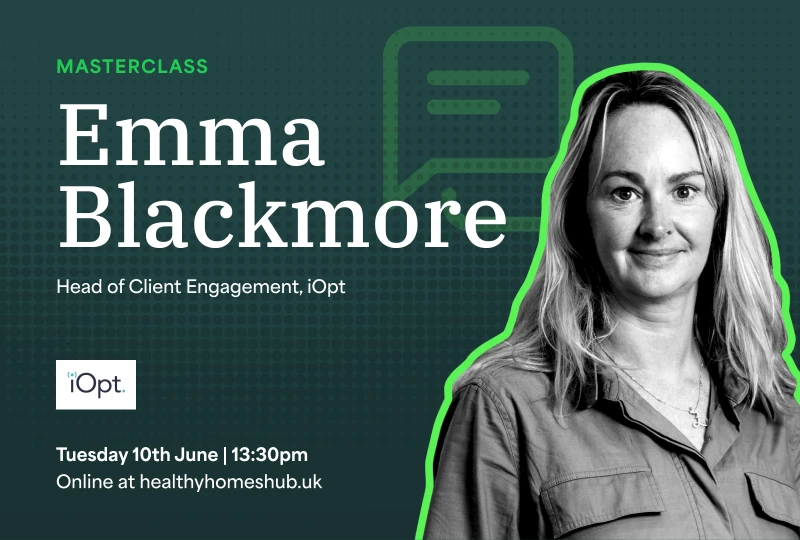
At Healthy Homes Hub, we know that housing providers are increasingly turning to IoT to improve homes and protect residents. But let’s be honest - fitting a few sensors isn’t the same as delivering IoT well, and certainly not at scale.
That’s why we hosted a recent IoT masterclass with Emma Blackmore, Director of Client Engagement at iOpt, to unpack the practical lessons from real-world social housing projects and help landlords move from scattered pilots to strategic implementation. This wasn’t about theory - it was about what works, what fails, and what to prioritise if you're ready to do IoT with purpose.
“We haven’t truly deployed IoT at scale.”
Emma opened the session with a clear-eyed view of the current state of the sector:
“We haven’t truly deployed IoT at scale - not one provider has done that yet, that I know of, and we haven’t done it over a sustained period of time.”
She explained that while most housing providers have some kind of IoT project underway, these efforts are often fragmented, short-lived, or reactive. The real challenge now is creating sustainable systems that shift us from firefighting to forward planning.
Start with Why—and Map Your Flow
The foundation for getting IoT right is clarity of purpose. Emma was frank about the temptation to skip this stage:
“At the start of every project... there's sometimes just an over-eagerness from our side to just start - to land a logo, to land a sale - and we miss this fundamental part of why we're doing this.”
Understanding your “why” isn’t just about intent - it’s about aligning strategy with operations. Emma advised participants to map the entire process flow, from the moment a resident raises a repair to the closure of the job. This provides clarity on:
Where IoT data can be embedded,
What metrics matter,
And who needs to be involved from day one.
“It’s looking at that process… and then you overlay where the data can help—where it can enable, where it can make decisions better, where it can identify problems even before a tenant does.”
This diagnostic approach helps avoid investing in tech without knowing how it fits into existing workflows.
Culture Change Is Everything - and It’s Underrated
One of the most powerful insights from Emma’s session was the reminder that IoT is not just a tech project - it’s a cultural one.
“There’s this big cultural shift in the sector that we’re all responsible for trying to help move on… and we sometimes feel like we’re not giving it the time and attention that it needs.”
Emma urged landlords to think hard about how they introduce IoT to staff and residents. From briefings and dashboards to language and training formats, the key is to reduce friction and meet people where they are.
“We need to think about how we provide the information, how many times, and in what format - so you’re not adding yet more things to people’s to-do list.”
Avoid Data Overload - Focus on Decisions
Emma encouraged participants to move past the question of whether the tech works:
“Don’t use the pilot to test if the tech works… 95% of the time the data is correct. Use the pilot to test how you are going to use the data.”
That means getting clear about what decisions will be made with the data, who will make them, and what support or processes are needed to take action. Emma highlighted how easy it is to get overwhelmed:
“It’s not about how much data you have - it’s about what you do with it. And if it's too complex, the quicker it will fail.”
Building the Right Foundations to Scale
Emma shared a “pyramid” framework of 10 steps to help organisations scale sustainably. She stressed that you can’t scale until you’ve built your operational foundations, which include:
Defined processes and pathways,
Aligned internal teams,
A clear success criteria,
And simple, intuitive systems.
“The sooner you can get to sustainably scaling, the sooner that you will realise the tangible benefits and the ROI.”
Final Word: IoT Isn’t a Side Project
Emma closed by urging providers to treat IoT as a long-term infrastructure - not a novelty.
“It’s about shifting our mindset… from sensors and data to systems. From reactive to proactive. From fragmented pilots to integrated strategy.”
She pointed to countries like Sweden and Norway, where IoT is already embedded in housing and commercial property management as part of everyday operations, not just innovation teams.
Want to Make It Stick?
If you’re ready to scale IoT in your housing stock, start by:
Defining your “why” and mapping your workflows.
Engaging residents and staff early, often, and accessibly.
Building a cross-functional team that owns the process.
Prioritising decision-making over data collection.
Learning from those who’ve already been there.
This session was just the start. We’ll continue to share tips, case studies, and tools through Healthy Homes Hub to help you take the next step with confidence.
Unlock all content
This is the 1 of 3 articles you can access for free. Become a member to unlock unlimited access to our full content library.